The Rhinocerotidae family, commonly known as rhinoceroses or rhinos, comprises a group of large, herbivorous odd-toed Hoofed mammals (perissodactyls) characterized by one or two keratin horns on the snout, thick protective skin, and a massive body size. These animals are among the last surviving megafauna. Today, only five extant species remain: two in Africa and three in South and Southeast Asia.
Physical characteristics
Rhinoceroses are instantly recognizable by their horns, which are made of compressed keratin (the same material as fingernails and hair) rather than bone. These horns are used for defense, territorial displays, and foraging. Most species have a prehensile upper lip or broad mouth adapted to their diet. Their skin is thick and grayish (often appearing white or black due to mud wallowing or soil color), providing protection but making them vulnerable to parasites and overheating. Adults can weigh from about 500 kg (1,100 lb) for smaller Asian species up to over 2,000–3,000 kg (4,400–6,600 lb) for the largest. Rhinos have three toes on each foot, a trait shared with other odd-toed ungulates like horses and tapirs. They possess poor eyesight but compensate with acute hearing and smell.
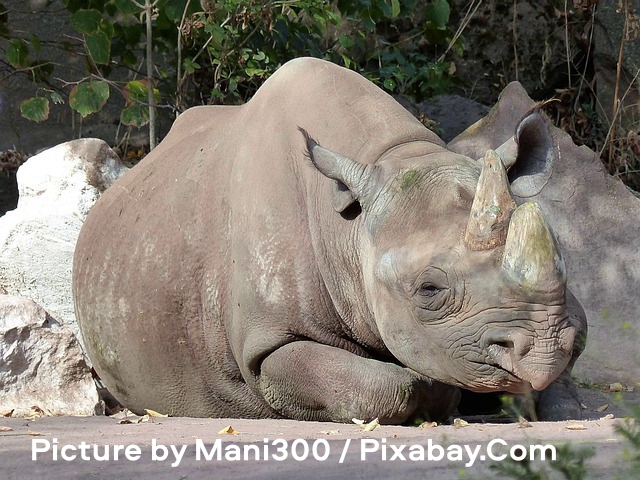
A massive Black Rhinoceros rests peacefully on a sunlit patch of ground, its thick grayish-brown skin folded and textured with deep wrinkles especially around its face and legs. The animal lies with its body angled slightly toward the viewer, head lowered and one eye partially closed in a relaxed expression, while its two prominent horns—one longer and pointed, the other shorter and blunted—rise from its snout. Its large ears stand upright, catching the light, and its sturdy legs are tucked beneath its bulky frame. In the background, light-colored rocks and green foliage create a natural enclosure setting, with scattered leaves visible on the ground nearby. Picture by Mani300 / Pixabay.Com.
The living species
The five extant species of the Rhinocerotidae family are divided into distinct genera, reflecting their differences. Each species has unique adaptations in size, horn structure, lip shape, and habitat preferences that influence their ecology and conservation needs.
The White Rhinoceros (Ceratotherium simum) is the largest living rhino and one of the two African species. It features a broad, square-shaped mouth suited for grazing on grasses in open savannas and grasslands. Adults typically weigh 1,400–3,600 kg (3,000–8,000 lb) or more, with males larger than females, and they stand about 1.5–2 m (5–6.5 ft) at the shoulder. There are two subspecies: the Southern White Rhinoceros (Ceratotherium simum simum), which has a relatively stable population, and the Northern White Rhinoceros (Ceratotherium simum cottoni), which is functionally extinct in the wild with only two females remaining under strict protection in Kenya’s Ol Pejeta Conservancy. White Rhinos are generally more social than other species and can form small groups or “crashes,” sometimes grazing together in larger aggregations. As of the end of 2024, the southern population stands at around 15,752 individuals across multiple African countries, primarily South Africa, Namibia, Zimbabwe, and Kenya, though overall numbers have fluctuated due to poaching pressure.
The Black Rhinoceros (Diceros bicornis), also known as the Hook-lipped Rhinoceros, is the other African species. It has a pointed, prehensile upper lip ideal for browsing leaves, twigs, and shrubs in a variety of habitats from deserts and semi-arid shrublands to woodlands and wetlands. Adults weigh 800–1,400 kg (1,800–3,000 lb) on average and stand about 1.5 m (5 ft) at the shoulder. Unlike the White Rhino, Black Rhinos are typically solitary and more aggressive when threatened, relying on their acute sense of smell and hearing. They once roamed much of sub-Saharan Africa but have suffered severe population declines. Recent estimates place the total population at around 6,788 individuals across 12 countries, with the majority in South Africa, Namibia, Zimbabwe, and Kenya. There are several subspecies, including the south-western, southern, and eastern Black Rhinos, while the western subspecies is extinct. Conservation efforts, including translocations and range expansions, have helped the population trend stabilize or increase modestly in well-protected areas, though the species remains Critically Endangered overall.
The Indian Rhinoceros (Rhinoceros unicornis), also called the Greater One-Horned Rhinoceros, is found in the grasslands, swamps, and riverine floodplains of northern India and Nepal, particularly in protected areas like Kaziranga National Park and Chitwan National Park. It possesses a single horn (up to 25–60 cm [10–24 in] long) and distinctive skin folds that give it an armored appearance, along with tubercles on the skin. This species is the largest Asian rhino, with adults weighing 1,800–2,700 kg (4,000–6,000 lb) and standing about 1.7–2 m (5.6–6.5 ft) at the shoulder. It is primarily a grazer but also browses, often found near water sources where it wallows extensively. Once reduced to fewer than 200 individuals in the early 20th century due to hunting and habitat loss, strict protection and anti-poaching measures have driven a remarkable recovery. As of March 2025, the population is estimated at 4,075 individuals (about 3,323 in India and 752 in Nepal), making it the second-most numerous rhino species. It is classified as Vulnerable, with ongoing threats from habitat fragmentation and human-wildlife conflict, but numbers continue to trend upward in core protected areas.
The Javan Rhinoceros (Rhinoceros sondaicus), or Sunda Rhinoceros, is a single-horned species now restricted to a single population in Ujung Kulon National Park on the western tip of Java, Indonesia. Similar in appearance to the Indian Rhino but smaller, with adults weighing 900–2,300 kg (2,000–5,100 lb) and standing 1.4–1.7 m (4.6–5.6 ft) at the shoulder, it inhabits dense tropical rainforests, marshy areas, and thick bush. It has loose skin folds and a relatively short horn (typically under 25 cm [10 in] in males). This browser species is extremely elusive and solitary, feeding on a variety of plants, including pioneer species in forest gaps. It is one of the rarest large mammals on Earth, with a population estimated at around 50 individuals. Poaching incidents, including confirmed losses of up to 26 animals in recent years, combined with the tiny population size and risks from disease or natural disasters like tsunamis, make it Critically Endangered. No Javan Rhinos exist in captivity, and the species has no other wild populations after the extinction of the Vietnamese subpopulation in 2011.
The Sumatran Rhinoceros (Dicerorhinus sumatrensis) is the smallest and most primitive living rhino, distinguished by its two horns (the front one larger, up to 25–30 cm [10–12 in]) and a coat of reddish-brown hair, especially in younger animals and on the ears and tail. Adults weigh 500–960 kg (1,100–2,100 lb) and stand about 1–1.5 m (3.3–5 ft) at the shoulder. It inhabits dense highland and lowland tropical rainforests on the islands of Sumatra and Borneo (Indonesia), where it is a browser feeding on fruits, leaves, twigs, and bamboo. This species is highly solitary, climbs hilly terrain well, and visits natural salt licks regularly. Once more widespread across Southeast Asia, it has suffered catastrophic declines due to poaching and severe habitat fragmentation. Recent estimates suggest only 34–47 individuals remain in fragmented subpopulations, with no viable populations in Malaysia since 2019. It is Critically Endangered, and small captive breeding programs have had limited success. The species’ low numbers and isolated groups exacerbate reproductive challenges, as females can develop reproductive issues if they do not mate regularly.
Habitat and ecology
Rhinoceroses occupy a wide range of habitats across Africa and Asia, shaped by their dietary needs, water requirements, and thermoregulatory behaviors. All species are hindgut fermenters, allowing them to process large volumes of fibrous, low-quality vegetation efficiently, though they must forage for many hours each day and drink water regularly (daily or every other day). They create and maintain wallows—muddy depressions that help regulate body temperature, protect skin from parasites and insects, and serve as social or cooling sites for multiple species. Their dung piles (known as middens) act as communication hubs and contribute to nutrient cycling and seed dispersal, while their grazing and browsing activities shape vegetation structure, promote plant diversity, and create pathways or clearings that benefit other wildlife. As keystone species and ecosystem engineers, rhinos influence habitat heterogeneity, supporting insects, birds, small mammals, and even larger herbivores through modified landscapes.
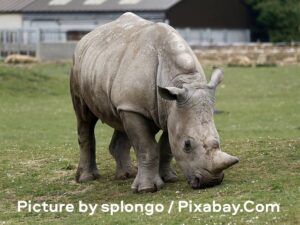
A White Rhinoceros stands in the center of a grassy field, its massive gray body angled slightly toward the right as it lowers its head to graze on the short vegetation scattered with small white flowers. The animal’s thick, wrinkled skin shows subtle folds and patches of lighter discoloration, particularly along its back and shoulders, while its prominent horn curves forward from the snout and its ears are perked attentively. In the background, a low stone wall and a building with a dark roof are visible under natural daylight, creating a calm enclosure-like setting. Picture by splongo / Pixabay.Com.
The White Rhinoceros (Ceratotherium simum) prefers open tropical and subtropical grasslands, savannas, and shrublands with short to medium grasses and reliable access to water. As a dedicated grazer, it maintains short-grass swards that can benefit other grazers and prevents woody encroachment in some areas.
The Black Rhinoceros (Diceros bicornis) is more adaptable, inhabiting semi-arid savannas, thorn scrub, thickets, dry woodlands, and even mountainous regions. As a browser, it selects for shrubs, young trees, and forbs, helping control bush density and promoting grassland patches within mixed landscapes.
The Indian Rhinoceros (Rhinoceros unicornis) thrives in alluvial grasslands, riverine floodplains, swamps, and tall grass habitats along the Himalayan foothills, often in mosaic landscapes with wetlands and forests. It grazes on grasses and aquatic plants while also browsing, and its wallowing and movement help maintain wetland dynamics and grassland openness.
The Javan Rhinoceros (Rhinoceros sondaicus) is confined to dense lowland tropical rainforests, reed beds, wet grasslands, and forest-edge floodplains with abundant mud wallows and sunny clearings or gaps. It feeds on a diverse array of leaves, shoots, twigs, and fallen fruits, many of which grow in disturbed or open patches within the forest, contributing to localized vegetation regeneration.
The Sumatran Rhinoceros (Dicerorhinus sumatrensis) inhabits rugged, dense highland and lowland tropical rainforests, including mountainous terrain where it navigates steep slopes adeptly. It browses on fruits (such as figs and wild mangoes), leaves, twigs, bamboo, and other understory plants, frequently visiting mineral-rich salt licks essential for its nutrition. Its solitary nature and wide-ranging movements in fragmented forests aid in seed dispersal across varied elevations.
Reproduction is slow across the family: gestation lasts 15–18 months, and females typically produce a single calf every 2–4 years. Calves remain dependent on their mothers for 2–4 years. Lifespans in the wild range from 35–50 years, though actual longevity is often limited by threats. All species are primarily solitary (except for mother-calf pairs and occasional white rhino groups), with social interactions centered around mating, territorial marking via dung and urine, and resource sharing at wallows or water sources.
Conservation status and threats
All five species face significant threats, primarily poaching for their horns (driven by illegal wildlife trade and unfounded medicinal beliefs) and habitat loss due to human population growth, agriculture, and infrastructure development. The Javan Rhinoceros, Sumatran Rhinoceros, and Black Rhinoceros are classified as Critically Endangered by the IUCN. The Indian Rhinoceros is Vulnerable, while the White Rhinoceros is Near Threatened overall (though its northern subspecies is Critically Endangered). Global populations total roughly 27,000 individuals, a sharp decline from historical levels. Conservation successes, such as anti-poaching patrols, translocations, community-based programs, and protected area management in Africa and Asia, have stabilized or increased some populations (notably the southern White Rhinoceros and Indian Rhinoceros). Sustained international efforts under frameworks like CITES, advanced techniques such as embryo creation for the northern White Rhinoceros, and habitat connectivity projects remain critical for long-term survival.
The Rhinocerotidae family represents a remarkable lineage. Protecting these iconic animals requires addressing both immediate threats like poaching and long-term challenges such as habitat connectivity, climate impacts, and genetic management. Ongoing research into genetics, captive breeding, and rewilding offers cautious hope for their future.


