The Black Rhinoceros (Diceros bicornis), also known as the Hook-lipped Rhinoceros, is a critically endangered species of rhinoceros native to eastern and southern Africa. It is one of two extant African rhino species (alongside the White Rhinoceros).
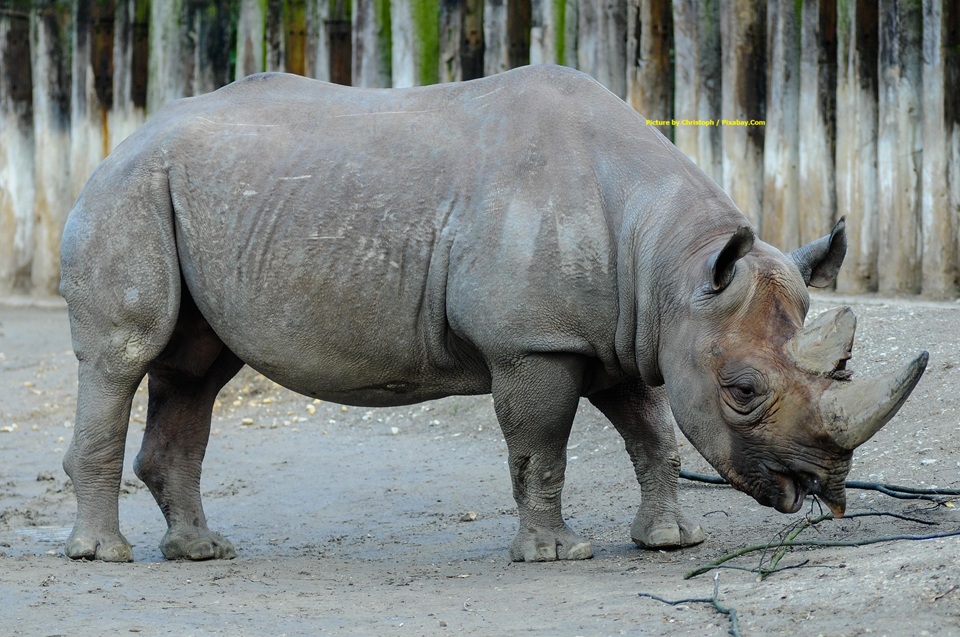
A majestic Black Rhinoceros (Diceros bicornis) stands in profile on a sandy dirt ground within what appears to be an enclosure, its massive gray body showing prominent folds and textured skin as it lowers its head toward some scattered branches on the ground, its two horns clearly visible with the larger front one curving upward while its ears remain alert and its eye looks downward. The background features a tall fence made of vertical wooden logs, creating a naturalistic yet contained setting for the powerful animal. Picture by Christoph / Pixabay.Com.
| Genus | Diceros |
| Species | D. bicornis |
| Binomial Name | Diceros bicornis |
| Length | 2.8–3.8 m (9–13 ft) |
| Shoulder Height | 1.3–1.8 m (4–6 ft) |
| Weight | 800-1,400 kg (1,800 to 3,100 lb) |
| IUCN Status | Critically Endangered |
Physical characteristics
Black Rhinos are smaller and lighter than White Rhinos. Adults typically weigh 800-1,400 kg (1,800 to 3,100 lb) and stand about 1.3–1.8 m (4–6 ft) at the shoulder. They measure 2.8–3.8 m (9–13 ft) in length. They have two horns made of keratin (the same material as human fingernails): a larger anterior horn (up to 50–140 cm (20–55 in) long, though usually shorter) and a smaller posterior one. Their skin is thick (up to 5 cm (2 in)), gray to dark brown, and often covered in mud or dust for protection and thermoregulation.
The most distinctive feature is their prehensile, hooked upper lip, adapted for browsing leaves, twigs, and shrubs rather than grazing grass (unlike the square-lipped White Rhino). They have poor eyesight but excellent hearing and smell.
Habitat and distribution
Black Rhinos inhabit a variety of environments, including semi-desert savannas, woodlands, shrublands, montane forests, and wetlands. They prefer areas with dense cover for browsing and wallows for cooling.
Historically widespread across sub-Saharan Africa, their range has drastically shrunk. Today, they persist in scattered, mostly protected populations in countries such as Kenya, Namibia, South Africa, Tanzania, Zimbabwe, and others. Strongholds are in South Africa, Namibia, Kenya, and Zimbabwe. One subspecies (western Black Rhinoceros, D. b. longipes) is extinct.
Behavior and ecology
Black Rhinos are generally solitary and territorial, though mothers stay with calves for 2–4 years. They are browsers, consuming up to 50–100 kg (110–220 lb) of vegetation daily, and are important for shaping vegetation structure. They are more aggressive than White Rhinos and can charge when threatened. Lifespan in the wild is 40–50 years.
The gestation period lasts approximately 15–17 months (around 450–460 days). A single calf is born, typically weighing 35–50 kilograms (80–110 lb) at birth. Calves can stand shortly after birth and follow their mother within a few days.
Population and conservation status
The species is listed as Critically Endangered on the IUCN Red List (2020 assessment), though some subspecies vary (e.g., south-western Black Rhinoceros is Near Threatened). Poaching drove numbers from an estimated 70,000 in 1970 to a low of around 2,300–2,500 in the mid-1990s—a 96% decline.
Intensive conservation has led to recovery: as of recent 2024–2025 estimates, the wild population stands at approximately 6,500–6,788 individuals, with Black Rhino numbers increasing by about 5.2% in 2024. Most are in protected areas or conservancies.
Major threats
- Poaching for horns: This remains the most severe and immediate threat to Black Rhinos. Rhino horn is highly valued in illegal wildlife trade, primarily in Asia, where it is sought for traditional medicine (despite no proven medicinal benefits) and as a status symbol of wealth and success. Highly organized criminal syndicates drive the trade, often hiring local poachers. Poaching surged dramatically from 2008, peaking at over 1,300 African rhinos killed in 2015. While rates have declined (e.g., 420 rhinos poached in South Africa in 2024, down over 15% from 2023), at least one rhino is still lost every day on average. More than 10,000–12,000 African rhinos have been poached since 2008. Tactics include sophisticated methods with helicopters, night-vision gear, and veterinary drugs, making enforcement challenging.
- Habitat loss and fragmentation: Rapid human population growth, agricultural expansion, settlement, logging, mining, and infrastructure development have drastically reduced and fragmented suitable habitats. This has eliminated rhinos from many countries entirely and isolated remaining populations, limiting movement, breeding opportunities, and genetic diversity. Fragmented patches increase vulnerability to edge effects, invasive species, livestock competition, and human-wildlife conflict. Over 55% of the Black Rhinoceros’s historic range has been lost since 1970, with ongoing pressures from land invasions and resource extraction further squeezing viable habitats and corridors.
- Other factors: Drought and occasional human-wildlife conflict.
Conservation efforts
Success stories include anti-poaching patrols, ranger training, advanced technologies (e.g., thermal cameras, tracking), dehorning (which can reduce poaching by up to 80%), translocation to safer habitats, and community-based conservancies that provide economic benefits to local people. Organizations like WWF, IUCN, Save the Rhino, and national wildlife agencies lead these initiatives. Populations have been reintroduced to parts of their historic range.
Future projections are cautiously optimistic: with continued efforts, numbers could reach over 8,000 by the early 2030s.
The Black Rhinoceros symbolizes both the devastating impact of wildlife crime and the power of dedicated conservation. Sustained international cooperation, demand reduction for horn, habitat protection and restoration, and community engagement are essential to secure its future in the wild.


