Burundi is a landlocked country in East Africa, situated to the east of the Democratic Republic of the Congo. It lies at the coordinates 3°30′S 30°0′E and covers a total area of 27,830 square kilometers (10,750 sq mi), of which 25,680 square kilometers (9,920 sq mi) is land.
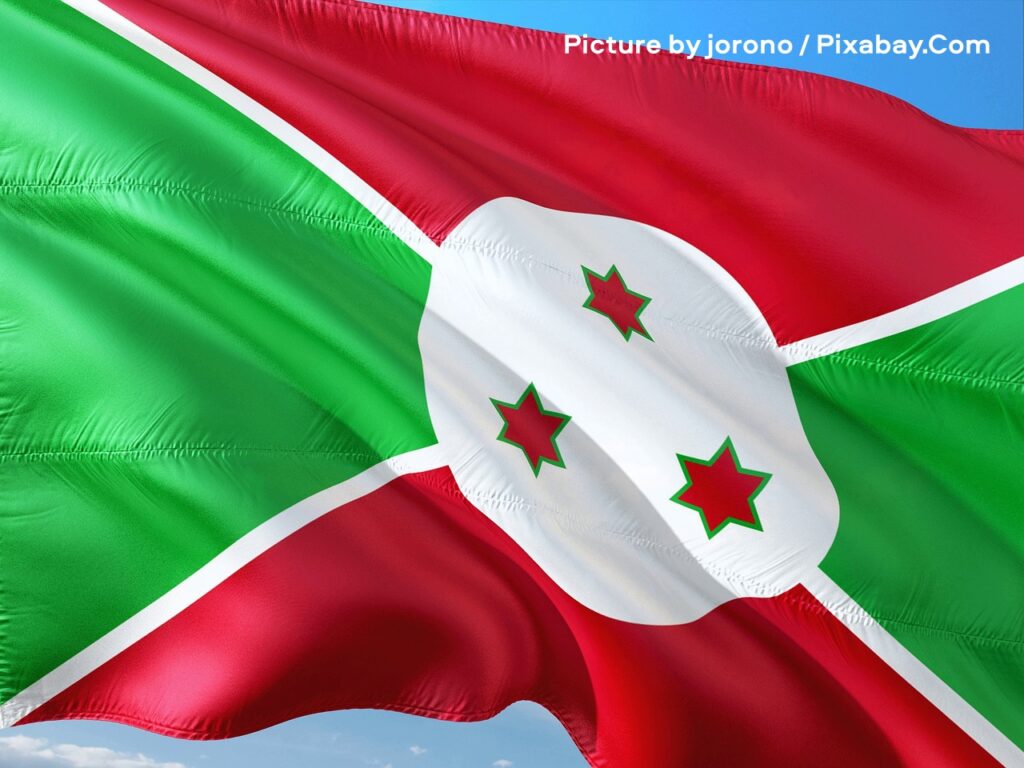
A vibrant flag waves dynamically against a clear blue sky, its fabric rippling with realistic folds and creases that catch the light. This is the national flag of Burundi, featuring bold sections of green and red divided by crisp white diagonal stripes forming a cross, while at the center a white circular emblem displays three prominent red stars outlined in green. The entire scene captures the energetic motion of the cloth as it billows in the wind, evoking a sense of national pride and movement. Picture by jorono / Pixabay.Com.
The country shares 1,140 kilometres (710 mi) of land borders: 236 kilometres (147 mi) with the Democratic Republic of the Congo, 315 kilometres (196 mi) with Rwanda, and 589 kilometres (366 mi) with Tanzania. As it has no coastline, Burundi relies entirely on its neighbours for access to the sea. The country straddles the crest of the Congo–Nile Divide, which separates the drainage basins of the Congo and Nile rivers. Notably, the Ruvyironza River in southern Burundi forms one of the farthest headwaters of the Nile. Rising on the slopes of Mount Kikizi (also known as Gikizi) in Bururi Province at over 2,000 metres elevation, the Ruvyironza is approximately 182 km long. It is recognized as the most remote source of the Nile when measured by total river distance — its waters travel some 6,671 km (4,145 mi) to reach the Mediterranean Sea via the Ruvubu River, Kagera River, and Lake Victoria. A small monument near Rutovu marks this symbolic southernmost source.
Climate
Burundi has an equatorial climate characterized by high mean annual temperatures, relatively small temperature variations, and rainfall distributed throughout the year. Both temperature and precipitation levels vary significantly with altitude. The country typically experiences a dry season from May to August and a rainy season from February to May.
Landscape
The landscape of Burundi is predominantly hilly and mountainous, transitioning to a plateau in the east. The southern and eastern plains form part of the Central Zambezian miombo woodlands ecoregion, as classified by the World Wide Fund for Nature.
The lowest point in the country is the shore of Lake Tanganyika at 772 metres (2,533 ft) above sea level, while the highest point is the summit of Mount Heha at 2,684 metres (8,806 ft). Mount Heha, the highest peak in the Burundi Highlands mountain range, is located in Bujumbura Rural Province, approximately 30 km southeast of Bujumbura and about 20 km east of Lake Tanganyika. Part of the Albertine Rift, it features rounded, forested slopes with patches of montane forest and offers panoramic views of the surrounding hills, valleys, and Lake Tanganyika on clear days. The mountain is popular for hiking, with accessible trails leading to the summit. Natural hazards in Burundi include flooding and landslides, which are common in its rugged terrain.
Forests
Burundi’s forests include three main types: the Albertine Rift Montane Forests (in the west and highlands), Central Zambezian Wet Miombo Woodlands (in the south and east), and elements of the Victoria Basin Forest-Savanna Mosaic. Historically, natural forests once covered 30–50% of the country, but decades of agricultural expansion, fuelwood demand, and civil conflict led to severe losses. Today, forest cover stands at around 11% of the total land area (approximately 279,640 hectares as of 2020), a slight increase from 276,480 hectares in 1990 thanks to reforestation initiatives.
Of the 2020 total, naturally regenerating forest covered 166,670 hectares, while planted forest accounted for 112,970 hectares. Primary forest (native tree species with no clear signs of human disturbance) made up 23% of the naturally regenerating area. Around 41% of all forest lies within protected areas. In 2015, 100% of the country’s forest area was under public ownership.
Since 2018, the government has pursued an ambitious national reforestation program called “Ewe Burundi Urambaye” (“Yes Burundi, Let’s Go”), which has resulted in the planting of over 150 million trees across tens of thousands of hectares. Common plantation species include various Eucalyptus, Pinus, Cupressus, and Acacia, often used for fuelwood, construction, and soil protection. Despite these efforts, ongoing pressures from population growth and energy needs continue to challenge forest sustainability.


