
The Numbat (Myrmecobius fasciatus), also known as the Noombat or Walpurti, is a small, insectivorous marsupial native to Australia. It is unique among marsupials for being strictly diurnal and feeding almost exclusively on termites. Classified in the order Dasyuromorphia and the monotypic family Myrmecobiidae, the Numbat is the faunal emblem of Western Australia.
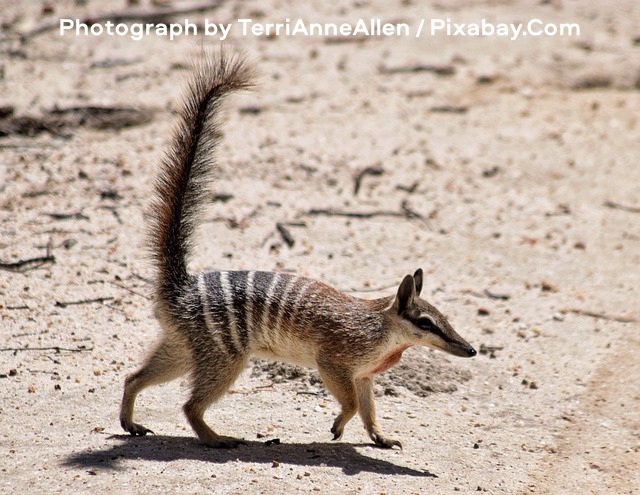
The photograph above captures a Numbat, a small marsupial with a sleek, elongated body covered in coarse fur that transitions from brownish tones on its sides to a series of bold white and dark stripes running along its back, as it strides across a sunlit, sandy terrain scattered with dry twigs and debris. The creature’s long, pointed snout extends forward, its ears are alert and upright, and its prominent, bushy tail arches upward in a graceful curve behind it, while its shadow stretches clearly on the pale ground beneath its moving limbs. photograph by TerriAnneAllen / Pixabay.Com.
| Genus | Myrmecobius |
| Species | M. fasciatus |
| Binomial Name | Myrmecobius fasciatus |
| Length | 35–45 cm (1′ 2″–1’6″) |
| Weight | 280–700 g (10 oz–1.5 pounds) |
| IUCN Status | Near Threatened |
Taxonomy
The Numbat is the sole living member of the family Myrmecobiidae, one of four families in the order Dasyuromorphia (Australian carnivorous marsupials). It is placed in the order alongside families such as Thylacinidae and Dasyuridae. Two subspecies were once recognized, but the rusty-colored Myrmecobius fasciatus rufus (from arid central South Australia) has been extinct since at least the 1960s. Only the nominate subspecies remains.
Common names derive from Indigenous languages: “Numbat” (or regularized “Noombat”) from the Nyungar people of southwest Australia, and “Walpurti” from the Pitjantjatjara. Other historical names include banded anteater and marsupial anteater.
Description
The Numbat is a distinctively striped animal measuring 35–45 cm (14–18 in) in total length, including a bushy tail roughly equal to its body length. It has a finely pointed muzzle, small rounded ears, and powerful claws for digging (five toes on the forefeet, four on the hind feet). Its coat ranges from soft grey to reddish-brown, often with a brick-red patch on the upper back. A prominent black stripe runs from the muzzle tip through the eye to the ear. Four to eleven white stripes cross the hindquarters, fading toward the mid-back. The underparts are cream to light grey, and the tail is covered in long grey hair flecked with white. Adults weigh 280–700 g (10–25 oz). They also have a sternal scent gland used for territory marking.
Unlike most small marsupials, Numbats are diurnal—a trait driven by their specialized termite diet. Most termite-rich ecosystems support large, powerful diggers like anteaters or pangolins, but the Numbat lacks such heavy forelimbs. Its jaw has up to 50 tiny, mostly non-functional teeth (it rarely chews due to soft prey). Uniquely among terrestrial mammals, it has an extra cheek tooth between the premolars and molars. Its dental formula is generally:
Upper: 4.1.3.1.4
Lower: 3.1.4.1.4
The Numbat possesses a long, narrow tongue coated in sticky saliva from large submandibular glands, plus ridges on the soft palate that help scrape termites off the tongue for swallowing. Its digestive system is relatively simple, reflecting the easier-to-digest termite exoskeleton compared to ants. It obtains most of its water directly from termites, so its kidneys lack typical desert adaptations for water retention. Numbats have the highest visual acuity of any marsupial, with a high proportion of cone cells in the retina—adaptations for daytime activity and predator detection, though they also rely heavily on scent.
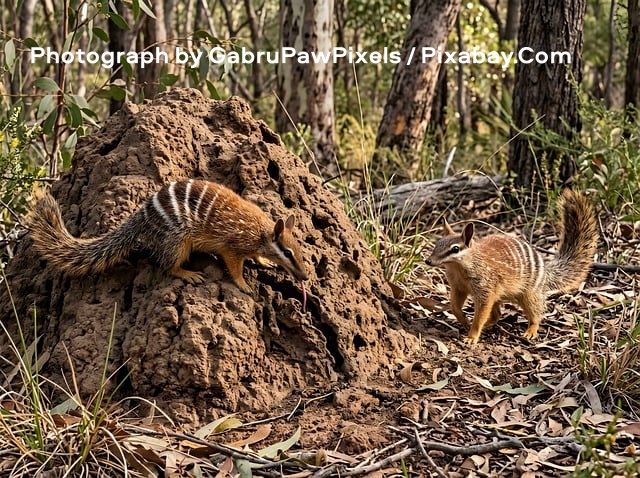
The photograph above shows two striped Numbats in a sunlit Australian woodland, with one perched atop a large, rugged termite mound while the other stands alert on the forest floor nearby, both displaying their distinctive white bands against reddish-brown fur and bushy tails. The background features scattered eucalyptus trees, dry leaves, and undergrowth bathed in natural daylight, capturing a moment of curious wildlife activity in their native habitat. Photograph by GabruPawPixels / Pixabay.Com.
Distribution and habitat
Historically, Numbats ranged widely across southern Australia from Western Australia to northwestern New South Wales. European settlement, habitat loss, and especially introduced predators (Red Fox (Vulpes vulpes) and Feral Cat (Felis catus)) caused a dramatic decline. Today, wild populations survive only in small areas of eucalypt forest in Western Australia, primarily Dryandra Woodland and Tone-Perup Nature Reserve.
The Numbat prefers open eucalypt woodlands with an abundance of hollow logs, fallen timber, and loose soil that support high termite densities. These habitats provide essential shelter and foraging opportunities. Historically, the species occupied a wider variety of semiarid woodlands, spinifex grasslands, and sand dune terrains, but it is now largely restricted to fragmented patches of suitable woodland with sufficient cover and termite resources.
Current estimates place the total population at around 2,000–3,000 individuals. Conservation efforts have shown success: after feral cat exclusion in Dryandra Woodland, numbers have stabilised or increased. The species has been reintroduced to predator-proof fenced reserves, including:
- Yookamurra Sanctuary (mallee, South Australia)
- Scotia Sanctuary (semi-arid NSW)
- Mount Gibson Sanctuary (Western Australia)
- Mallee Cliffs National Park (NSW, from 2020)
- Eyre Peninsula (South Australia, from 2022)
Some reintroduction attempts failed, but plans continue for additional sites. The Numbat remains listed as Endangered under Australia’s EPBC Act, though it was downlisted to Near Threatened on the IUCN Red List in 2026 thanks to decades of recovery work.
Ecology and behavior
Numbats are specialized myrmecophages, consuming up to 20,000 termites per day from genera such as Heterotermes, Coptotermes, Amitermes, and others. They do not intentionally eat ants. They locate shallow underground termite galleries by scent, dig them out with front claws, and lap them up with their sticky tongue. High water content in termites allows Numbats to thrive in arid habitats without drinking.
Adults are solitary and territorial, each defending up to 1.5 km². Territories of males and females overlap, with males roaming more during breeding season. Activity aligns with termite behavior: in winter, feeding occurs mid-morning to mid-afternoon; in summer, they are active earlier and later, sheltering midday. They can enter torpor for up to 15 hours in cold weather.
At night, Numbats shelter in hollow logs, tree hollows, or burrows (1–2 m long ending in a soft-lined chamber). They block burrow entrances with their thick rump hide. Vocalizations are limited—hisses, growls, or repetitive “tut” sounds when disturbed. Native predators include Carpet Python (Morelia spilota), Sand Goanna (Varanus gouldii), Wedge-tailed Eagle (Aquila audax), Collared Sparrowhawk (Accipiter cirrocephalus), Brown Goshawk (Accipiter fasciatus), and Little Eagle (Hieraaetus morphnoides); Red Foxes and Feral Cats remain major threats.
Reproduction
Breeding occurs in February–March (late austral summer), usually producing one litter per year (a second is possible if the first is lost). Gestation is just 15 days, resulting in four tiny young (about 2 cm long at birth). Females lack a true pouch; teats are protected by crimped golden hair and abdominal swelling during lactation.
Young attach to teats until late July or early August (reaching ~7.5 cm), develop fur at ~3 cm, and show adult patterning by ~5.5 cm. They are left in the nest or carried on the mother’s back after weaning and become independent by November. Females mature the following summer; males take an extra year.
Relation to humans and conservation
Europeans first recorded the Numbat in 1831 during an expedition in Western Australia’s Avon Valley. George Fletcher Moore described its ant-eater-like tongue and striking coloration. It was formally described in 1836 and featured in John Gould’s The Mammals of Australia (1845).
Its striking appearance and ecological interest made it Western Australia’s faunal emblem and spurred conservation. Intensive programs since the 1980s, including fox baiting, captive breeding at Perth Zoo, and reintroductions, have boosted numbers.
Project Numbat is a volunteer-driven organisation established in 2006 that has played an important supporting role in Numbat recovery. The group raises funds for on-ground conservation projects, including habitat restoration, population monitoring, and reintroduction initiatives. Volunteers also deliver educational presentations at schools, community groups, and public events to raise awareness and encourage broader community involvement in protecting the species. Through these combined efforts, Project Numbat helps connect the public with active conservation work across Western Australia.
With continued protection from introduced predators and careful habitat management, Numbats can be successfully returned to parts of their former range. While the species has made a remarkable recovery, ongoing efforts are essential to prevent any reversal.
The Numbat stands as a charismatic symbol of Australian conservation, highlighting both the fragility and resilience of the continent’s unique wildlife.


