
Exploring the fascinating world of marsupials
Marsupials are a unique group of mammals known for their distinctive traits and incredible diversity. Let’s dive into what makes these furry vertebrates so special!
What are marsupials?
Marsupials are one of three mammal types, alongside placental mammals and monotremes. Like all mammals, they are warm-blooded, nurse their young with milk from mammary glands, and belong to the class Mammalia within the kingdom Animalia and phylum Chordata. While placental mammals dominate in numbers, Marsupials boast a surprising variety of species, both living and in the fossil record.
What sets marsupials apart?
Marsupials share core mammalian traits like giving birth to live young, having hair or fur, and producing milk. However, they stand out due to several unique features:
- The pouch: The defining characteristic of Marsupials is the pouch (from the Latin marsupium), a fold of skin covering the mammary glands where most females nurture their young. This pouch plays a critical role in their development.
- Early birth: Marsupial young are born in an extremely underdeveloped state, resembling tiny, hairless “climbing jellybeans.” After a short gestation period, they use strong forelimbs with small claws to crawl from the birth canal to the pouch, where they continue developing.
- Epipubic bones: Marsupials have an extra pair of bones extending from the pelvis, likely supporting the pouch and stiffening the torso. This makes long pregnancies challenging.
- Syndactyly: Many Marsupials have fused second and third toes on their hind legs, a condition called syndactyly, which is unique among mammals.
Examples of marsupials
The iconic Red Kangaroo (Macropus rufus) is the largest living Marsupial, with males reaching up to 2.1 meters (6.9 feet) tall (excluding their 1-meter (3.3-foot) tails) and weighing 18–90 kilograms (40–200 lbs). Other notable Marsupials include Australian Possums (Phalangeriformes spp., e.g., Brushtail Possum, Trichosurus vulpecula), Opossums (Didelphis virginiana), Koalas (Phascolarctos cinereus), Wallabies (Macropus spp.), Bandicoots (Perameles spp.), Wombats (Vombatus ursinus), and Tasmanian Devils (Sarcophilus harrisii). With over 330 species worldwide, their diversity is remarkable!
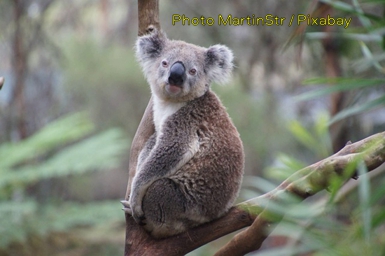
The picture shows a Koala sitting on a tree branch in a lush, green environment. The Koala has a fluffy, grey-brown coat, a black nose, and large ears, and it appears to be clinging to the branch with its limbs. The background features blurred green foliage, suggesting a natural habitat. The image is credited to MartinStr on Pixabay.
Spotlight on Koalas
Koalas (Phascolarctos cinereus) are one of Australia’s most beloved Marsupials, often mistaken for bears due to their cuddly appearance. These arboreal herbivores live primarily in eucalyptus forests, relying almost exclusively on eucalyptus leaves for nutrition. Their diet is low in nutrients, so Koalas have a slow metabolism and sleep up to 18–20 hours daily to conserve energy. They grow to about 60–85 centimeters (24–33 inches) in length and weigh 4–15 kilograms (9–33 lbs), depending on sex and region. Koalas have a backward-facing pouch, which protects their young, called joeys, from falling while climbing trees. Their strong limbs and sharp claws are adapted for gripping branches, and their thick, greyish fur provides camouflage in the treetops. Sadly, Koalas are listed as vulnerable due to habitat loss and climate change.
Spotlight on Wombats
Wombats (Vombatus ursinus and Lasiorhinus spp.) are sturdy, burrowing Marsupials native to Australia. These stocky herbivores have short tails, powerful legs, and rodent-like teeth for grazing on grasses, roots, and bark. Common Wombats (Vombatus ursinus) and Southern and Northern Hairy-nosed Wombats (Lasiorhinus latifrons and Lasiorhinus krefftii) grow to about 1 meter (3.3 feet) in length and weigh 20–35 kilograms (44–77 lbs). Their backward-facing pouches prevent dirt from entering while digging extensive burrow systems, which can span up to 20 meters (65 feet). Wombats are known for their unique cube-shaped feces, which help mark territory without rolling away. The Northern Hairy-nosed Wombat is critically endangered, with fewer than 300 individuals left, largely due to habitat destruction.
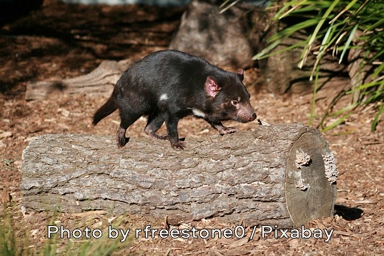
The picture above shows a Tasmanian Devil, a small, stocky marsupial with black fur, walking along a fallen log. The animal has a robust build, a broad head, and prominent ears. The background features a natural setting with dry grass, some green foliage, and a tree trunk, suggesting a forest or woodland environment. The photo is credited to rfreestone0 on Pixabay.
Spotlight on Tasmanian Devils
The Tasmanian Devil (Sarcophilus harrisii) is a carnivorous Marsupial found only on the island of Tasmania. Known for their fierce temperament and powerful jaws, they have one of the strongest bite forces relative to body size among mammals, capable of crushing bones. They grow to 50-78 cm(1’8”-2’7”) in length, with a weight of 6-14 kg(13-31 lbs.). Their black fur and nocturnal habits make them elusive, and their eerie screeches add to their reputation. Tasmanian Devils are scavengers and predators, feeding on small mammals, birds, and carrion. Their pouch opens backward, protecting their young during foraging. They are endangered due to Devil Facial Tumour Disease (DFTD), a contagious cancer that has reduced populations by over 80% since the 1990s. Conservation efforts, including captive breeding programs and disease-free population sanctuaries, are underway to protect this iconic species.
Marsupials are classified into two superorders:
- Ameridelphia: About 100 species, including Opossums (Didelphimorphia) and Shrew Opossums (Paucituberculata), found in the Americas.
- Australidelphia: Roughly 230 species, primarily in Australia, including Red Kangaroos, Wombats, Koalas, Tasmanian Devils, Australian Possums, and the extinct Tasmanian Tiger (Thylacinus cynocephalus), with one species in South America (Monito del Monte, Dromiciops gliroides).
Australian marsupial diets
Australian Marsupials are grouped by diet:
- Dasyurids: Carnivores like the Tasmanian Devil, Quolls (Dasyurus spp.), and Numbats (Myrmecobius fasciatus).
- Peramelemorphs: Omnivores, such as Bandicoots and Bilbies (Macrotis lagotis).
- Diprotodonts: Herbivores, including Red Kangaroos, Koalas, Wallabies, Australian Possums (e.g., Brushtail Possum, Trichosurus vulpecula), and Wombats.
Where do marsupials live?
Marsupials are found primarily in Australia (234 species, including Tasmania, New Guinea, and nearby islands), South and Central America (99 species), and North America (2 species). No native Marsupial species live in Europe, Africa, or Asia.
Marsupials are a captivating group, showcasing nature’s creativity with their pouches, unique development, and diverse lifestyles. From the tree-dwelling Koala and burrowing Wombat to the fierce Tasmanian Devil, they continue to fascinate animal lovers worldwide!


