
The Fennec Fox (Vulpes zerda) is the smallest member of the Canidae family, instantly recognizable by its disproportionately large ears, which can reach up to 15 cm (6 inches) in length—nearly half the size of its body. These “desert foxes” are native to the arid regions of North Africa, captivating people with their cute appearance and remarkable adaptations to one of Earth’s harshest environments.
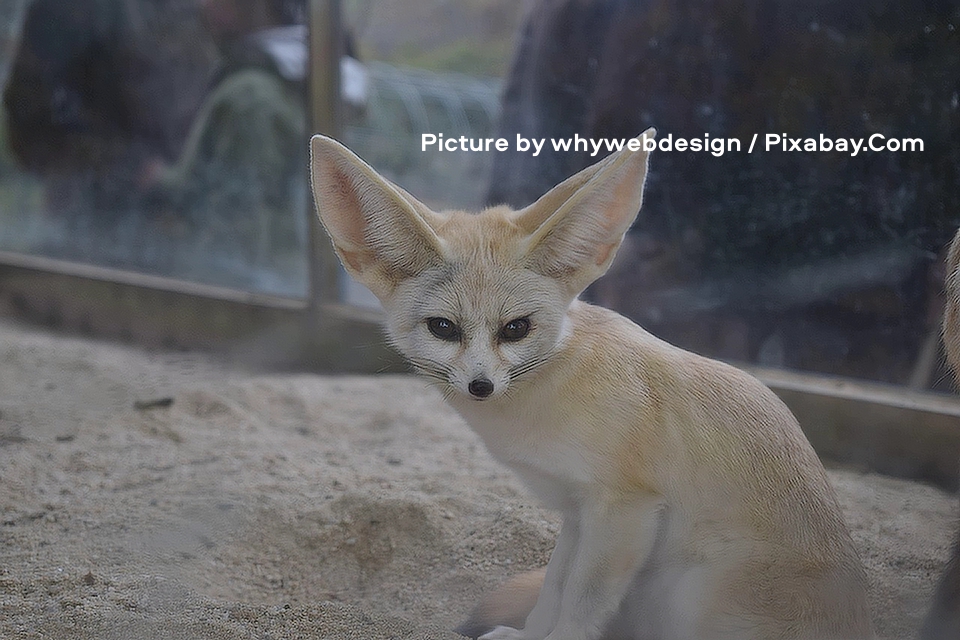
A small Fennec Fox with strikingly large, pointed ears sits attentively on a bed of fine sand, its light tan and cream-colored fur glowing softly under the light as it gazes directly toward the viewer with dark, expressive eyes and a curious tilt to its head. The background is softly blurred, revealing hints of an enclosure with glass or barriers, suggesting a captive or zoo-like setting. Picture by whywebdesign / Pixabay.Com
| Genus | Vulpes |
| Species | V. zerda |
| Binomial Name | Vulpes zerda |
| Head-and-body Length | 24–41 cm (9.5 to 16 inches) |
| Tail length | 18–30 cm (7 to 12 inches) |
| Weight | 1–1.9 kg (2.2–4.2 lb) |
| IUCN Status | Least Concern |
Physical characteristics
Fennec Foxes are tiny, with a head-and-body length of 24–41 cm (9.5 to 16 inches) and a bushy tail adding another 18–30 cm (7 to 12 inches). They typically weigh just 1–1.9 kg (2.2–4.2 lb), making them smaller than many house cats. Their fur is thick, soft, and creamy or pale tan, providing excellent camouflage against sandy dunes. The tail ends in a distinctive black tip.
Their oversized ears serve dual purposes: they act as radiators to dissipate excess body heat during the day and sensitive hearing devices to detect prey moving under the sand at night. Fur covers the soles of their feet, protecting them from scorching sand while providing traction like built-in snowshoes. Their kidneys are highly efficient at conserving water, allowing them to survive long periods without drinking.
Habitat and distribution
Fennec Foxes inhabit the sandy deserts and semi-arid regions of North Africa, ranging from Morocco and Mauritania in the west, across the vast Sahara Desert, to Egypt, the Sinai Peninsula, and as far east as northern Sudan. Their range covers an enormous area of approximately 8.6 million km² (3.3 million square miles)—roughly the size of the United States. Other countries the Fennec Fox is found in include Algeria, Chad, Libya, Mali, Niger, and Tunisia.
They prefer stable sand dunes and vast treeless sand areas with sparse vegetation such as grasses, sedges, and small shrubs, which provide suitable conditions for digging extensive burrow systems. These dens can reach depths of up to 1 meter (3 feet) or more and help the Fennec Foxes regulate temperature. In the northern parts of their range, annual rainfall is typically less than 100 mm (4 inches), while southern areas may receive up to 300 mm (12 inches). As nocturnal animals, they spend the day in these underground burrows to escape the extreme daytime heat (which can exceed 38°C/100°F) and emerge at dusk to hunt.
Diet and hunting
As omnivores, Fennec Foxes eat a varied diet: insects (especially grasshoppers, locusts, and beetles), small rodents, lizards, birds, eggs, and plant matter like fruits, leaves, roots, and tubers. They obtain most of their moisture from food, rarely needing to drink water. Their large ears help pinpoint prey sounds, and they dig efficiently with strong front paws.
Behavior and social life
Fennec Foxes are highly social, living in small family groups of up to 10 individuals. They are playful, especially the young, and communicate through a range of vocalizations, including barks, growls, and purrs. Males mark territories with urine, and pairs often mate for life. Breeding occurs once a year, with a gestation of about 50 days leading to litters of 1–5 kits. Pups are born blind and helpless but develop quickly, reaching independence around 4–6 months.
Adaptations for desert life
Thermoregulation
The Fennec Fox’s most striking adaptation is its enormous ears, which act as highly efficient radiators. Richly supplied with blood vessels, the ears release excess body heat into the air through a process called radiative cooling, helping the Fennec Fox maintain a stable internal temperature even when daytime desert heat soars. Their thick, multi-layered fur further aids thermoregulation: the outer coat reflects intense sunlight during the day, while the dense undercoat traps air to insulate against freezing desert nights, when temperatures can drop dramatically. In extreme heat, Fennec Foxes can pant at rates of up to 690 breaths per minute to enhance evaporative cooling with minimal water loss. They also retreat to cool underground burrows during the hottest parts of the day.
Water conservation
Fennec Foxes are masters of water economy in an environment where free-standing water is rare. Their kidneys are exceptionally efficient, producing highly concentrated urine that minimizes water excretion. They lose very little moisture through their skin or respiration. Most of their hydration comes from the food they eat—especially insects, fruits, and roots that contain metabolic water. They have also been observed licking dew that condenses inside their burrows in the early morning. This combination of physiological adaptations allows them to survive for extended periods without drinking any water at all.
Camouflage and mobility
The Fennec Fox’s pale, sandy-colored coat provides near-perfect camouflage against the desert dunes, making them almost invisible to predators and prey alike when motionless. Their fur is not only for concealment but also reflects sunlight to reduce heat absorption. For mobility, the soles of their feet are densely covered in soft fur, which serves multiple purposes: it acts like natural snowshoes to prevent sinking into loose sand, provides excellent traction for running and jumping, and insulates their paws from the scorching daytime ground temperatures (which can exceed 70°C/158°F). These hairy “boots” also protect against the cold sand at night. Combined with powerful hind legs, Fennec Foxes can leap over 1.2 meters (4 feet) and dig rapidly to pursue prey or expand burrows.
These traits make the Fennec Fox one of the best-adapted mammals to extreme desert conditions.
Conservation status
The IUCN lists the Fennec Fox as Least Concern with a stable population. However, threats include habitat loss, hunting for the pet trade, and occasional fur use. They are legally protected in several North African countries. In captivity, they can live up to 14 years, compared to about 10 years in the wild.
Fun facts
- Fennec Foxes can jump high and dig burrows rapidly.
- They pant up to 690 breaths per minute in extreme heat for cooling.
- Their name “fennec” comes from the Arabic word for “small fox.”
The Fennec Fox embodies resilience and cuteness in equal measure—a tiny powerhouse thriving where few others can. Whether in the wild dunes of the Sahara or conservation programs worldwide, these big-eared survivors continue to charm and inspire.


