
A computer is a machine that can be programmed to carry out sequences of arithmetic or logical operations automatically. Modern digital electronic computers run general-purpose programs, which is why the same kind of machine can handle everything from spreadsheets and video games to industrial control and scientific simulation.
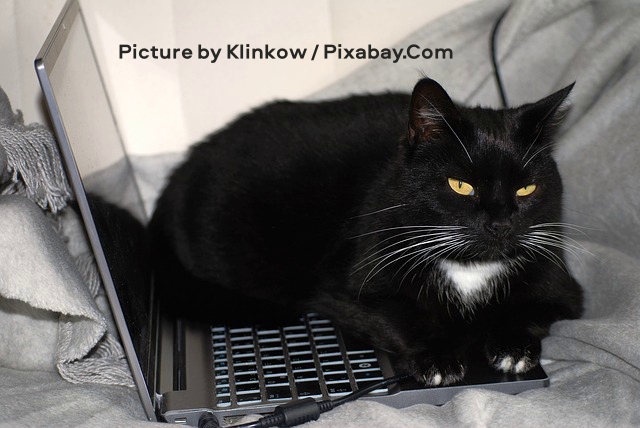
The photograph above captures a sleek black cat with bright yellow eyes and a distinctive white patch on its chest and chin, comfortably sprawled across the keyboard of an open silver laptop whose screen is tilted back; the cat’s front paws rest near the laptop’s edge while its body covers much of the keys, all set against rumpled gray bedding with a glimpse of a light-colored scarf or fabric on the left and a black cable plugged into the computer. Photograph by Klinkow / Pixabay.Com.
The phrase computer system can mean a complete setup—hardware, operating system, software, and peripherals—or a group of machines working together, as in a network or cluster.
Computers were rare in the 1930s. Today they are everywhere: in factories, appliances, cars, phones, and the infrastructure of the internet. They range from tiny single-purpose chips in a key fob or microwave to personal computers, smartphones, and vast supercomputers. Price, size, and complexity span that entire spectrum.
The first calculating aids were simple and manual. The abacus is the classic example. During the Industrial Revolution, inventors built mechanical devices to take over repetitive work, such as the patterned control of looms. In the early twentieth century, specialized electrical machines performed analog calculations. Digital electronic calculators arrived during World War II, moving through electromechanical designs, vacuum tubes, transistors, MOSFETs, and finally monolithic integrated circuits. Each step made circuits smaller and more efficient. That path led to the microprocessor and the microcomputer boom of the 1970s. Since then, transistor counts have risen at a pace often summarized as Moore’s law—roughly doubling every two years—driving the Digital Revolution of the late twentieth and early twenty-first centuries.
A conventional modern computer has at least one processing element, usually a microprocessor acting as the CPU, plus semiconductor memory. The processor performs arithmetic and logic; a control unit can change the order of operations according to stored instructions.
Peripheral devices are the equipment attached to that core so a computer can take in information, present results, store data for later use, or talk to other machines. In other words, the CPU and main memory do the computing; peripherals connect that work to people, sensors, files, and networks. They are often grouped into four overlapping kinds.
Input devices turn human actions or physical measurements into signals the computer can use. The keyboard, descended from the typewriter, remains the main way to enter text and commands. Pointing devices—mice, trackballs, trackpads, joysticks, styluses, and graphics tablets—describe position and motion. Scanners digitize paper; microphones and cameras capture sound and images; game controllers add buttons and analog sticks. In industrial and scientific systems, sensors for temperature, pressure, light, motion, and many other quantities act as input peripherals as well.
Output devices do the reverse: they turn digital results into something a person or another machine can use. Monitors display text, graphics, and video (first as bulky cathode-ray tubes, later as flat LCD, LED, and OLED panels). Printers produce paper or, in the case of 3D printers, physical objects. Speakers, headphones, and buzzers provide sound; projectors throw images onto a wall or screen.
Many devices are both input and output. A touchscreen shows an interface and accepts taps and gestures. A modem, network card, or Wi-Fi adapter sends and receives data. External disk drives, USB flash drives, memory cards, optical disc drives, and tape units store files and also read them back. Even a smartphone or tablet can function as a peripheral to another computer while remaining a complete computer in its own right.
Storage peripherals matter because main memory is usually volatile: it forgets when power is cut. Secondary storage keeps programs and data. The lineage runs from punched cards and paper tape through magnetic tape and IBM’s early hard disks (the 1956 RAMAC stored about 5 megabytes in a room-sized cabinet) to floppy disks, CDs and DVDs, high-capacity hard drives, and today’s solid-state drives and flash memory. The same devices that hold data often double as I/O hardware.
Historically, peripherals defined how people used machines. Herman Hollerith’s punched-card equipment for the 1890 U.S. census was among the first large-scale input and output systems. Early electronic computers still read cards or paper tape and printed on teletypes. The personal-computer era standardized the keyboard, mouse, and CRT monitor; later came USB, wireless mice and keyboards, cheap flat panels, and pocket-sized flash storage. In embedded systems—cars, appliances, factory robots—the “peripherals” are often sensors and actuators rather than a keyboard and screen: the computer reads the world and then moves a motor, opens a valve, or lights a display.
Taken together, peripherals are what make a processor useful. Without them, a computer can only compute in isolation. With them, it can be typed at, pointed at, spoken to, networked, and used to control almost any device that electricity can reach.
Charles Babbage (1791–1871), an English mathematician, mechanical engineer, and polymath, originated the idea of a programmable digital computer and is often called the father of the computer. Born in London to a prosperous banking family, he studied at Cambridge, where he helped found the Analytical Society to modernize British mathematics. From 1828 to 1839 he held the Lucasian Professorship of Mathematics—the chair once occupied by Isaac Newton.
His interest in machines grew from a practical problem: mathematical tables used in navigation, astronomy, finance, and engineering were calculated by hand and riddled with errors. Around 1812–1813 he saw that a mechanism using the method of finite differences could compute polynomials automatically and print the results, removing both calculation and transcription mistakes. By 1822 he had a small working model. That June he presented “Note on the application of machinery to the computation of astronomical and mathematical tables” to the Royal Astronomical Society. In 1823 the British government began funding a full-scale Difference Engine No. 1, intended to handle 20-digit numbers with some 25,000 parts and weigh about four tons.
Construction stalled. Precision metalwork of that era was slow and expensive, and Babbage clashed with his engineer, Joseph Clement. Work stopped in 1833; government support ended in 1842 after spending on the order of £17,500. By then Babbage had already conceived something far more ambitious: the Analytical Engine (1833–1834), a general-purpose mechanical computer. Programs and data would enter on punched cards, as on a Jacquard loom. Output would include a printer, a curve plotter, and a bell; results could also be punched onto cards. The design included an arithmetic logic unit (the “mill”), a store for numbers, and control flow with conditional branching and loops—making it, in modern terms, the first design for a Turing-complete general-purpose computer. It was steam-era machinery imagined on a factory scale, and it was never built in his lifetime.
Ada Lovelace (1815–1852) became Babbage’s most important interpreter. Born Augusta Ada Byron in London, she was the only legitimate child of the poet Lord Byron and Anne Isabella Milbanke, a mathematically minded aristocrat who steered her daughter toward mathematics and science rather than poetry. In 1833, at seventeen, she was introduced to Babbage by the writer and mathematician Mary Somerville and saw a working fragment of the Difference Engine. The meeting began a long collaboration. In 1835 she married William King, later Earl of Lovelace, and is known thereafter as Ada King, Countess of Lovelace.
In 1842 the Italian engineer Luigi Menabrea published a French account of Babbage’s Turin lectures on the Analytical Engine. Charles Wheatstone suggested that Lovelace translate it for a British audience; Babbage urged her to add notes of her own. The result appeared in 1843 in Taylor’s Scientific Memoirs, signed only with the initials A.A.L. Menabrea’s text was short; Lovelace’s seven appendices (Notes A through G) ran to some forty-one pages—more than one and a half times as long.
The last appendix, Note G, is the piece that made her reputation. It sets out, step by step, how the unbuilt engine could compute Bernoulli numbers, a recursive sequence important in analysis. She chose the example not because it was the easiest calculation, but because it showed what the machine could do: repeated operations, loops, and values that depended on earlier results. She also saw further than calculation. The engine, she wrote, “weaves algebraical patterns just as the Jacquard-loom weaves flowers and leaves.” It could manipulate symbols—letters, musical notes, any tokens that obeyed rules—not only numbers. That insight, that a programmable machine need not be limited to arithmetic, is why she is widely called the first computer programmer, even though the hardware she described was never built in her lifetime.
Lovelace published little else and died in London in 1852, at thirty-six. For a long time she was remembered mainly as Byron’s daughter. The 1843 notes are now read as the first substantial paper on what it would mean to program a general-purpose computer.
Between 1847 and 1849 Babbage also designed Difference Engine No. 2, a cleaner machine needing far fewer parts than No. 1. His son Henry later built a simplified version of the Analytical Engine’s mill (1888) and demonstrated table calculation with it in 1906. In 1991 the Science Museum in London constructed a working Difference Engine No. 2 from Babbage’s drawings, confirming that the designs were sound.
Babbage’s engines failed as nineteenth-century projects for political, financial, and manufacturing reasons, and because he kept enlarging the vision faster than anyone could follow. Conceptually they were about a century early. The Analytical Engine already separated a programmable processor from memory and treated computation as a sequence of stored operations—the architecture later computers would reinvent in electronics. It also already assumed peripherals: cards for input, a printer and plotter for output, and a store that could hold both numbers and intermediate results.
Leonardo Torres Quevedo (1852–1936) was a Spanish civil engineer, mathematician, and inventor who picked up Babbage’s unfinished program and recast it in electricity. Born in Santa Cruz de Iguña, in Cantabria, he trained as an engineer and became one of the most versatile inventors of his generation: aerial cable cars (including the Whirlpool Aero Car at Niagara Falls), semi-rigid airships, and, in 1903, the Telekine (or Telekino), an early practical radio remote-control system he demonstrated so airships could be tested without putting a pilot at risk. In 1907 he founded a Laboratory of Applied Mechanics in Madrid, later renamed the Laboratory of Automatics, to study machines that could act according to rules.
His computing work was an explicit attempt to realize Babbage’s Analytical Engine with the technology of his own day. In Essays on Automatics (Ensayos sobre automática, 1913–1914), he reviewed Babbage’s Difference Engine and Analytical Engine and argued that automata could be given “discernment”: they could compare quantities and change what they did according to conditions fixed in advance. The paper includes a design for a machine that would evaluate formulas such as (a^{x}(y-z)^{2}) over a sequence of values. Control would come from a read-only program—conducting patterns on a rotating cylinder—with conditional branching. Almost in passing, Torres also proposed floating-point arithmetic so a machine could handle very large or very small numbers without a fixed scale. Historian Brian Randell later called the essay a work that “well repays reading even today.”
He did not stop at paper. In 1912 he completed El Ajedrecista (“The Chess Player”), an electromechanical automaton that played the endgame of king and rook against a human king. Electrical contacts sensed the pieces; a mechanical arm (and, in a later version built with his son Gonzalo, electromagnets under the board) moved them. The machine followed fixed rules and could force mate. It was demonstrated in Paris in 1914 and described in Scientific American; it is often cited as the first genuine game-playing automaton and an early landmark in machine decision-making.
In 1920, at a Paris meeting marking the centenary of Thomas de Colmar’s arithmometer, Torres presented his Electromechanical Arithmometer. A user typed arithmetic problems on a typewriter that could sit at a distance from the calculating unit; the machine computed the four basic operations, handled certain conditional steps, and printed the results. He treated the device as a demonstration that an electromechanical analytical engine was feasible, not as a product to sell. Combined with the Essays and El Ajedrecista, it showed that Babbage’s ideas—stored control, arithmetic, conditional action, and usable input and output—could be built with relays, magnets, and a keyboard long before electronic computers existed.
Torres was celebrated in Spain and France, served as president of the Spanish Royal Academy of Sciences, and died in Madrid in December 1936, during the Spanish Civil War. Outside the Spanish- and French-speaking world his computing work was long overshadowed; it is now recognized as a direct bridge from Babbage to the electromechanical and electronic machines of the mid-twentieth century.


