Wildlife conservation used to depend on boot leather, binoculars, and luck. Today it increasingly runs on sensors, satellites, and algorithms. Across forests, oceans, and grasslands, five technologies are quietly rewriting how scientists find rare animals, measure ecosystem health, and intercept threats before they become catastrophes.
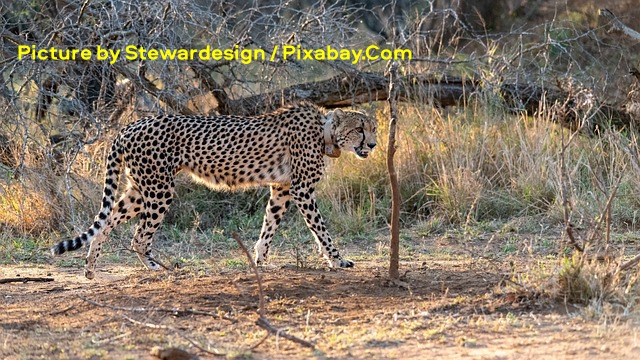
the photograph above shows a Cheetah walking from left to right across dry dusty ground with patches of grass and scattered thin trees and branches in warm sunlight, its spotted tawny coat clearly visible as it moves with its head turned slightly forward, and the animal is wearing a tracking collar around its neck. Photograph by Stewardesign/ Pixabay.Com.
Eyes in the woods: camera traps and AI
Motion-triggered cameras have long been the workhorses of field biology. Hidden along trails, waterholes, and den sites, they work day and night, in rain and dust, with almost no disturbance. The problem was never capturing images; it was drowning in them. A single reserve can generate millions of frames filled with empty trails, swaying branches, and the occasional animal.
Projects such as Snapshot Serengeti showed the scale of the opportunity and the bottleneck. Hundreds of cameras in Tanzania’s Serengeti National Park produced millions of images of Lions (Panthera leo), Spotted Hyenas (Crocuta crocuta), African Savanna Elephants (Loxodonta africana), and dozens of other species. Citizen scientists on Zooniverse once shouldered the labeling; deep-learning models now identify, count, and even describe behavior in those images at accuracies that rival volunteer teams, while cutting years of human effort. Shared tools such as MegaDetector and Wildlife Insights let parks on different continents reuse the same detectors instead of training a model from scratch every time. Newer systems go further: they use the sequence of frames and neighboring animals in a shot, the way a human would, instead of classifying each cropped animal in isolation.
On-device machine learning has closed the last gap—time. Modern camera traps classify species, or people, on the camera itself, then transmit only the frames that matter via cellular, radio, or satellite links. Systems such as TrailGuard AI and Instant Detect can push an alert to rangers in under a minute. In India’s Similipal Tiger Reserve, an AI camera network helped intercept four armed poachers during monsoon operations. In South Africa, similar tools are now part of a wider anti-poaching effort that coincided with a reported drop in rhinoceros killings (Ceratotherium simum and Diceros bicornis); cameras and collars are one piece of that mix, not a proven sole cause. Instant Detect units can be tuned to flag African Savanna Elephants (Loxodonta africana), Hippopotamuses (Hippopotamus amphibius), Brown Bears (Ursus arctos), or Gray Wolves (Canis lupus) while ignoring everything else. Product case studies describe cameras watching Gray Wolf families through denning season without anyone entering the territory, and triggering non-lethal deterrents when African Savanna Elephants approach a village.
Beyond alerts, camera traps now support science that used to require years of field craft: occupancy maps across whole landscapes, activity patterns by hour and season, and individual identification from stripe patterns on Tigers (Panthera tigris) or unique marks on other mammals. Combined with solar power and satellite backhaul, they turn the most remote trail into a live sensor.
Eyes in the sky: drones
Unmanned aerial vehicles cover terrain that is too vast, too dangerous, or too sensitive for people. They count herds, map habitat, follow migrations, deter poachers, and even restore landscapes. What began as a novelty has become one of conservation’s most versatile tools.
Counting what ground teams cannot see. Drones now replace or complement line transects for species that live in the canopy or nest in remote rivers. Deep-learning models trained on thousands of nest photos can find orangutan (Pongo pygmaeus and Pongo abelii) nests in Sabah and Sumatra with high precision, turning days of walking into hours of flight. Thermal cameras pick out Koalas (Phascolarctos cinereus) in eucalyptus crowns that human observers miss, detect Alaotran Gentle Lemurs (Hapalemur alaotrensis) in Madagascar’s marshes, and census Gharials (Gavialis gangeticus) along Nepal’s Babai River. In the Amazon, drones flying over mass-nesting beaches of Giant Amazon River Turtles (Podocnemis expansa) produce orthomosaics that make population estimates far more reliable than scramble counts from the ground.
Anti-poaching and rapid response. Thermal and zoom payloads let rangers scan thick bush at night without walking into an ambush. In Kenya’s Maasai Mara, rangers have used drones to relocate individual rhinoceroses that were hard to find from the ground and to help with identification. In Nepal’s Chitwan and Bardia national parks, community anti-poaching units use drones both to intercept illegal activity and to warn villages when Tigers, rhinoceroses, or Asian Elephants (Elephas maximus) approach settlements. In South Africa, an AI collar that flags abnormal rhinoceros behavior is sometimes followed by a thermal drone flight, so a response team can assess the scene before committing. Industry analyses claim large savings over ground-only patrols and fewer incidents in heavily monitored zones; those figures come mainly from market and operator reports, not independent field trials.
Non-invasive sampling at sea. One of the most striking marine applications is collecting whale “blow”—the exhaled mist that carries DNA, hormones, microbiome data, and other biological clues about an animal’s condition. Drones fitted with Petri dishes or foam samplers fly a few meters above a surfacing animal and harvest respiratory droplets. Researchers have used the method on Humpback Whales (Megaptera novaeangliae), Sperm Whales (Physeter macrocephalus), Fin Whales (Balaenoptera physalus), Blue Whales (Balaenoptera musculus), Bottlenose Dolphins (Tursiops truncatus), and North Atlantic Right Whales (Eubalaena glacialis). The samples can yield sex, individual identity, pregnancy status, and genetic profiles without a biopsy dart or a close boat. Behavioral disturbance is typically low; in one baleen-whale study, no response was detected on 87 percent of flights. The same platforms can drop suction-cup tags or photograph body condition from above.
Habitat, restoration, and conflict. High-resolution imagery detects illegal logging and small clearings long before they appear on satellites. Some operators now fly seed-dispersal drones that fire encapsulated native seeds into degraded ground. Others map waterholes, grazing lines, and fire scars so managers can reduce conflict between people and African Savanna Elephants. Dual visible-thermal surveys in Indonesian parks have counted waterbirds, ungulates, and primates faster and with less disturbance than traditional walks.
Drones are not a panacea. Battery life, weather, rotor noise, airspace rules, and the risk of habituation or stress all constrain use. Used carefully, however, they shrink the gap between what a park contains and what a ranger can know in time to act.
Ghost DNA: environmental DNA
Animals constantly shed genetic material—skin cells, feces, mucus, pollen. Scientists now sequence that leftover DNA from water, soil, or even air.
eDNA is especially powerful for species that are rare, cryptic, or newly invading. A few liters of river water can reveal an endangered fish or an invasive mussel weeks or months before anyone sees it. U.S. programs such as READI-Net use autonomous samplers specifically for early detection of aquatic invaders. Seasonal timing matters: Zebra Mussel (Dreissena polymorpha) DNA peaks in midsummer, while Common Carp (Cyprinus carpio) is easier to detect in spring and Rusty Crayfish (Faxonius rusticus) in early autumn. Spiny Waterfleas (Bythotrephes longimanus) remain among the hardest targets. Used well, the method slashes the number of samples needed for high-confidence detection. Quagga Mussels (Dreissena rostriformis), Great Crested Newts (Triturus cristatus), and Harbour Porpoises (Phocoena phocoena) are among the species now routinely screened this way. Plant surveys of the Upper Rhine have also flagged Black Locust (Robinia pseudoacacia), Japanese Knotweed (Reynoutria japonica), and Giant Knotweed (Reynoutria sachalinensis).
Because sampling is non-invasive, eDNA also works in sacred, politically sensitive, or simply inaccessible waters.
Living sensors: GPS and biologgers
Tiny tags now report not only where an animal is, but how it moves and how it feels. GPS collars, satellite transmitters, and multi-sensor biologgers record location, three-dimensional acceleration, heart rate, dive depth, body temperature, and ambient conditions such as air temperature, pressure, or water salinity. Devices that once fit only large mammals now ride on songbirds, fish, and even some insects. Networks such as Argos and ICARUS relay those points from remote oceans and forests; public archives such as Movebank already hold billions of locations from more than a thousand species.
The maps that result are more than pretty tracks. They show which corridors still work and which have been cut by roads, fences, or farms. In the Yellowstone-to-Yukon region, compiled GPS studies of Elk (Cervus canadensis), Gray Wolves, Golden Eagles (Aquila chrysaetos), and other species reveal how animals actually use the landscape inside and outside parks. Decades of Caribou (Rangifer tarandus) telemetry show shrinking migrations that track human disturbance more closely than weather alone. Some Beluga Whale (Delphinapterus leucas) populations, notably in the Chukchi Sea, have delayed autumn movements as sea ice forms later; other populations do not show the same pattern. Tracking of White Storks (Ciconia ciconia) has turned up unexpectedly frequent Sahara crossings; acceleration sensors on the same birds distinguish soaring from flapping and link flight effort to wind and food. Tagged Tiger Sharks (Galeocerdo cuvier) have revealed offshore banks that standard coastal models had missed.
Onboard processing is changing the operational side as well. Some collars run AI that flags abnormal behavior—a rhinoceros that has suddenly stopped moving, an African Savanna Elephant leaving a reserve—and can trigger a drone check before rangers commit. Similar tags are used on Lions, Spotted Hyenas, Cheetahs (Acinonyx jubatus), Leopards (Panthera pardus), forest antelope, Vultures, and marine mammals. Because the animal chooses where to go, the tag also samples the environment at the scale that matters to that animal, filling gaps that static weather stations and satellites cannot see.
Animals have become mobile observatories of a changing planet.
Listening networks: bioacoustics
Solar-powered recorders and hydrophones turn landscapes into continuous audio streams. Algorithms pick species calls out of the noise and, equally important, pick out human sounds that do not belong: chainsaws, trucks, and gunshots.
In Central African rainforests, grids of microphones have documented how African Forest Elephants (Loxodonta cyclotis) fall silent before shots are fired and then call more intensely afterward—evidence that poaching affects far more animals than those that are killed. Convolutional neural networks now run on or near the recorders themselves, cutting false alarms and sending coordinates to rangers. Similar systems map hunting pressure in North American forests and track biodiversity recovery after logging. Hydrophones do the same work underwater, listening for Whales, fish choruses, and illegal dynamite fishing.
The network effect
None of these tools works best in isolation. Camera alerts cue drones. A GPS collar that stalls cues a thermal flight. Acoustic gunshot detections cue ground teams. eDNA confirms a species a satellite tag has never quite photographed. Platforms such as EarthRanger already stitch collars, cameras, acoustics, and satellite layers into a single operational picture.
The result is a conservation science that is faster, less invasive, and more honest about what is happening when no human is watching. The animals are still elusive. The data no longer has to be.


