Burkina Faso, formerly known as Upper Volta until its renaming in 1984, stands as a quintessential landlocked country in West Africa’s Sahel region. Sharing borders with six neighboring nations, it occupies a unique geographical position between the arid expanses of the Sahara Desert to the north and the humid coastal influences of the Gulf of Guinea to the south. Situated directly south of the dramatic loop of the Niger River, Burkina Faso lies predominantly between latitudes 9° and 15° North, though a small northern sliver extends just beyond 15° North. Its longitudinal span runs from 6° West to 3° East, placing it at the crossroads of the Africa’s major climatic zones.
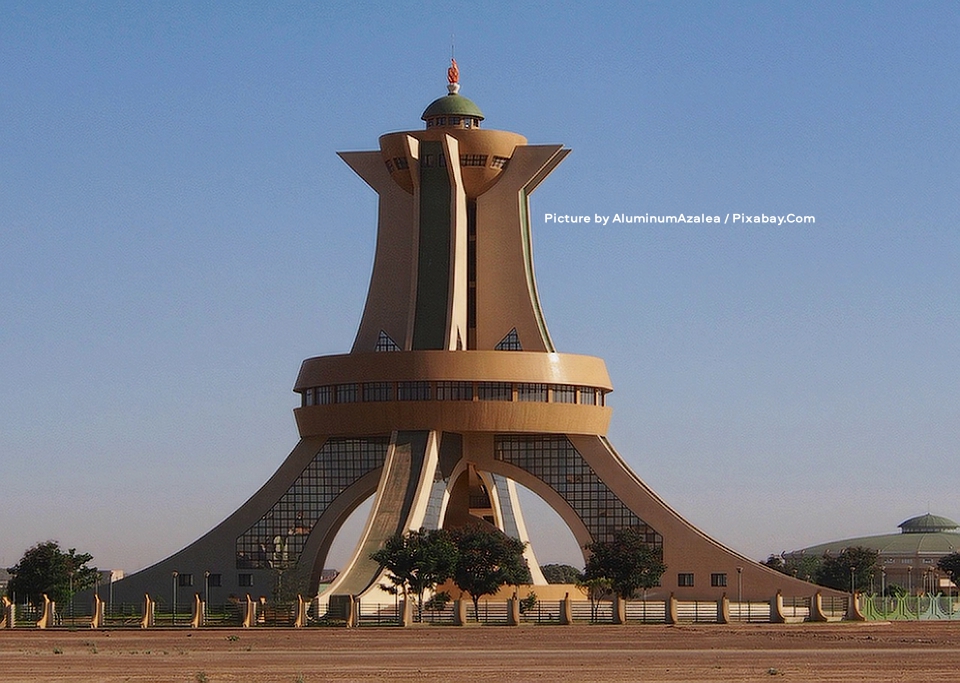
The National Heroes Monument in Ouagadougou, Burkina Faso, rises dramatically against a clear blue sky as a bold example of modern architecture, its broad, sweeping concrete base formed by massive, curved arches that spread outward like powerful legs supporting the towering central structure above. The beige-toned building features extensive glass panels and geometric cutouts along its facades, with a distinctive midsection that flares outward before tapering into a narrower upper tower capped by a green dome and a prominent red flame-like sculpture at the very top. In the foreground, sparse trees and a simple fence line the dry, open ground surrounding the monument, emphasizing its imposing presence in the landscape. Picture by AluminumAzalea / Pixabay.Com
The nation’s terrain reveals a striking north-south gradient shaped by its transitional location. Southern Burkina Faso is refreshingly green and fertile, blanketed in lush forests interspersed with fruit-bearing trees that flourish under relatively higher rainfall. These woodlands provide a vivid contrast to the semi-arid expanses of the north, where drier conditions prevail and vegetation thins as the Sahara’s influence grows stronger. This ecological shift creates a dynamic landscape that supports diverse plant life and serves as a critical buffer zone between desert and tropical environments.
At the heart of the country lies a broad savanna plateau that forms the backbone of central Burkina Faso. Elevations here range from 198 to 305 meters (650 to 1,001 feet) above sea level, creating gently rolling terrain dotted with agricultural fields, low brush, and scattered trees. This plateau is not only the agricultural heartland—where millet, sorghum, and cotton are cultivated—but also a visual tapestry of golden grasses and hardy shrubs that stretch toward the horizon, embodying the classic West African savanna.
Burkina Faso’s commitment to conserving its natural heritage is evident in its network of game preserves and national parks, which rank among the region’s most important wildlife sanctuaries. The premier protected areas include Arly National Park, Nazinga Reserve, and the vast W National Park—a transboundary reserve that underscores regional cooperation in conservation. Within these havens roam iconic African megafauna: powerful Lions (Panthera leo), majestic African Bush Elephants (Loxodonta africana), lumbering Common Hippopotamuses (Hippopotamus amphibius), agile monkeys, gregarious Common Warthogs (Phacochoerus africanus), and graceful herds of antelopes. These parks offer vital refuges where visitors and scientists can observe the full spectrum of Sahelian and savanna biodiversity in its natural setting. Among the antelopes, notable species include the impressive Roan Antelope (Hippotragus equinus), the Waterbuck (Kobus ellipsiprymnus), Kob (Kobus kob), Hartebeest (Alcelaphus buselaphus), and various smaller duikers and oribis, which graze across the savanna and woodlands, contributing to the rich tapestry of herbivores that sustain the ecosystem’s predators.
Yet the story of Burkina Faso’s wildlife also carries a cautionary note. The endangered African Wild Dog (also known as the Painted Hunting Dog, Lycaon pictus) once thrived across parts of the country. Despite its highly social pack behavior and remarkable hunting efficiency, the species has vanished from Burkina Faso. The last confirmed sightings occurred in Arli National Park (also known as Arly), and it is now officially considered extirpated from the nation. This loss highlights the ongoing pressures of habitat fragmentation, human-wildlife conflict, and environmental change that challenge even the most resilient species in the Sahel.
In essence, Burkina Faso embodies the resilience and beauty of a landlocked Sahel nation. Its position between desert and coast, its layered landscapes of forest, savanna, and plateau, and its protected wildlife corridors paint a portrait of ecological richness tempered by the realities of conservation. As the country continues to balance development with the preservation of its natural treasures, these landscapes and their inhabitants remain enduring symbols of West Africa’s wild heart.


