Benin, officially the Republic of Benin (République du Bénin), is a country in West Africa known for its rich history, cultural diversity, and vibrant Christian heritage. Formerly called Dahomey, it gained independence from France in 1960 and has since become one of the region’s more stable democracies.
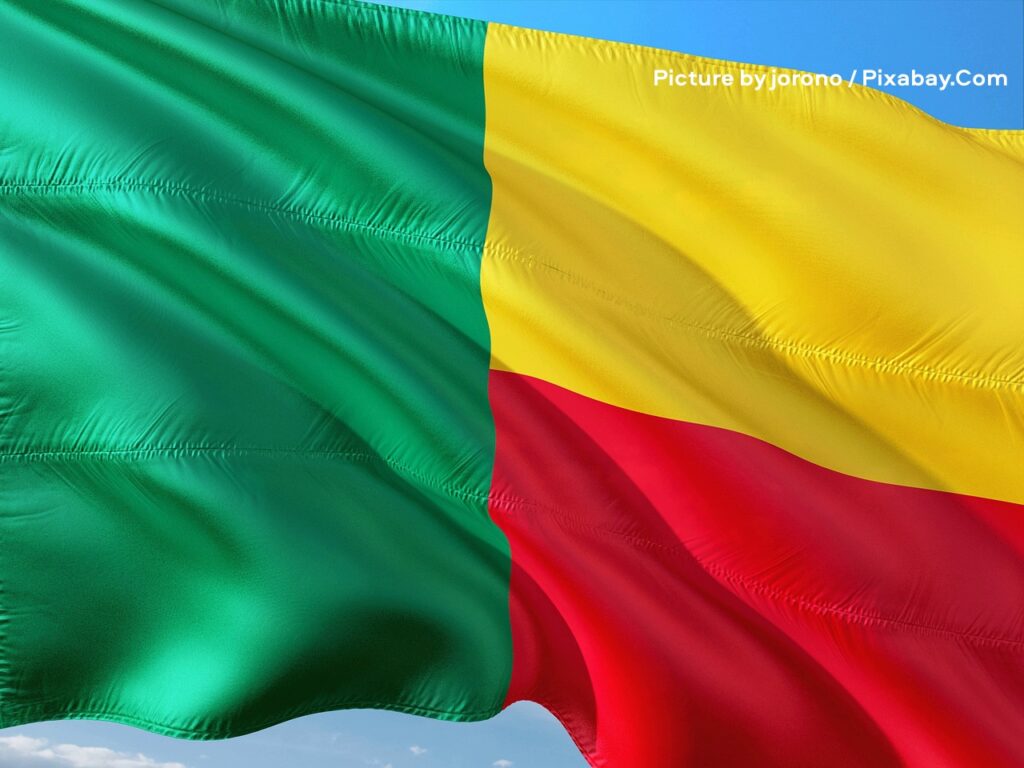
A vibrant national flag of Benin waves gracefully in the wind against a clear blue sky, featuring three bold vertical stripes of emerald green on the left, bright yellow in the upper portion on the right, and vivid red filling the lower section, with realistic fabric folds and ripples capturing the motion of the breeze. Picture by jorono / Pixabay.Com.
Geography and climate
Benin is a narrow, north-south strip of land extending about 675 km (420 miles) from the Gulf of Guinea in the south to the Niger River in the north. It covers an area of approximately 114,763 km² (44,310 sq mi). Borders include Togo to the west, Nigeria to the east, Burkina Faso to the northwest, and Niger to the northeast.
The terrain varies: a flat coastal plain with lagoons and sandbanks in the south, transitioning to plateaus and savannas in the central and northern regions. The climate is tropical, with a rainy season (April–October) and a dry season. The south is more humid, while the north is drier and hotter.
Capital and major cities
- Official capital: Porto-Novo, located in the southeast near the Nigerian border. It serves as the formal seat of the presidency, National Assembly, and constitutional court. A relatively small but historic city with a population of around 300,000, it features well-preserved colonial-era architecture, colorful markets, and cultural landmarks such as the Porto-Novo Royal Palace. It retains a quieter, more traditional atmosphere compared to the commercial bustle of the south.
- De facto administrative and economic capital: Cotonou, the largest city in Benin with over 1 million residents. Situated on a narrow strip between the Atlantic Ocean and an inland lagoon, it functions as the country’s true economic heart. It is home to the chief port (Port of Cotonou), the international airport, major government ministries, businesses, and vibrant markets like Dantokpa (also known as Tokpa or Marché Dantokpa). One of West Africa’s largest open-air markets, Dantokpa sprawls across approximately 20 hectares (about 50 acres) and is often described as a “city within a city.” It features thousands of vendors (estimates exceed 35,000) selling everything from fresh produce, spices, and live animals to clothing, electronics, household goods, and traditional items. The market attracts around a million buyers daily and generates a massive commercial turnover of over one billion CFA francs per day. Located along the lagoon, it buzzes with activity from boats, motorcycles, and traders, serving as a vital hub for local commerce and regional trade.
Population and demographics
Benin has a population of around 13–14 million, growing rapidly. It is one of Africa‘s most ethnically and linguistically diverse nations, with over 40 ethnic groups and 50+ languages.
Major groups include:
- Fon (largest, in the south)
- Adja, Yoruba, Goun, Bariba, Fulani, and Somba
French is the official language (used in government and education). Indigenous languages like Fon, Yoruba, Bariba, and others are widely spoken.
Christianity in Benin
Christianity is the predominant religion in Benin, practiced by approximately 48–53% of the population according to recent estimates and census data. It is especially strong in the southern and coastal regions, including major urban centers like Cotonou and Porto-Novo, where missionary activities first took root and where the majority of churches and Christian institutions are concentrated.
Roman Catholicism represents the largest Christian denomination, accounting for more than half of all Christians in the country, followed by various Protestant and independent African-initiated churches. The Catholic Church maintains a strong presence through dioceses, cathedrals (such as Notre Dame des Apôtres in Cotonou), and numerous parishes.
Christianity plays a vital role in daily life, shaping family values, moral frameworks, and community interactions. Churches serve as important social hubs where believers gather for worship, prayer meetings, and fellowship. The faith has had a profound influence on education, with Christian missions historically establishing many schools that continue to provide quality instruction and contribute to literacy and personal development. In healthcare and social services, Christian organizations run hospitals, clinics, orphanages, and charitable programs that support vulnerable populations.
Festivals, youth groups, choirs, and outreach initiatives further embed Christianity into the cultural fabric, fostering a vibrant expression of faith that blends devotion with communal solidarity. Overall, the religion remains a cornerstone of social cohesion and personal identity for millions of Beninese citizens.
Life expectancy is around 60–63 years. Most people live in the south, with agriculture supporting much of the rural population.
History
The region was home to powerful kingdoms, most notably the Kingdom of Dahomey (17th–19th centuries), known for its organized military (including the famous Dahomey Amazons), centralized administration, and involvement in the trans-Atlantic slave trade. The historical Kingdom of Benin (in present-day Nigeria) is distinct but shares cultural ties in the broader region.
France colonized the area in the late 19th century as part of French West Africa. It became independent as the Republic of Dahomey on August 1, 1960. After periods of political instability and a Marxist-Leninist regime (1975–1990, when it was renamed Benin), it transitioned to multiparty democracy in 1990–1991.
Government and politics
Benin is a multiparty republic with a president as head of state and government, and a National Assembly. It has been praised for its democratic stability in West Africa, though it continues to face challenges such as corruption, media restrictions, and border security.
Economy
Benin is a developing economy reliant on agriculture (cotton is a major export), subsistence farming, palm oil, and trade through the Port of Cotonou. It serves as a gateway for landlocked neighbors. Challenges include poverty, limited industrialization, and vulnerability to climate impacts, but there is potential in tourism, offshore oil, and regional trade.
Culture and tourism
Key attractions include:
- Royal Palaces of Abomey (UNESCO World Heritage site) — remnants of the Dahomey Kingdom with intricate bas-reliefs and history.
- Beaches and lagoons near Cotonou and Ouidah.
- Pendjari National Park (wildlife, though security concerns exist in northern border areas).
- Vibrant markets and colonial-era architecture.
Flag: A vertical green stripe on the hoist side with horizontal yellow (top) and red (bottom) bands on the fly side. Green symbolizes hope and agriculture; yellow represents wealth; red stands for courage and ancestors’ blood.
Benin faces ongoing security challenges from regional instability near its northern borders, but it continues to promote tourism by embracing its history. It remains a culturally rich, resilient nation blending tradition and modernity.
Benin offers a fascinating glimpse into West African heritage, from ancient kingdoms to its living Christian traditions. Whether for history, culture, or nature, it rewards visitors with depth and authenticity.


