
The Binturong (Arctictis binturong), often called the Bearcat, is neither a bear nor a cat. It is the largest living member of the civet family (Viverridae) and the only species in its genus. Despite belonging to the order Carnivora, it is a bulky, mostly fruit-eating mammal of South and Southeast Asia’s forests. Its range runs from Nepal, India, Bhutan, and Bangladesh through Myanmar, Thailand, Laos, Cambodia, Vietnam, and southern China, then south to Peninsular Malaysia, Sumatra, Java, and Borneo, and east to Palawan in the Philippines.
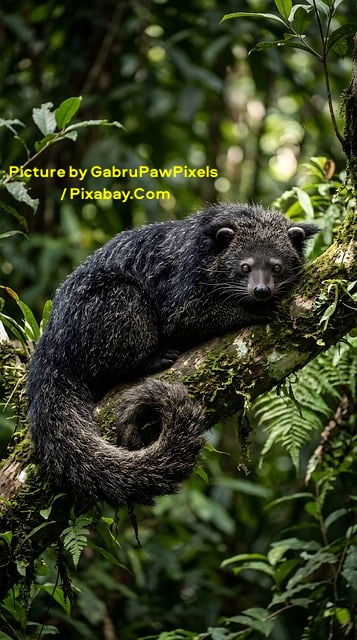
the photograph above captures a Binturong resting on a thick, moss-covered tree branch in the heart of a dense tropical forest, its dark shaggy fur blending with the shadows while its long bushy tail curls around the limb, the animal gazing calmly toward the viewer amid lush green foliage, hanging vines, and ferns that fill the background with layered depths of jungle greenery. Photograph by GabruPawPixels / Pixabay.Com.
| Genus | Arctictis |
| Species | A. binturong |
| Binomial Name | Arctictis binturong |
| Length | 60–96 cm (24–38 inches) |
| Tail Length | 50–90 cm (20–35 inches) |
| Weight | 9–15 kg (20–33 pounds) |
| IUCN Status | Vulnerable |
The animal is hard to mistake. A stocky body is covered in long, coarse black fur, often tipped with gray or white so that the coat looks grizzled. The ears are short and rounded, with tufts; the whiskers are long and pale. The tail is nearly as long as the head and body and is prehensile toward the tip, a rare trait among Old World carnivores. It is used as a fifth limb for climbing, bracing, and hanging in the canopy.
Head-and-body length is typically about 60–96 cm (24–38 inches), with the tail adding another 50–90 cm (20–35 inches). Wild adults usually weigh about 9–15 kg (20–33 pounds), though heavier animals occur and captives often grow much larger. Females are often reported to be larger than males.
Binturongs spend most of their time in trees. They are mainly nocturnal and crepuscular, but they are also seen by day, especially when feeding in fruiting figs. They climb well, yet they seldom leap from crown to crown; to change trees they often come down to the ground. On the forest floor they walk plantigrade, on the soles of the feet. They mark routes by dragging the hindquarters and tail, leaving a scent many people compare to buttered popcorn. That odor comes largely from 2-acetyl-1-pyrroline in the urine.
Diet is omnivorous but strongly frugivorous. Figs (Ficus) are the staple and, in some studies, account for most feeding sites; other fruits, shoots, and leaves make up much of the rest. Animal food is taken opportunistically: insects, earthworms, eggs, birds, small mammals, lizards, fish, and carrion. Seeds that pass through the gut, especially those of strangler figs, are scarified and often germinate more readily, so Binturongs are important seed dispersers in Asian forests.
In some areas they have been tamed and are said to make affectionate pets. The same familiarity feeds demand: animals are taken for the pet trade, hunted for meat or traditional medicine, caught in snares, and sometimes kept in civet-coffee operations.
The IUCN lists the species as Vulnerable. Populations have declined since the 1980s—an inferred drop of about 30 percent over three generations—despite a still-wide map range. In Indonesia and Malaysia the main pressures are deforestation and conversion of lowland forest to oil-palm plantations. Farther north, habitat loss is joined by hunting. The species is listed on CITES Appendix III (India) and is legally protected in several countries, but enforcement is uneven. Tall, connected forest remains essential if the Bearcat is to persist.


