
Spectacled Bear (Tremarctos ornatus), also known as the Andean Bear, is the only living bear species native to South America. It is the last surviving member of the short-faced bear subfamily (Tremarctinae) and is found along the Andes Mountains in northern and western South America. Classified as Vulnerable by the IUCN, the species faces ongoing threats from habitat loss, fragmentation, and human conflict.
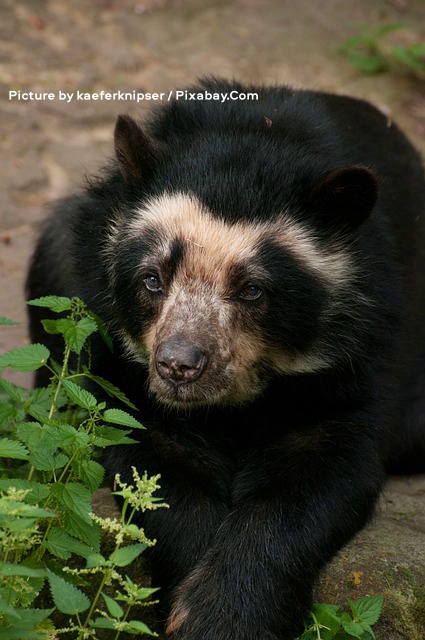
The image above shows a majestic Spectacled Bear with thick black fur and striking cream-colored facial markings rests calmly on the ground, its body angled slightly while its head is turned toward the viewer, revealing deep brown eyes and a dark snout. The bear’s front paw extends forward near lush green plants with small leaves and flower clusters in the foreground, set against a natural earthy backdrop. Picture by kaeferknipser / Pixabay.Com.
Names and etymology
The common name “Spectacled Bear” comes from the distinctive light-colored (beige or ginger) markings on its face, neck, and upper chest, which in some individuals resemble eyeglasses. It is also called the Andean Bear due to its range.
The scientific name Tremarctos ornatus reflects its anatomy and appearance: Tremarctos derives from Greek words meaning “hole bear,” referring to a unique opening in the humerus bone, while ornatus (Latin for “decorated”) highlights its facial markings. Locally, it is known as jukumari, ukumari, or ukuku in Aymara and Quechua languages.
| Genus | Tremarctos |
| Species | T. ornatus |
| Binomial Name | Tremarctos ornatus |
| Weight | 35-222.5 kg (77-491 lb.) |
| IUCN Status | Vulnerable |
Physical characteristics
The Spectacled Bear is a medium-sized bear with shaggy fur that ranges from jet black to dark brown or reddish-brown. Most individuals display pale markings on the face and chest, though the exact pattern varies uniquely between bears, allowing for individual identification. Not all bears have prominent “spectacles.”
Males are significantly larger than females, often a third bigger in linear dimensions and up to twice the weight. Males typically weigh 100–200 kg (220–440 lb), averaging around 115 kg (254 lb), while females weigh 35–82 kg (77–181 lb), averaging about 65 kg (143 lb). This makes the species one of the most sexually dimorphic living bears, rivaling the Polar Bear (Ursus maritimus). A notably heavy captive male once reached 222.5 kg (491 lb).
Distribution and habitat
Spectacled Bears are primarily restricted to the tropical Andes, ranging through western Venezuela, Colombia, Ecuador, Peru, western Bolivia, and northwestern Argentina. Their elongated geographical distribution forms a narrow band roughly 200–650 km (120–400 mi) wide but extends more than 4,600 km (2,900 mi) in length from north to south. Rare individuals have been recorded spilling over into eastern Panama.
The species is found almost entirely in the Andes Mountains and is highly adaptable, occupying a remarkable variety of habitats and altitudes. Its elevational range spans from as low as 200–250 m (near sea level in some Peruvian areas) to over 4,750 m (15,600 ft) near or above the tree line, and occasionally up to 5,000 m or higher.
Key habitats include:
- Humid montane cloud forests — the preferred and most productive habitat, typically between 1,000 and 2,700 m (3,300–8,900 ft), depending on latitude. These forests provide abundant food and shelter, with wetter areas supporting greater plant diversity.
- High-altitude páramo grasslands and moorlands (above ~2,900–3,500 m), where bears forage for bromeliads and other vegetation.
- Other environments such as dry forests, scrub deserts, sub-montane and lowland forests, puna grasslands, and even coastal desert fringes in parts of Peru.
The best habitats are humid to very humid montane forests, which offer a rich supply of the tough, fibrous plants that form the bulk of the Spectacled Bear’s diet. Spectacled Bears are known to move seasonally between these habitat types (e.g., descending to lower forests or ascending to páramos) in response to food availability, although detailed seasonal movement patterns are still not fully understood. Before populations became fragmented over the last 500 years, the species demonstrated exceptional adaptability—one population on the Peru-Ecuador border historically utilized as wide a variety of habitats as brown bears do worldwide today.
Diet
Unlike most bears, Spectacled Bears are predominantly herbivorous, with meat making up only about 5–7% of their diet. They specialize in tough, fibrous plants that few other animals can exploit, including:
- Bromeliads (such as Puya, Tillandsia, and Guzmania)
- Cacti
- Palm nuts and unopened palm leaves
- Bamboo hearts
- Orchid bulbs
- Frailejones (Espeletia spp.)
- Fallen fruits
- Moss and tree bark (for the nutritious inner layer)
Their skull, jaw muscles (particularly the zygomaticomandibularis), and teeth are specially adapted for grinding and crushing vegetation—featuring blunt cusps and additional roots on the premolars. They also consume agricultural crops like corn, sugarcane, and honey. When food is plentiful, multiple bears may feed together peacefully.
Although primarily herbivorous, they are South America’s largest native land predator. They occasionally hunt or scavenge, preying on small animals (rodents, birds, arthropods) and, less commonly, larger prey such as deer, llamas, cattle, horses, or even adult Mountain Tapirs (Tapirus pinchaque). They use ambush tactics, pinning prey with their weight and claws, or drive animals off cliffs. They are sometimes blamed for livestock deaths, but they frequently scavenge carrion rather than kill healthy animals.
Reproduction and life cycle
In the wild, mating can occur year-round but peaks in April–June, coinciding with fruit ripening at the start of the wet season. Pairs stay together for 1–2 weeks, engaging in playful courtship and multiple copulations.
Births typically occur during the dry season (December–February). Gestation lasts 5.5–8.5 months. Litters usually consist of 1–3 cubs (average 2), each weighing 300–330 g at birth. Cubs are born blind and remain in a den for 3–4 months until they can see and walk. Mothers provide milk for about a year and continue caring for the young for another year.
Cubs stay with their mother for roughly two years. Sexual maturity is reached at 4–7 years, with females usually producing their first litter around age 5. Wild Spectacled Bears can live about 20 years on average. Litter size correlates with maternal weight and food availability.
Threats and conservation
The primary threats to Spectacled Bears are habitat loss and fragmentation caused by agricultural expansion (including cattle grazing and illicit crops), logging, road construction, mining (legal and illegal), oil exploration, and urban development. These pressures have severely fragmented populations, especially in Venezuela, Colombia, Ecuador, and Argentina, leading to small, isolated groups that are more vulnerable to local extinction and reduced genetic diversity.
Human-bear conflict is another major issue: as natural food sources decline, bears increasingly raid crops (such as corn) or livestock, resulting in retaliatory killing. Poaching for trophies, the pet trade, traditional medicine or cultural beliefs, and subsistence hunting also contributes significantly—estimates suggest around 200 bears may be killed annually in parts of the northern Andes. Overall population estimates vary but suggest fewer than 18,000–20,000 individuals remain in the wild, with a continuing declining trend.
Protected areas currently cover only a limited portion of the species’ range, and many are too small or poorly managed to support viable populations. Legislation protecting the species exists across its range countries but is often weakly enforced.
Conservation efforts focus on several key strategies. Organizations such as the Spectacled Bear Conservation Society (SBC) in Peru conduct research (including GPS collaring), purchase and protect critical private lands (e.g., nearly 2,000 acres in recent years), engage local communities through education and economic incentives, and support habitat restoration. National action plans, environmental education programs, and community stewardship initiatives (notably in Venezuela and Colombia) have raised awareness and established the Andean Bear as a flagship species. International bodies like the IUCN recommend expanding protected areas and habitat corridors, improving monitoring of populations and threats, stronger enforcement against poaching, and greater involvement of local residents in conservation.
Recent studies highlight the importance of well-managed protected areas (e.g., in Bolivia) and emphasize the need for landscape-level approaches that connect habitats and reduce human-wildlife conflict. Ongoing research, camera-trapping, and community-based programs continue to provide hope for this unique South American bear.
Here is the link to the Spectacled Bear Conservation Society (SBC)


