
The Hyacinth Macaw(Anodorhynchus hyacinthinus) is a new world parrot classified in the order Psittaciformes and the family Psittacidae. The Hyacinth Macaw is the largest macaw in the world and is also the heaviest parrot capable of flying. Hyacinth Macaws are social birds that live in families, bands or groups. They are rarely found alone in the wild.
Physical Characteristics
Adult Hyacinth Macaws are cobalt blue throughout. The undersides of the flight feathers and tail are gray. Hyacinth Macaws have a bare yellow eye ring and a yellow strip at the base of the lower mandible; the bill is black. A Hyacinth Macaw’s tongue is black and yellow.
| Length | 90 cm-1 m(2’11”-3’3”) |
| Wingspan | 1.2-1.5 m(3’11”-4’11”) |
| Weight | 1.4-1.7 kg(3-4 lbs.) |
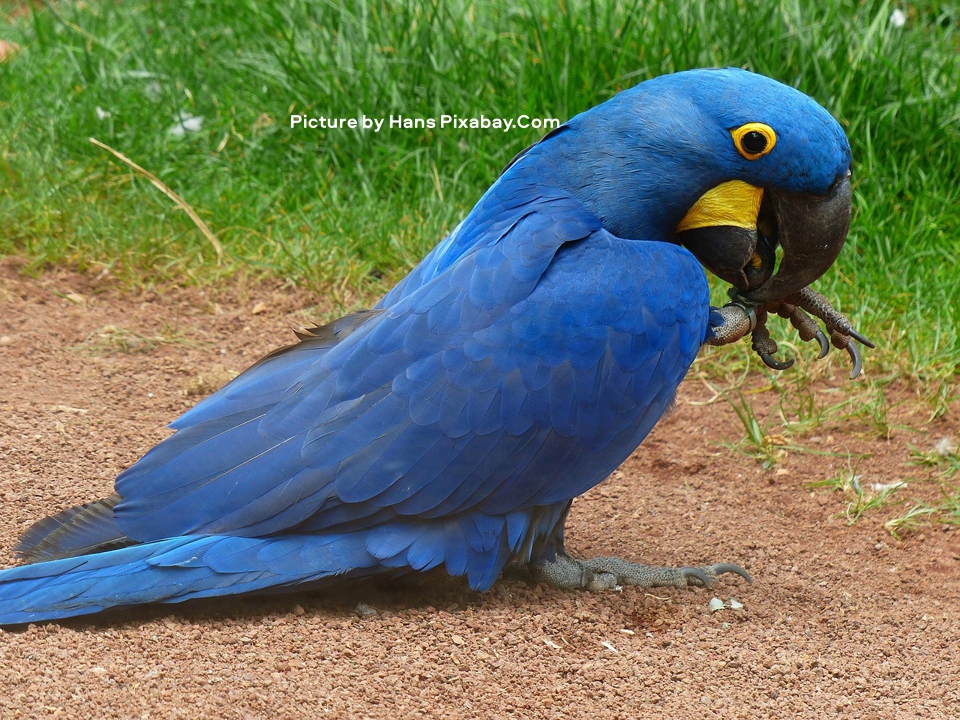
A striking Hyacinth Macaw with vibrant cobalt-blue plumage sits on a patch of brown dirt, its body angled slightly to the right as it lifts one gray foot toward its large, dark beak in a grooming or feeding gesture. The bird features a bright yellow patch of bare skin around the base of its beak and encircling its dark eye, with long tail feathers extending behind it against a backdrop of lush green grass. Picture by Hans / Pixabay.Com.
Range
From NC to SC Brazil, ranging into extreme E Bolivia and NW Paraguay. The Hyacinth Macaw is a year-round resident throughout its range.
Habitat
The Hyacinth Macaw inhabits tropical moist lowland forests, palm savannas, gallery forests, and areas where there are Mauritia palm trees.
Breeding
The Hyacinth Macaw usually nests in a tree cavity. The chosen tree is found in the Amazon. Sometimes pairs nest in cliffs; the pairs that nest in cliffs are found in NE Brazil. The clutch size is 2-3 eggs; the incubation period is 27-30 days. The Hyacinth Macaw reaches sexual maturity at 10 years old.
Diet
Hyacinth Macaws eat palm nuts, seeds, fruits, and Pomacea snails.
Predators
Toucans, corvids, possums and coatis prey on the Hyacinth Macaw’s eggs.
Conservation Status
The Hyacinth Macaw is listed as vulnerable.
Fun Facts
- Even though Hyacinth Macaws are native only to South America; the Hyacinth Macaw has been illustrated on postage stamps of India.
- Hyacinth Macaws can be seen at The Caiman Ecological Refuge, Miranda, Mato Grosso do Sul, Brazil.
- The Hyacinth Macaw Project maintains viable populations of Hyacinth Macaws in their South American habitats.
- The Hyacinth Macaw can live for up to 50 years.


