
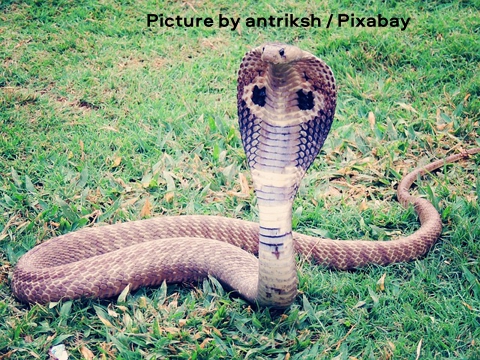
The image depicts a Spectacled Cobra (Naja naja) in a defensive posture, with its hood fully flared and head raised. The snake’s hood features distinctive eye-like markings that resemble a pair of spectacles, which is characteristic of this species. Its body is coiled on lush green grass, with a brownish-gray scaled pattern along its length. The background is a simple grassy field, and there’s a small credit overlay in the top-left corner reading “Picture by antriksh/Pixabay.” The overall tone is natural and vibrant, capturing the snake in a striking, alert pose.
Reptiles: diverse and fascinating vertebrates
Reptiles are a remarkably diverse group of vertebrates, distinguished by their backbones and dry, scaly skin. From the massive dinosaurs that dominated the Earth millions of years ago to today’s surviving species, reptiles have long captivated our imagination. The primary living groups include turtles, snakes, lizards, and crocodiles.
The physiology of reptiles
Unlike mammals and birds, which maintain a constant internal body temperature, reptiles are ectothermic, or “cold-blooded.” This means they rely on external sources to regulate their heat. Without fur, feathers, or sweat glands, reptiles bask in the sun to warm up or seek shade to cool down.
How reptiles breathe
All reptiles breathe using lungs, but their methods vary due to their diversity. Most lack a secondary palate, requiring them to hold their breath while swallowing—except for crocodiles. Crocodiles’ bony secondary palate enables them to breathe underwater and shields their brains from injury during struggles with prey or threats.
Turtles, with their rigid shells that don’t expand or contract, have adapted unique mechanisms. Some use a muscular sheet to exhale by contracting it or retracting it into their body cavity to expel air.
Reproduction
Most reptiles lay eggs in nests, burying them in soil or sand to keep them dry, and return when they hatch. However, boas give birth to live young. Protective behaviors include pythons and mud snakes coiling around their eggs and alligator mothers carrying hatchlings in their mouths.
Temperature-dependent sex determination
In species like turtles and crocodiles, the sex of offspring is determined by egg incubation temperature (TDSD). For certain turtles, warmer temperatures yield females, cooler ones produce males, and intermediate levels result in a mix. Conversely, crocodiles develop females at cooler temperatures and males at warmer ones.
Skin
Reptiles’ dry, scaly skin, topped with a horny epidermis, suits terrestrial life. Lacking a thick dermal layer like mammals, their skin is relatively fragile. Snakes’ exposed areas are reinforced by scales with bony bases, forming natural armor.
Shedding
Reptiles shed their skin throughout life via ecdysis to accommodate growth and wear. Young reptiles shed every 5-6 weeks due to rapid development, while adults do so 3-4 times annually. The process involves lymphatic fluid separating the old skin from a new layer beneath, allowing the old one to slough off.
Food and digestion
Did you know most reptiles are carnivorous or insectivorous? Their digestion is slower than mammals’, but they efficiently break down meat. Reptilian jaws are designed for tearing rather than chewing. Some herbivores, like certain turtles, swallow rocks to grind vegetation in their stomachs.
Defense tactics
Snakes and lizards face threats from birds and other reptiles, so evasion is key. Common strategies include camouflage and other adaptive behaviors.
Camouflage
Many reptiles blend into environments with green, gray, or brown hues and can stay motionless for extended periods. When threatened, turtles, snakes, and crocodiles may hiss, while rattlesnakes rattle their tails.
Defense in snakes
Snakes employ evolved tactics like raising their heads and flaring neck skin to appear larger. If needed, venomous species like vipers or cobras strike with venom as a final defense.
Crocodile defense mechanisms
Crocodiles intimidate with exposed teeth, followed by hissing and body inflation to seem bigger. Their ultimate weapon is a powerful bite.
Lizard escape plan
Some lizards detach their tails when grabbed by predators; the wriggling tail distracts while the lizard flees. Regrown tails are often shorter and differently colored.
Reptiles are intelligent creatures
Despite smaller brains than mammals, reptiles demonstrate surprising smarts. They solve complex problems, retain memories, and match birds and mammals in cognitive abilities. Socially adept, they recognize kin, care for offspring, and show play, cooperation, and learning from others.


