
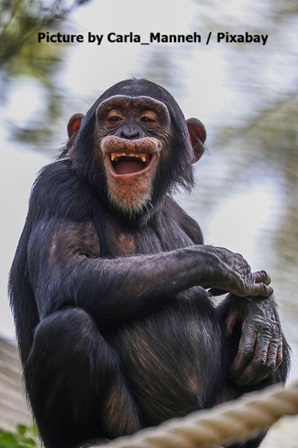
The image shows a close-up portrait of an adult Chimpanzee (Pan troglodytes) sitting on a rope or branch in an outdoor setting, likely a zoo or sanctuary. The Chimpanzee has dark black fur with some graying around the face and beard area, giving it a distinguished, older appearance.It is displaying a wide, open-mouthed “smile” that reveals its teeth — a classic Chimpanzee play face or laugh expression, often seen when they’re excited, happy, or engaging in social play. The eyes are squinted slightly due to the broad grin, adding to the joyful and almost human-like expression.The background is softly blurred (bokeh effect) with green and light tones, suggesting trees or foliage, and the lighting is natural daylight. The photo has a warm, lively feel and captures a moment of pure primate joy.Credit in the corner: “Picture by Carla_Manneh / Pixabay”
What is a mammal? A clear guide to their defining traits and diversity
Mammal species include some of the largest animals on Earth, from towering elephants to colossal Blue Whales (Balaenoptera musculus). But what exactly makes an animal a mammal? The simplest answer is: you. Humans (Homo sapiens) are mammals. Yet that single fact only scratches the surface. At its core, a mammal is a vertebrate whose young are nourished with milk produced by the mother’s mammary glands—a feature reflected in the very name “mammal,” derived from the Latin mamma, meaning “breast.”
While milk production is the hallmark trait, several other characteristics set mammals apart from all other animals. Let’s explore the seven key features that define this remarkable group, how mammals reproduce, and the incredible variety of environments they conquer.
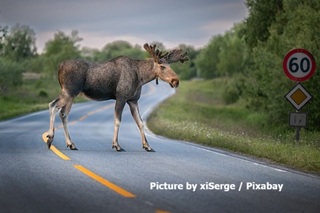
The photograph shows a large adult Moose (Alces alces) standing in the middle of a rural paved road, calmly walking toward the camera. The Moose is centered on the yellow centerline, with its massive palmate antlers fully visible and its thick brown fur slightly wet, suggesting recent rain or morning dew.The road curves gently to the right, bordered by lush green forest on both sides. On the right side of the image, two road signs are visible: a round speed-limit sign displaying “60” (likely 60 km/h) and a smaller yellow diamond-shaped warning sign with a black Moose symbol, indicating a Moose-crossing area.The lighting is soft and overcast, giving the scene a peaceful, early-morning or late-afternoon feel. The overall mood is serene yet slightly humorous—classic “only in Canada” wildlife moment.Credit in the corner: “Picture by xiSerge / Pixabay”
The seven defining characteristics of mammals
Biologists rely on shared traits to classify life, and mammals stand out thanks to the following seven features (with rare exceptions):
- Hair or fur
Every mammal has hair at some point in its life. Blue Whales may lose most of it as adults, but they’re born with it. Hair insulates, camouflages, senses the environment, and even protects skin. - Warm-blooded (endothermic)
Mammals maintain a constant internal body temperature regardless of external conditions—a huge evolutionary advantage that allows activity in cold climates and at night. - Live birth and milk nourishment
Most mammals give birth to live young and feed them milk from mammary glands. (Two small groups—monotremes and some marsupials—bend this rule, as we’ll see.) - Three middle-ear bones
The malleus, incus, and stapes (ossicles) transmit sound more efficiently than the single bone found in reptiles and birds, contributing to keen hearing. - Highly developed brain with a neocortex
Mammals possess the most complex brains in the animal kingdom. The neocortex handles advanced sensory processing, memory, planning, and problem-solving—explaining why mammals display remarkable intelligence and behavioral flexibility. - Four-chambered heart
Shared with birds, this efficient pump completely separates oxygen-rich and oxygen-poor blood, supporting high metabolic demands. - Single lower jawbone (dentary)
Unlike reptiles, which have multiple jaw bones, mammals have one robust dentary bone. This design delivers powerful bites and specialized teeth for tearing meat, grinding plants, or filtering krill.
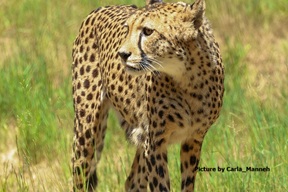
The image captures a striking side profile of an adult Cheetah (Acinonyx jubatus) standing poised and alert in a sunlit grassland. Its sleek, muscular body is covered in a golden-yellow coat densely patterned with solid black spots, and the iconic black tear marks streak from the inner corners of its amber eyes down the sides of its muzzle to the mouth. The Cheetah’s small, rounded head turns slightly toward the horizon, ears perked forward, giving it an expression of intense focus.Its long, powerful legs are built for explosive speed, with the front leg closest to the camera lifted just off the ground as though frozen mid-stride. A faint ridge of slightly longer hairs runs along the back of its neck, and the tip of its tail—partially visible—shows the characteristic rings of black near the end. The background is a soft blur of green grass and foliage, keeping the Cheetah in razor-sharp focus under bright natural daylight. The scene radiates the raw elegance and quiet tension of an African savanna predator ready to sprint at a moment’s notice. A small credit in the corner reads “Picture by Carla_Manneh.”
Three ways mammals reproduce
Mammals fall into three reproductive categories:
- Placental mammals (Eutheria) – ~95% of species
The fetus develops inside the mother, nourished via a placenta. Babies are born relatively mature and mobile. Examples: Humans, Blue Whales, African Savanna Elephants (Loxodonta africana), bats, Domestic Dogs (Canis familiaris), House Mice (Mus musculus). - Marsupials (Metatheria)
Young are born tiny and immature, then crawl into a pouch where they attach to a teat and continue developing. Famous examples: Red Kangaroos (Macropus rufus), Koalas (Phascolarctos cinereus), Common Wombats (Vombatus ursinus), Virginia Opossums (Didelphis virginiana), Tasmanian Devils (Sarcophilus harrisii). - Monotremes (Prototheria) – only 5 living species
These egg-laying mammals hatch their young and nurse them with milk (secreted onto the belly rather than through teats). The Platypus (Ornithorhynchus anatinus) and four echidna species (Short-beaked Echidna Tachyglossus aculeatus; Long-beaked Echidnas Zaglossus bruijnii, Z. bartoni, Z. attenboroughi), all native to Australia and New Guinea, are the sole survivors of this ancient lineage.
Where mammals live: from ice caps to treetops
Thanks to their warm-blooded metabolism, versatile diets, and intelligence, mammals have colonized every continent, including Antarctica, and nearly every habitat:
- Terrestrial
Land-dwellers dominate: Gray Wolves (Canis lupus), Bengal Tigers (Panthera tigris tigris), European Rabbits (Oryctolagus cuniculus), Pronghorns (Antilocapra americana), Humans. - Aquatic & semi-aquatic
Fully aquatic: Blue Whales, Common Bottlenose Dolphins (Tursiops truncatus), West Indian Manatees (Trichechus manatus).
Semi-aquatic: Harbor Seals (Phoca vitulina), North American River Otters (Lontra canadensis), North American Beavers (Castor canadensis), Common Hippopotamuses (Hippopotamus amphibius), Greater Capybaras (Hydrochoerus hydrochaeris), Pyrenean Desmans (Galemys pyrenaicus). - Arboreal
Tree specialists: Lar Gibbons (Hylobates lar), Sumatran Orangutans (Pongo abelii), Koalas (Phascolarctos cinereus), Three-toed Sloths (Bradypus spp.), Goodfellow’s Tree-Kangaroos (Dendrolagus goodfellowi), Eastern Gray Squirrels (Sciurus carolinensis), Ring-tailed Lemurs (Lemur catta), Eastern Black-and-white Colobus Monkeys (Colobus guereza), Geoffroy’s Spider Monkeys (Ateles geoffroyi). - Aerial
Bats—the only mammals capable of powered flight—number over 1,400 species and fill night skies worldwide. - Fossorial (underground)
European Moles (Talpa europaea), Naked Mole-Rats (Heterocephalus glaber), and Eastern Pocket Gophers (Geomys spp.) spend most of their lives tunneling.
From the 200-tonne (440,000 lb) Blue Whale to the 2-gram (0.07 oz) Kitti’s Hog-nosed Bat (Craseonycteris thonglongyai), from Polar Bears (Ursus maritimus) in the Arctic to Fennec Foxes (Vulpes zerda) in the Sahara, mammals demonstrate extraordinary adaptability. Roughly 6,400 species roam Earth today, making them one of the most successful vertebrate groups in history.
In short, if it has hair, nurses its young with milk, and possesses those seven signature traits, you’re looking at a mammal—one of evolution’s most versatile and enduring creations.


