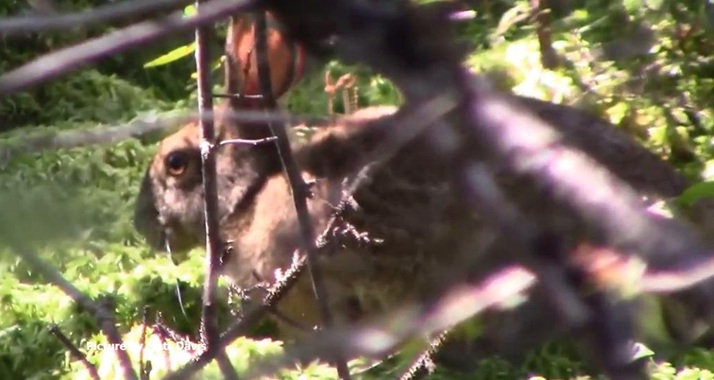
This is a beautiful shot of a Snowshoe Hare (Lepus americanus) captured on one of the trails at the Memorial University of Newfoundland Botanical Garden in St. John’s, Newfoundland and Labrador, Canada.The hare is in its summer coat: a rich mottled brown with hints of gray and russet, perfectly blended into the mossy forest floor. Its large hind foot is just visible, black-tipped ears are laid back, and that big, dark eye peers directly through the fence with a mix of curiosity and wariness.Dappled sunlight filters through the trees, lighting up the lush green ferns and undergrowth typical of Newfoundland’s boreal trails in late spring or summer. The chain-link fence adds a subtle barrier that emphasizes how close—yet still wild—these hares remain, even in the heart of the MUN campus area.Picture by Matt DavisClassic Newfoundland wildlife moment, perfectly framed. Thanks for the correction and for sharing this gem from the garden trails!
Rabbits and hares belong to the family Leporidae, a diverse group of lagomorph mammals that includes about 60 species worldwide. These charming animals range in size from the tiny Pygmy Rabbit (Brachylagus idahoensis), which weighs just 1.4 lbs (0.6 kg), to the sturdy Arctic Hare (Lepus arcticus), reaching up to 11 lbs (5 kg). Interestingly, female leporids are typically larger than males—a rare trait among mammals.Though often confused, rabbits and hares are distinct:
- True hares (genus Lepus) include hares and jackrabbits.
- All other species are classified as rabbits.
Hares are built for endurance and speed, with long, powerful muscle fibers and larger bodies. Rabbits, in contrast, excel at short bursts of speed and digging, with shorter limbs and compact muscles.
What do rabbits and hares look like?
Leporids are instantly recognizable by their long hind legs, large ears, and short, bushy tails. Key features include:
- Ears: Vary dramatically by species—up to 17 cm (6.7 in) in the Antelope Jackrabbit (Lepus alleni).
- Fur: Ranges from brown, gray, and black to pure white. Wild species usually have muted, camouflaged coats, while domestic rabbits often sport spots or bold patterns.
- Seasonal coats: Many high-latitude species (like the Snowshoe Hare) turn white in winter for camouflage, molting back to brown or gray in spring.
- Feet: Hairy soles for traction; long, slightly curved claws.
- Tail: 1.5–12 cm (0.6–4.7 in) long, sometimes brightly marked (e.g., white underside in cottontails).
Where do they live?
Leporids inhabit nearly every corner of the globe except:
- Southern South America
- The West Indies
- Madagascar
- Most islands southeast of Asia
They were introduced by humans to Australia and New Zealand, where feral European rabbits famously became invasive.
Habitat preferences
- Hares: Thrive in open landscapes—tundra, grasslands, deserts—where they rely on speed and camouflage among rocks and shrubs.
- Rabbits: Prefer dense vegetation, forests, or wetlands. Many dig complex burrow systems (warrens); species like marsh and swamp rabbits are strong swimmers and semi-aquatic.
How do they behave?
Constant predation pressure has shaped their survival strategies:
- Rabbits: Quick dashes to nearby cover or burrows. Smaller home ranges, often just around their warren.
- Hares: Long-distance runners with larger territories. They “box” during mating season and freeze or bolt when threatened.
Many rabbits live in social groups in warrens; most hares are solitary except when breeding.What Do They Eat? Leporids are strict herbivores and opportunistic feeders. Their diet includes:
- Grasses and clovers (primary foods)
- Herbs, buds, twigs, and tree bark
- Fruits, seeds, and roots
- Occasionally garden veggies (broccoli, brussels sprouts, etc.)
A unique adaptation: coprophagy. They produce soft, nutrient-rich fecal pellets (cecotropes) at night and re-eat them to extract maximum nutrition—essential for surviving on tough plant matter. Whether bounding across Arctic tundra or nibbling in a suburban garden, rabbits and hares remain some of nature’s most adaptable and endearing mammals.


