
The Red-breasted Nuthatch (Sitta canadensis) is a small, energetic songbird characteristic of North America’s coniferous and mixed forests. It is a common resident of boreal regions and the sole New World member of a broader Holarctic superspecies complex. The term Holarctic refers to the biogeographic region encompassing the northern continents of North America, Europe, and Asia—essentially the temperate and Arctic zones of the Northern Hemisphere. Despite its wide distribution across the continent, no subspecies are currently recognized in North America.
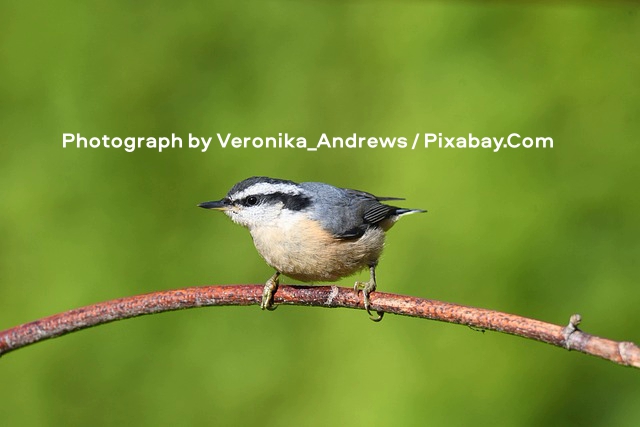
The photograph above captures a Red-breasted Nuthatch perched sideways on a slender reddish-brown branch, its body angled slightly toward the left with feet firmly gripping the bark. The bird displays blue-gray plumage across its back, wings, and short tail, contrasted by a clean white face marked by a bold black stripe running through the eye and a pale supercilium above it, while the underparts show soft buffy-orange tones fading toward the belly. Its slender pointed bill points leftward, and the legs appear pale and sturdy against the textured branch that curves gently across the lower frame. Soft natural light illuminates the subject evenly, highlighting fine feather details, while the background dissolves into a smooth out-of-focus wash of green foliage that isolates the bird and branch. A white text overlay reading “Photograph by Veronika_Andrews / Pixabay.Com” stretches across the upper portion of the frame.
| Genus | Sitta |
| Species | S. canadensis |
| Binomial Name | Sitta canadenis |
| Length | about 11 cm (4.3 inches) |
| Weight | 8–13 g (0.3–0.5 oz) |
| Wingspan | 18–20 cm (7.1–7.9 inches) |
| IUCN Status | Least Concern |
Adults measure about 11 cm (4.3 inches) in length, weigh 8–13 g (0.3–0.5 oz), and have a wingspan of 18–20 cm (7.1–7.9 inches). They belong to the order Passeriformes and the nuthatch family Sittidae. The species is instantly recognizable by its bold black-and-white head pattern, rusty-red underparts, and blue-gray upperparts, along with its distinctive habit of hitching headfirst down tree trunks while probing bark crevices.
Range, habitat, and movements
Red-breasted Nuthatches inhabit coniferous and mixed forests across Canada, Alaska, and much of the northern and mountainous western United States. In recent decades, the breeding range has expanded southward, aided by the growth of conifer plantations in the southeastern United States and southern Canada that provide suitable habitat.
The species is unique among North American nuthatches in undertaking regular irruptive movements. These southward invasions are driven primarily by shortages of winter food (especially conifer seeds) on the breeding grounds. In major irruption years, large numbers reach uncharacteristic habitats as far south as the Gulf Coast of Louisiana and the desert washes of northern Mexico. Its propensity for long-distance travel also makes it the only North American nuthatch recorded as a vagrant in Europe.
Foraging and behavior
Diet consists of insects, spiders, and seeds. Like other nuthatches, Red-breasted Nuthatches climb head-down on trunks and branches, extracting prey from bark crevices. In winter they cache seeds for later use and readily join mixed-species foraging flocks. They are frequent and bold visitors to bird feeders.
Breeding and nesting
Breeding pairs typically excavate their own nest cavities in tree snags and only rarely occupy existing holes or nest boxes. A distinctive feature of their nests is the heavy application of sticky conifer resin around the entrance. Adults collect resin from live trees and smear it on the cavity rim throughout incubation and the nestling period, apparently as a deterrent to predators and competitors.
Clutch size ranges from 2 to 8 eggs. The eggs are white, creamy, or pinkish-white and speckled with reddish brown. Only the female incubates, for 12–13 days. Nestlings remain in the cavity for up to 21 days. Hatchlings are naked and helpless (altricial). Both parents feed the young, which receive an exclusively insect diet. Early in the nestling period the adults enter the cavity to deliver food; later they often pass food from the entrance as the young grow larger. Parents may forage together or separately. At the cavity entrance the female sometimes behaves aggressively toward the male, jabbing at him with her bill. Occasionally both adults arrive simultaneously with food and enter the cavity together.
In winter, Red-breasted Nuthatches continue to associate with mixed-species flocks and remain conspicuous at feeders, their nasal “yank-yank” calls a familiar sound in conifer woods.


