
The Ocelot (Leopardus pardalis) is a medium-sized spotted wild cat that reaches 40–50 cm (16–20 in) at the shoulders and weighs between 7 and 16 kg (15 and 35 lb) on average. It is native to the southwestern United States, Mexico, Central and South America, and the Caribbean islands of Trinidad and Margarita. Carl Linnaeus scientifically described it in 1758. Two subspecies are recognized: the northern subspecies Leopardus pardalis pardalis, which ranges from Texas and Arizona south through Mexico and Central America to Costa Rica and tends to have greyer fur, and the southern subspecies Leopardus pardalis mitis, which occurs throughout much of South America as far south as northern Argentina and is generally larger with more yellowish fur.
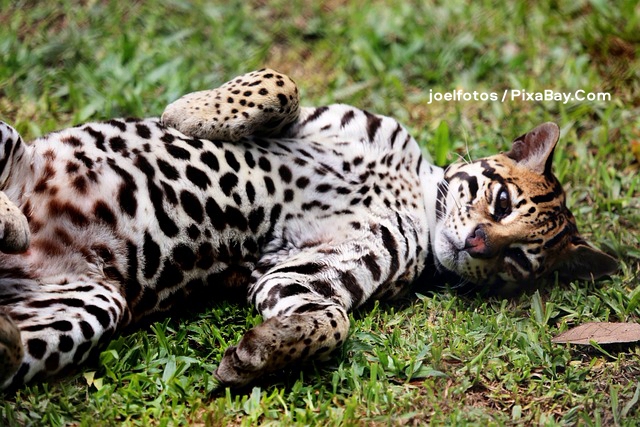
the photograph above shows an Ocelot (Leopardus pardalis), lying on its back amid lush green grass with its paws raised and curled in a relaxed pose, its white underbelly and distinctive black rosette patterns clearly visible against the soft outdoor lighting as it gazes toward the viewer with alert eyes and a slightly open mouth. Photograph by joelfotos / Pixabay.Com.
| Genus | Leopardus |
| Species | L. pardalis |
| Binomial Name | Leopardus pardalis |
| Length | 40–50 cm (16–20 in) |
| Weight | 7-16 kg (15-35 lb) |
| IUCN Status | Least Concern |
The Ocelot is efficient at climbing, leaping, and swimming. It prefers areas close to water sources with dense vegetation cover and high prey availability. It preys on small terrestrial mammals such as Nine-banded Armadillos (Dasypus novemcinctus), North American Opossums (Didelphis virginiana), and lagomorphs. It is typically active during twilight and at night and tends to be solitary and territorial. Both sexes become sexually mature at around two years of age and can breed throughout the year; peak mating season varies geographically. After a gestation period of two to three months, the female gives birth to a litter of one to three kittens. They stay with their mother for up to two years, after which they leave to establish their own home ranges.
The Ocelot is listed as Least Concern on the IUCN Red List and is threatened by habitat destruction, hunting, and traffic accidents. While its range is very large, various populations are decreasing in many parts of its range. The association of the Ocelot with humans dates back to the Aztec and Incan civilizations; it has occasionally been kept as a pet.
Etymology
The name “Ocelot” comes from the Nahuatl word ōcēlōtl (pronounced [oːˈseːloːt͡ɬ]), which generally refers to the Jaguar (Panthera onca), rather than the Ocelot. Another possible origin for the name is the Latin ocellatus (“having little eyes” or “marked with eye-like spots”), in reference to the cat’s spotted coat.
Other vernacular names for the Ocelot include cunaguaro (Venezuela), gato onza (Argentina), gato tigre (Panama), heitigrikati (Suriname), jaguatirica, maracaja (Brazil), manigordo (Costa Rica, Panama, and Venezuela), mathuntori, ocelote, onsa, pumillo, tiger cat (Belize), tigrecillo (Bolivia), and tigrillo (Colombia, Ecuador, Guatemala, and Peru).
Description
The Ocelot’s fur is extensively marked with solid black markings on a creamy, tawny, yellowish, reddish-gray, or gray background color. The spots on the head and limbs are small, but markings on the back, cheeks, and flanks are open or closed bands and stripes. A few dark stripes run straight from the back of the neck to the tip of the tail. Its neck and undersides are white, and the insides of the legs are marked with a few horizontal streaks. Its round ears are marked with a bright white spot. Its fur is short, about 0.8 cm (0.31 in) long on the belly, but with about 1 cm (0.39 in) long guard hairs on the back. The body has a notably strong odor. Each Ocelot has a unique color pattern, which can be used to identify individuals. Its eyes are brown but reflect in a golden hue when illuminated. It has 28 to 30 teeth, with the dental formula
3.1.2–3.1
3.1.2.1.
It has a bite force quotient at the canine tip of 113.8. Only one Ocelot is known to possess albinism, and the appearance of such a trait in Ocelots is likely an indication of shrinking populations due to deforestation.
With a head-and-body length ranging from 55 to 100 cm (22 to 39 in) and a 30 to 45 cm (12 to 18 in) long tail, the Ocelot is the largest member of the genus Leopardus. It typically reaches 40–50 cm (16–20 in) at the shoulder. The weight of females ranges between 7 and 12 kg (15 and 26 lb) and of males between 8 and 18 kg (18 and 40 lb). Its footprint measures nearly 5 cm × 5 cm (2.0 in × 2.0 in).
The Ocelot can be confused with the Margay (Leopardus wiedii) and the Oncilla (Leopardus tigrinus), though the Ocelot is noticeably larger and heavier with a shorter tail. Though all three have rosettes on their coats, the Ocelot typically has a more blotched pattern; the Oncilla has dark spots on its underbelly unlike the other two. Other differences lie in the facial markings, appearance of the tail, and fur characteristics. The Ocelot is similar in size to a Bobcat (Lynx rufus), though larger individuals have occasionally been recorded. The Jaguar is notably larger and heavier and has rosettes instead of spots and stripes.
Distribution and habitat
The Ocelot ranges from the southwestern United States to northern Argentina, up to an elevation of 3,000 m (9,800 ft). In the United States, it occurs in Texas and Arizona and is extirpated from Louisiana and Arkansas. Ocelot fossils have been found in Florida.
It inhabits tropical forests, thorn forests, mangrove swamps, and savannas. In the Amazon rainforest, it prefers habitats with availability of prey and water and tends to avoid other predators. It favors areas with dense forest cover and water sources, far from roads and human settlement, avoiding steep slopes and highly elevated areas. In areas where Ocelots coexist with larger predators such as Cougars (Puma concolor) and humans, they tune their active hours to avoid them and seek dense cover to avoid competitors. It can adapt well to its surroundings; as such, factors other than the aforementioned are not significant in its choice of habitat.
It shares a large part of its range with the Jaguar, Jaguarundi (Herpailurus yagouaroundi), Margay, Oncilla, and Cougar.
Behavior and ecology
The Ocelot is usually solitary and active mainly during twilight and at night. Radio-collared individuals in the Cocha Cashu Biological Station in Peru rested during the day and became active earliest in the late afternoon; they moved between 3.2 and 17 hours until dawn and then returned to their dens.
During the daytime, it rests on trees, in dens below large trees, or other cool, sheltered sites on the ground. It is agile in climbing and leaping and escapes predators by jumping into trees. It is also an efficient swimmer. It scent-marks its territory by spraying urine. The territories of males are 3.5–46 km² (1.4–17.8 sq mi) large, while those of females cover 0.8–15 km² (0.31–5.79 sq mi). Territories of females rarely overlap, whereas the territory of a male includes those of two to three females. Social interaction between sexes is minimal, though a few adults have been observed together even in non-mating periods, and some juveniles interact with their parents. Data from camera-trapping studies confirm that several Ocelot individuals deposit scat in one or several communal sites, called latrines. Ocelots can be aggressive in defending their territory, fighting even to death.
The population density of Ocelots has been observed to be high in areas with high rainfall but tends to decrease with increasing latitude; highest densities have been recorded in the tropics. In 2014, the Ocelot population density in Barro Colorado Island was estimated to be 1.59–1.74/km² (4.1–4.5/sq mi), greater than 0.984/km² (2.55/sq mi) recorded in northwestern Amazon in Peru in 2010, which was the densest Ocelot population recorded thus far.
Potential predators of Ocelot kittens in Texas include people, Cougars, Coyotes (Canis latrans), American Alligators (Alligator mississippiensis), Great Horned Owls (Bubo virginianus), Bobcats, Feral Dogs (Canis familiaris), Feral Pigs (Sus scrofa), crotalid pit vipers, and colubrid constrictors. Studies have found that adult Ocelots are vulnerable to predation by both Cougars and Jaguars, with decreasing water sources in Guatemala causing predatory encounters with the latter.
Hunting and diet
Ocelots have been observed to follow scent trails in search of prey, walking at a speed of about 0.3 km/h (0.2 mph). Alternatively, an Ocelot may wait for prey for 30 to 60 minutes at a certain site and move to another walking at 0.8–1.4 km/h (0.50–0.87 mph) if unsuccessful. An Ocelot typically prefers hunting in areas with vegetation cover, avoiding open areas, especially on moonlit nights, so as not to be seen by the prey. As a carnivore, it preys on small terrestrial mammals such as rodents, lagomorphs, Nine-banded Armadillos, and North American Opossums, as well as fish, crustaceans, insects, reptiles, and birds. It usually feeds on the kill immediately but removes bird feathers beforehand. It typically preys on animals that weigh less than 1 kg (2.2 lb) but rarely targets large ungulates such as deer, sheep, and peccaries, as well as anteaters, New World monkeys, and Green Iguanas (Iguana iguana). It requires 600–800 g (21–28 oz) of food every day to satisfy its energy requirements.
Primates prevail in the diet of Ocelots in southeastern Brazil and Green Iguanas in a tropical deciduous forest in Mexico. The composition of the diet varies by season; in Venezuela, Ocelots were found to prefer Green Iguanas and rodents in the dry season and then switch to land crabs in the wet season. In the Atlantic rainforest, Ocelots have a similar prey preference as Margays and Oncillas. In the Cerrado, an Ocelot was recorded dragging a dead calf.
Reproduction
Both male and female Ocelots produce a long-range “yowl” in the mating season and a short-range “meow.” Ocelots can mate any time during the year. The peak mating season varies geographically; in Argentina and Paraguay, peaks have been observed in autumn, and in Mexico and Texas in autumn and winter. Estrus lasts four to five days and recurs every 25 days in a non-pregnant female. A study in southern Brazil showed that sperm production in Ocelots, Margays, and Oncillas peaks in summer. When mating, captive Ocelots spend more time together, scent-mark extensively, and eat less.
The female gives birth to a litter of one to three kittens after a gestation period of two to three months. Dens are usually located in dense vegetation. A newborn kitten weighs 200–340 g (7.1–12.0 oz). The kitten is born with spots and stripes, though on a gray background; the color changes to golden as the Ocelot grows older. A study in southern Texas revealed that a mother keeps a litter in a den for 13 to 64 days and shifts the young to two or three dens. The kitten’s eyes open 15 to 18 days after birth. Kittens begin to leave the den at the age of three months. They remain with their mother for up to two years and then start dispersing and establishing their own territory. In comparison to other felids, Ocelots have a relatively longer duration between births and a narrow litter size. Captive Ocelots live for up to 20 years.
Threats and conservation
Throughout its range, the Ocelot is threatened by loss and fragmentation of habitat. In Texas, the fertile land that supports dense cover and constitutes the optimum habitat for the Ocelot is being lost to agriculture. The habitat is often fragmented into small pockets that cannot support Ocelots well, leading to deaths due to starvation. Traffic accidents have emerged as a major threat over the years, as Ocelots try to expand beyond their natural habitat to new areas and get hit by vehicles. In the Atlantic Forest in northeastern Argentina, it is affected by logging and poaching of prey species.
The Ocelot is listed as Least Concern on the IUCN Red List because of its wide distribution in the Americas. Ocelot hunting is banned in Argentina, Brazil, Bolivia, Colombia, Costa Rica, French Guiana, Guatemala, Honduras, Mexico, Nicaragua, Panama, Paraguay, Suriname, Trinidad and Tobago, the United States, Uruguay, and Venezuela; hunting is regulated in Peru. As of 2013, the global population was estimated at more than 40,000 mature individuals. Ocelot populations were stable in some Amazon basin areas as of 2013. As of 2012, the Ocelot population in Argentina’s subtropical regions was estimated to consist of 1,500 to 8,000 mature individuals. It has been recorded in oil palm landscapes and big cattle ranches in the Colombian Llanos and inter-Andean valleys.
In Texas
In Texas and northeastern Mexico, Ocelot populations have reduced drastically; as of 2014, the population in Texas was estimated to be 50–80 individuals. The reduced numbers have led to increased inbreeding and low genetic diversity. Despite this, the US Fish and Wildlife Service failed to acknowledge the Ocelot population in Texas as a distinct population segment worthy of listing as endangered. The US Fish and Wildlife Service, the Texas Parks and Wildlife Department, and The Nature Conservancy are among agencies actively involved in Ocelot conservation efforts, such as the protection and regeneration of vegetation in the Rio Grande Valley. Much of the reintroduction effort is taking place on private lands. NatureServe considers the Ocelot apparently secure globally but critically imperiled in Texas and Arizona.
In captivity
The Association of Zoos and Aquariums (AZA) established the Ocelot Species Survival Plan (SSP) in 2001 (with Ken Kaemmerer of the Dallas Zoo as the first coordinator) to cooperatively manage the ex situ population of Ocelots in North American zoos and related facilities. The program maintains a regional studbook (first published in 1994) and develops regular Breeding and Transfer Plans in collaboration with the AZA Population Management Center. These plans recommend specific breeding pairs and transfers to maximize genetic diversity, improve demographic structure, and ensure a healthy, sustainable captive population over the long term.
One of the SSP’s early priorities was to shift the North American captive population toward representation of the Brazilian subspecies (Leopardus pardalis mitis) through the Brazilian Ocelot Consortium, collaborating with Brazilian governmental and non-governmental organizations on conservation projects. In 2006 the North American captive population consisted of 16 Ocelots representing six founders and their offspring; some litters were produced using artificial insemination. More recent figures indicate a managed population of approximately 54–64 Ocelots held across roughly 28–40 AZA-accredited institutions and additional non-AZA facilities.
The SSP supports wild Ocelot conservation, particularly the recovery of the highly endangered Texas population, by providing animals, husbandry expertise, and reproductive management. It works closely with the U.S. Fish and Wildlife Service Ocelot Recovery Team and Plan. Since 2023 the Ocelot SSP has been integrated with the AZA SAFE (Saving Animals From Extinction) Ocelot program, which focuses on supplying zoo-sourced Ocelots for propagation, rewilding, and reintroduction into historical Texas habitat, habitat improvements at zoos to increase breeding success, public education, and collaboration with partners including the East Foundation, Texas A&M University, and others. The Cincinnati Zoo & Botanical Garden’s Center for Conservation and Research of Endangered Wildlife (CREW) has played a leading role in Ocelot reproductive research and SSP coordination for many years.
The Emperor Valley Zoo in Trinidad keeps confiscated and trapped Ocelots.
Trade
The fur trade was a flourishing business in the 1960s and the 1970s that resulted in severe exploitation of felids such as the Ocelot and the Jaguar. In the 1960s, Ocelot skins were among the most highly preferred in the US, reaching an all-time high of 140,000 skins traded in 1970. This was followed by prohibitions on commercial trade of spotted cat skins in several range states such as Brazil and the US, causing Ocelot skins in trade to plummet. In 1986, the European Economic Community banned import of Ocelot skins, and in 1989, the Ocelot was included in Appendix I of the Convention on International Trade in Endangered Species of Wild Fauna and Flora. However, hunting of Ocelots for skins has continued and is still a major threat to Ocelot survival.
Another threat has been the international pet trade; this typically involves capturing Ocelot kittens by killing their mothers; these cats are then sold to tourists. Though it is banned in several countries, the pet trade survives; in some areas of Central and South America, Ocelots are still sold in a few local markets.


