
The Smurfs (French: Les Schtroumpfs; Dutch: De Smurfen) is a beloved Belgian comic franchise centered on a colony of small, blue, humanoid creatures who live in mushroom-shaped houses in a hidden forest. Created by Belgian artist Peyo (Pierre Culliford) in 1958, the characters were originally known as Les Schtroumpfs and quickly became a global phenomenon.
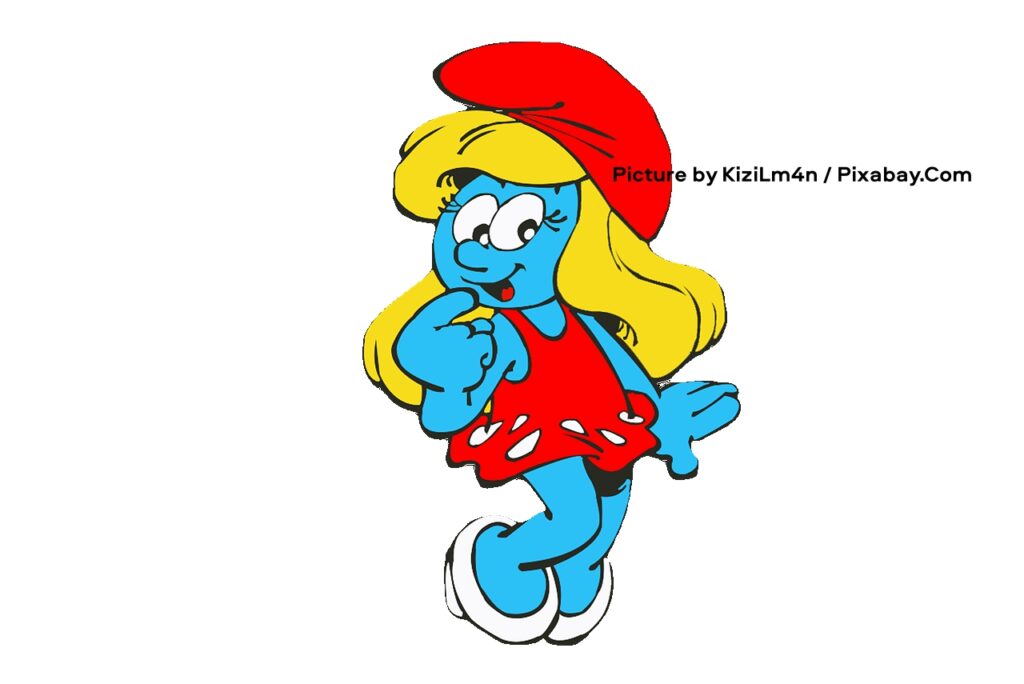
Smurfette is depicted in a vibrant cartoon style, standing dynamically against a plain white background with her body angled slightly to the right while her head faces forward. She has bright blue skin, long flowing blonde hair cascading down her back, and large expressive eyes with long lashes, complemented by a cheerful smile showing her open mouth and red tongue. She wears a floppy red beret-style hat, a short red dress with white petal-like accents along the hem, and white shoes. Her pose is lively, with her right hand raised near her chin in a thoughtful or playful gesture and her left arm extended outward, capturing a sense of movement and joy. Picture by KiziLm4n / Pixabay.Com.
There are over 100 distinct Smurf characters, most named after personality traits or professions—such as Jokey Smurf (the prankster) or Handy Smurf (the inventor). Smurfette was the first female Smurf introduced. They all wear distinctive red Phrygian caps, a style historically associated with freedom.
The word “Smurf” comes from the Dutch translation of Peyo’s invented French term “schtroumpf.” According to Peyo, the word arose during a meal with fellow cartoonist André Franquin when Peyo forgot the word for “salt” and asked him to pass the “schtroumpf.” The joke evolved into an entire weekend of speaking in “Smurf language.”
The franchise began as comics but expanded into TV series, films, toys, video games, theme parks, music, and more. By 2008, it had generated over $4 billion in revenue, cementing its status as one of the most successful media franchises ever.
Origin
Peyo created the Smurfs while working on his medieval adventure series Johan and Peewit (Johan et Pirlouit). In the 1958 story The Flute with Six Holes (La Flûte à six trous), the heroes encounter a tiny blue creature in white clothes called a Schtroumpf, along with a whole village of identical blue beings led by an elderly Smurf in red with a white beard.
The characters were an instant hit. Independent Smurf stories began appearing in Spirou magazine in 1959, alongside the first merchandise. Later editions of the original story were retitled The Flute with Six Smurfs. The Smurfs continued to appear alongside Johan and Peewit before gaining their own successful series.
Smurf village
The Smurf Village is the idyllic, hidden home of the Smurf community, nestled in a clearing deep within an enchanted forest. Its exact location remains a closely guarded secret, known only to the Smurfs themselves, Mother Nature, and a few trusted allies. Humans and other outsiders find it nearly impossible to locate without a Smurf guide, as it is protected by dense woods, magical barriers, and natural obstacles.
In the earliest Johan and Peewit stories, the village appeared in a desolate, rocky area called “Le Pays Maudit” (the Cursed Land), with irregularly shaped mushroom houses. As the Smurfs gained their own series, the setting evolved into a lush, vibrant forest clearing featuring grass, a river, flowers, and abundant vegetation. Paths lead to a river with bridges, a swimming pond, a waterfall, sarsaparilla fields, and surrounding woods.
The village resembles a patch of oversized mushrooms for camouflage. Individual Smurf houses are typically two-story structures with rounded caps, doors, windows, and chimneys. The ground floor often serves as a living room or workspace (customized to each resident—Papa Smurf’s includes a laboratory, Handy’s a workshop), while the upper floor is a bedroom. Communal facilities include an outdoor theater, meeting house, kitchen, dining hall, storehouse, playing field, hospital/infirmary, and crop fields.
Daily life emphasizes cooperation, with each Smurf contributing according to their talents. They use storks for long-distance travel and maintain a simple, harmonious existence filled with work, play, singing, and shared meals. Gargamel’s rundown hovel lies on the forest’s edge near a murky pond, posing the main recurring threat.
Main characters
The Smurfs are typically depicted as three apples high, with blue skin, white trousers (with a hole for their short tails), and Phrygian caps. Most are male and around 100 years old (except Papa Smurf, Baby Smurf, Smurfette, and a few elders). They embody simple human archetypes:
- Papa Smurf: The wise, 542-year-old leader with a bushy white beard, red cap, and red trousers. A skilled alchemist and magician, he acts as a father figure, resolves disputes, and devises plans against threats.
- Smurfette: The first female Smurf, originally created by Gargamel as a brunette saboteur. Papa Smurf transformed her into a kind, blonde Smurf who loves flowers and pink. She is caring, resourceful, and often central to adventures.
- Brainy Smurf: The bespectacled know-it-all who carries books and offers (often misguided) advice. Loyal but frequently annoying; best friends with Clumsy.
- Hefty Smurf: The strongest and bravest, with a red heart tattoo. Athletic, protective, and reliable in physical tasks.
- Grouchy Smurf: The perpetual pessimist whose catchphrase is “I hate [whatever]!” Gruff on the surface but loyal at heart.
- Jokey Smurf: The prankster famous for exploding “surprise” gifts and his signature laugh.
- Handy Smurf: The inventive mechanic in overalls, always ready to build or fix things.
- Clumsy Smurf: Kind-hearted but accident-prone; optimistic and eager to help.
- Greedy Smurf (often Chef/Baker): The food-obsessed cook who wears a chef’s hat.
- Vanity Smurf: Narcissistic mirror-carrier with a flower in his cap.
Other notables include Lazy, Poet, Painter, Farmer, Tracker, Miner, Wild Smurf, Baby Smurf, Grandpa Smurf, Nanny Smurf, and Sassette. The village functions as a cooperative micro-society where individual quirks strengthen the community.
Villains and allies
- Gargamel: The bumbling evil wizard obsessed with capturing Smurfs for gold or food.
- Azrael: Gargamel’s orange tabby cat and loyal (if long-suffering) companion. Azrael is a skilled and persistent hunter who actively pursues the Smurfs, often serving as the physical threat in Gargamel’s schemes. He is agile, cunning, and frequently suffers comical injuries or failures due to the Smurfs’ clever escapes or his own bad luck. Despite his antagonistic role, Azrael occasionally shows moments of reluctance or gets outsmarted in humorous ways, adding to the lighthearted tone of the conflicts.
- Allies: Johan and Peewit, wizard Homnibus, and magical beings like Puppy.
Language
The Smurfs’ speech is famous for substituting “smurf” for almost any noun or verb. Context makes the meaning clear. One story even parodies Belgium’s language divide.
Smurf comics
Peyo wrote and drew the first 16 albums himself; later volumes were produced by his studio. English editions have been published by Papercutz and Marvel. Peyo’s lively style emphasizes movement and humor.
Other media
Films: Early Belgian shorts, The Smurfs and the Magic Flute (1976), Sony’s live-action/CGI hybrids (2011–2013), Smurfs: The Lost Village (2017), and a later musical film.
Television: The Hanna-Barbera animated series, which aired on NBC from 1981 to 1989 (with reruns continuing afterward), brought The Smurfs massive fame in North America and around the world. Produced in association with SEPP International, the show ran for eight seasons and became a Saturday morning staple, introducing the characters to a huge new audience with colorful storytelling, catchy songs, and classic orchestral background music. It was nominated for multiple Daytime Emmy Awards and won Outstanding Children’s Entertainment Series in 1982–1983. A fully CGI-animated reboot series premiered in 2021, featuring new stories and modern animation styles while staying true to the classic characters. It was co-produced internationally and aired on Nickelodeon in the United States.
Merchandising, music, theme parks, and games: Hundreds of millions of Schleich figurines, hit records like “The Smurf Song,” Ice Capades appearances, theme park areas, and numerous video games including the Smurfs’ Village app.
The Smurfs remain a colorful symbol of fun, community, and gentle adventure, delighting generations worldwide.


