
The lesser apes, commonly known as gibbons (and including the Siamang), are a fascinating group of small apes belonging to the family Hylobatidae. Often called “lesser” simply due to their smaller size compared to the great apes (chimpanzees, gorillas, orangutans, and humans), they are in no way inferior in ecological importance or behavioral complexity. Gibbons are among the most specialized and acrobatic primates on Earth.
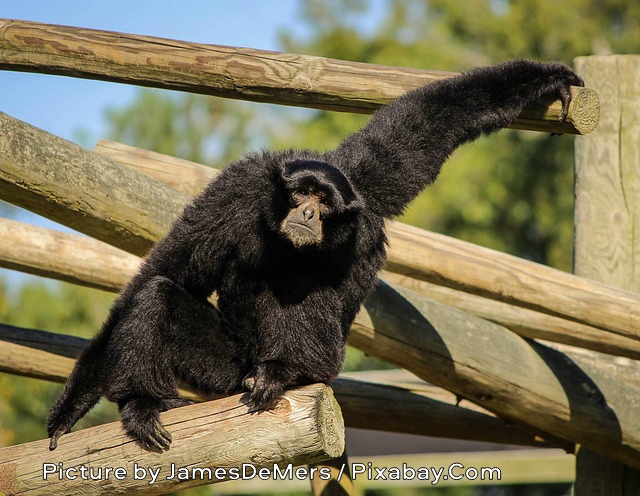
The picture captures a striking Siamang (Symphalangus syndactylus) perched casually on a sturdy wooden beam in what appears to be a zoo enclosure. This large black ape sits in a relaxed yet alert posture, with its long, powerful arms extended dramatically—one limb stretched high overhead gripping the upper rail while the other rests downward—showcasing the species’ signature elongated limbs perfectly adapted for brachiation. Its glossy black fur contrasts sharply against the warm tones of the weathered wooden structure and the soft blue sky with scattered green foliage in the background, while its expressive face, featuring a prominent throat sac and soulful dark eyes, gazes thoughtfully outward with a quiet intensity. Picture by JamesDeMers / Pixabay.Com.
Classification and diversity
Lesser apes belong to the family Hylobatidae within the superfamily Hominoidea (apes). There are approximately 20 recognized species, grouped into four genera:
- Hylobates (dwarf gibbons or lar gibbons, e.g., Lar Gibbon (Hylobates lar), Agile Gibbon (Hylobates agilis), Bornean White-bearded Gibbon (Hylobates albibarbis), Western Grey Gibbon or Abbott’s Grey Gibbon (Hylobates abbotti), Eastern Grey Gibbon or Northern Grey Gibbon (Hylobates funereus), Müller’s Gibbon or Southern Grey Gibbon (Hylobates muelleri), Silvery Gibbon (Hylobates moloch), Pileated Gibbon (Hylobates pileatus), Kloss’s Gibbon (Hylobates klossii))
- Hoolock (hoolock gibbons, e.g., Western Hoolock Gibbon (Hoolock hoolock), Eastern Hoolock Gibbon (Hoolock leuconedys), Skywalker Hoolock Gibbon (Hoolock tianxing))
- Nomascus (crested gibbons, e.g., Hainan Crested Gibbon (Nomascus hainanus), Eastern Black Crested Gibbon (Nomascus nasutus), Western Black Crested Gibbon (Nomascus concolor), Northern White-cheeked Crested Gibbon (Nomascus leucogenys), Southern White-cheeked Crested Gibbon (Nomascus siki), Northern Yellow-cheeked Crested Gibbon or Northern Buff-cheeked Gibbon (Nomascus annamensis), Southern Yellow-cheeked Crested Gibbon or Southern Buff-cheeked Gibbon (Nomascus gabriellae))
- Symphalangus (the siamang, Siamang (Symphalangus syndactylus), the largest member of the group)
Genetic studies show these genera are quite distinct, with divergence levels comparable to those between humans and chimpanzees.
Unlike great apes, gibbons exhibit low sexual dimorphism (males and females are similar in size and appearance), do not build sleeping nests, and are exclusively arboreal.
Physical characteristics
Gibbons are small to medium-sized primates, typically weighing 5–12 kg (11–26 lbs), though the Siamang can reach up to 14 kg (31 lbs) and stand about 1 m (3.3 ft) tall when upright. Key adaptations include:
- Extremely long arms (often longer than the legs), ideal for brachiation
- No tail (a defining trait of all apes)
- Dense fur, usually black, gray, brown, or cream, often with contrasting markings such as white hands, feet, or facial rings
- A specialized throat sac (especially large and inflatable in Siamangs) used to amplify vocalizations
The Siamang stands out as the largest gibbon species and the only one in its genus. It has distinctive jet-black, shaggy fur covering its body, with a mostly hairless face and pale hairs around the mouth and chin. Males tend to be slightly heavier than females (averaging around 12 kg / 26 lbs for males and 10.5 kg / 23 lbs for females). A unique physical feature is the partial webbing (syndactyly) between the second and third toes on each foot, which gives the species its scientific name. The Siamang‘s most prominent trait is its large, inflatable gular sac (throat pouch), which can expand to the size of a grapefruit and serves as a natural amplifier for its exceptionally loud calls.
Behavior and locomotion
Gibbons are unparalleled in brachiation—a specialized form of arboreal locomotion (from the Latin “brachium” meaning “arm”), also known as arm-swinging, in which primates swing hand-over-hand from branch to branch using only their forelimbs, with the body suspended below and alternately supported by each arm. This suspensory movement allows gibbons to navigate the forest canopy with remarkable speed and agility, often as their primary mode of travel.
Gibbons have several anatomical features that make brachiation highly efficient: extremely elongated forelimbs relative to body size, long curved fingers with reduced thumbs for hook-like grips, highly mobile shoulder and wrist joints that enable a wide range of rotation, a short lumbar spine for better body alignment during swings, and powerful shoulder muscles. These adaptations minimize energy expenditure while maximizing reach and momentum. Brachiation occurs in two main patterns—at slower speeds, gibbons use a continuous-contact gait where at least one hand remains in contact with a branch at all times, resembling a pendulum-like motion with smooth energy transfer between potential and kinetic energy. At higher speeds, they shift to a ricochetal (ballistic) gait with brief aerial phases between handholds, allowing greater forward velocity and the ability to cross larger gaps.
This locomotion enables gibbons to achieve impressive feats: covering distances of up to 15 m (50 ft) in a single swing (with reports of even greater leaps or swings across canopy gaps), reaching speeds of up to 56 km/h (35 mph), and traveling efficiently through dense forest while rarely descending to the ground. The method is energetically economical due to pendular mechanics and passive dynamics, with active adjustments (such as leg flexion/extension or arm positioning) helping to control trajectory, reduce collisions with branches, and maintain momentum with low muscular effort. On the rare occasions they descend to the ground, they walk bipedally with arms raised for balance.
They live in small, stable, monogamous family units—typically a mated pair and their dependent offspring—which is uncommon among primates. These family groups defend territories through loud, elaborate duet songs performed at dawn. The calls, which can carry over 1 km (0.6 mi), strengthen pair bonds and serve as territorial warnings to neighboring groups.
Siamangs produce some of the loudest and most distinctive vocalizations among gibbons, often described as deep booms followed by high-pitched “wow” sounds. Their morning duets, amplified by the inflated throat sac, can reach up to 113 decibels (comparable to a chainsaw) and be heard from several kilometers away, making them particularly resonant in the forest. Compared to other gibbons, Siamangs move somewhat more slowly and deliberately and often rest by propping or draping themselves in the trees. Their diet is mainly frugivorous (fruit-heavy), supplemented by leaves, flowers, buds, and insects. As seed dispersers, they play an important role in maintaining tropical forest diversity.
Habitat and distribution
Gibbons are native to the tropical and subtropical rainforests of Southeast Asia, ranging from northeastern India and Bangladesh through Myanmar, Thailand, peninsular Malaysia, Indonesia (Sumatra, Java, Borneo, and smaller islands), and into southern China and parts of Vietnam and Laos. They depend on continuous, dense canopy for movement and survival.
The Siamang is found primarily on the Malay Peninsula (including parts of southern Thailand and Malaysia) and the island of Sumatra in Indonesia. It inhabits a range of forest types, from lowland and hill rainforests to monsoon forests and montane areas, often at higher elevations (typically 300–1,500 m / 984–4,921 ft, but up to 3,800 m / 12,467 ft in some cases). Siamangs prefer mid- to upper canopy levels, usually 25–30 m (80–100 ft) above the ground.
Conservation status
Nearly all gibbon species face serious threats, primarily from habitat destruction (logging, agriculture, infrastructure development), hunting, and the illegal pet trade (where infants are often taken after mothers are killed). As of the most recent assessments, 19 of the 20 species are classified as Endangered or Critically Endangered by the IUCN Red List, with several species critically endangered and populations continuing to decline.
The Siamang is listed as Endangered by the IUCN, with populations having declined significantly (by about 50% in recent decades in some estimates) due to habitat loss from deforestation and the illegal pet trade. It is protected under CITES Appendix I, and while it shows some tolerance for disturbed or selectively logged forests compared to other gibbons, ongoing threats remain severe.
Conservation efforts include protected areas, community-based habitat restoration, anti-poaching initiatives, and rehabilitation programs for confiscated or orphaned gibbons. Organizations such as the Global Gibbon Network and various local NGOs are working to raise awareness and implement long-term protection strategies.
Far from being merely “lesser,” gibbons represent one of the most elegant and specialized branches of primate life. Their grace in the treetops, haunting songs, and tight-knit family life make them irreplaceable icons of Southeast Asian forests—and a poignant reminder of the fragility of biodiversity in the modern world.


