Denmark is a Nordic country located in Northern Europe, forming the southernmost part of Scandinavia. It consists of the Jutland Peninsula (Jylland), which connects to continental Europe, and an extensive archipelago of more than 400 islands, of which around 70–79 are inhabited. The largest islands are Zealand (Sjælland), home to the capital Copenhagen, Funen (Fyn), Lolland, Falster, and Bornholm in the Baltic Sea.
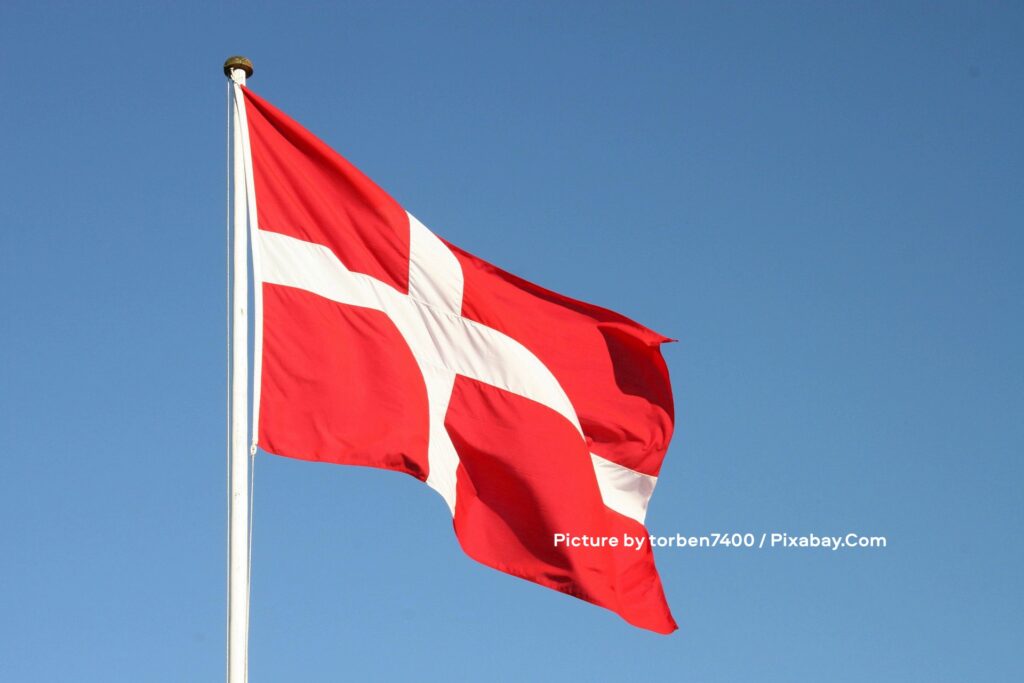
The image above captures the vibrant Danish flag, known as the Dannebrog, proudly waving against a clear, deep blue sky. The bright red rectangular banner features a bold white Scandinavian cross that extends to all four edges, with the fabric rippling gently in the breeze as it flies high atop a flagpole topped with a golden finial. The sunlight illuminates the colors vividly, making the red appear rich and the white crisp while the serene sky provides a striking, uncomplicated backdrop. Picture by torben7400 / Pixabay.Com.
Denmark shares a short land border of 68 km (42 miles) with Germany to the south. It is surrounded by water: the North Sea to the west, the Baltic Sea to the east, and the straits of the Skagerrak and Kattegat to the north, which Denmark controls and which connect the Baltic Sea to the North Sea and the Atlantic. Excluding its autonomous territories of Greenland and the Faroe Islands (which together with Denmark form the Kingdom of Denmark), the land area of Denmark proper is approximately 43,094 km² (about 16,639 square miles), making it roughly the size of Switzerland or twice the size of Massachusetts.
The terrain of Denmark is predominantly low-lying and flat, largely shaped by glacial activity during the last Ice Age. Most of the country lies below 100 meters (330 feet) above sea level, with gently rolling plains, fertile moraine soils in the east, sandy soils and heathlands in western Jutland, and coastal dunes along the North Sea. The highest point is Møllehøj (or nearby Yding Skovhøj) at about 170–173 meters (around 568 feet) in east-central Jutland.
Denmark has one of the longest coastlines in Europe relative to its size, measuring roughly 7,314 km (4,545 miles). No point in the country is more than about 52 km (32 miles) from the sea. This extensive coastline features numerous fjords, inlets, bays, and sandy beaches, particularly along the western coast facing the North Sea. The climate is temperate maritime, characterized by mild, wet winters and cool summers, strongly influenced by the surrounding seas.
The geography supports intensive agriculture, especially on the fertile eastern lands, and has historically shaped Denmark into a maritime nation with strong ties to the sea and shipping.
Copenhagen, the capital and largest city of Denmark, is situated on the eastern coast of the island of Zealand (Sjælland), with parts extending onto the adjacent island of Amager and several smaller natural and artificial islets. It lies at the southern end of the Øresund (The Sound), the strait separating Denmark from Sweden and connecting the Baltic Sea to the North Sea and Kattegat. The city’s coordinates are approximately 55.676° N, 12.568° E, and its elevation is very low, averaging around 9–14 meters (30–46 feet) above sea level, reflecting Denmark’s generally flat terrain. This coastal position gives Copenhagen a mild oceanic climate similar to the rest of the country, with cool summers and mild, wet winters. The city is renowned for its extensive network of canals, harbors, and waterways fed by the Øresund, contributing to its picturesque waterfront and maritime character. The Øresund Bridge (opened in 2000) connects Copenhagen directly to Malmö in Sweden, enhancing its role in the cross-border Øresund Region.
Denmark uses the Danish krone (DKK) as its official currency, often written as kr. or simply kr (for example, 100 kr). The krone is subdivided into 100 øre, although øre coins are no longer in general circulation. The name “krone” means “crown” in Danish, a naming convention shared with the currencies of Norway (krone) and Sweden (krona). Although Denmark is a member of the European Union, it has retained its own currency following a referendum in 2000 that rejected adoption of the euro. The Danish krone is closely pegged to the euro at an exchange rate of approximately 7.46 DKK per euro, maintained through Denmark’s participation in the ERM II mechanism. Banknotes and coins feature designs inspired by Danish bridges, landscapes, and cultural motifs.


