Norway is a captivating country in Northern Europe, occupying the western half of the Scandinavian Peninsula. It is renowned for its dramatic and diverse geography, shaped by glacial activity, rugged terrain, and an intricate coastline.
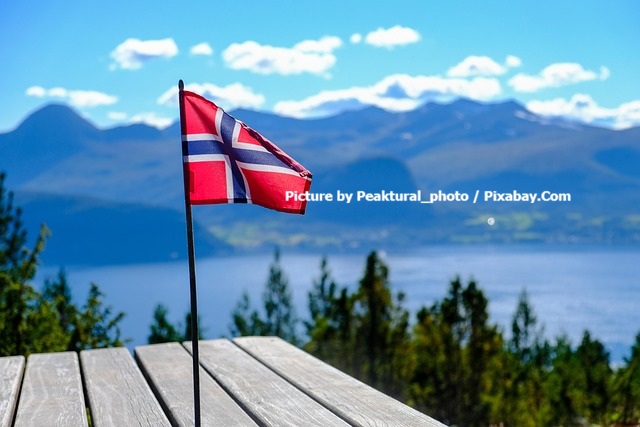
A small Norwegian flag flutters gently on a slender black pole, planted proudly on a weathered wooden tabletop in the foreground, its vivid red, white, and blue cross catching the bright daylight. Behind it stretches a breathtaking panoramic view of a serene fjord framed by towering, rugged mountains that rise dramatically from the water’s edge, their slopes cloaked in lush green vegetation and dotted with patches of forest. The deep blue water of the fjord reflects the endless expanse of a clear sky filled with scattered, soft white clouds, creating a peaceful and majestic scene of natural beauty that embodies the classic Norwegian landscape. Picture by Peaktural_photo / Pixabay.Com.
Location and borders
Norway stretches along the North Atlantic and Arctic Oceans, with its elongated, spoon-like shape extending from the temperate south to far above the Arctic Circle in the north. It shares land borders with Sweden to the east (the longest), Finland to the northeast, and a short border with Russia in the far north. To the west, it faces the Norwegian Sea and North Sea, while the south meets the Skagerrak strait.
Terrain and landscape
Approximately two-thirds of Norway is mountainous, dominated by the Scandinavian Mountains (also known as the Scandes, Skanderna in Swedish, or Kjølen/Kölen in parts of Norwegian and Swedish). This extensive mountain range forms the backbone of the Scandinavian Peninsula, stretching roughly 1,700 km (1,100 miles) in length—making it the longest mountain range in Europe—and up to about 320 km wide in places. It runs primarily through Norway and along the border with Sweden, with a small extension into northeastern Finland.
The range features glaciated high plateaus, rugged peaks, fertile valleys, forests, lakes, and scattered plains. In Norway, the western slopes drop steeply and precipitously toward the North Sea and Norwegian Sea, creating dramatic contrasts with the more gradual eastern descent into Sweden. The terrain also encompasses notable sub-regions like the Jotunheimen (home to many of the highest peaks), the Hardanger Plateau, and areas with vertical rock walls, such as Trollveggen (Europe’s tallest vertical rock face at around 1,700 meters in places).
The highest point in the entire range—and in mainland Northern Europe—is Galdhøpiggen at 2,469 meters (8,100 feet), located in southern Norway. Other prominent peaks include Glittertind (nearby at 2,464 meters with its glacier cap) and Kebnekaise (2,097 meters) on the Swedish side. In the northern parts, near the Arctic Circle, elevations reach around 2,000 meters, forming a natural border between Norway and Sweden.
Norway’s most iconic feature is its deeply indented coastline, one of the longest and most rugged in the world—stretching over 100,000 km (including fjords and islands) when measured in detail. This includes around 50,000 islands and the famous fjords, narrow inlets carved by glaciers with steep cliffs plunging into deep waters.
Northern Norway, much of it above the Arctic Circle, includes arctic tundra, jagged mountain ridges on islands, and phenomena like the midnight sun in summer and polar night in winter.
The country is divided into traditional regions: Østlandet (eastern, around Oslo), Vestlandet (western fjords), Trøndelag (central), and Nord-Norge (northern Arctic areas). Only about 3% of the land is arable, with vast forests, lakes, and plateaus dominating.
Climate and natural features
Norway experiences varied climates due to its latitude and Gulf Stream influence: mild, wet coastal areas contrast with colder inland and northern regions. Glaciers, waterfalls, and northern lights add to its natural allure.
Norway boasts some of the world’s most impressive waterfalls, many fed by melting snow and glaciers, cascading dramatically down steep mountainsides into fjords or valleys. Among the most famous is Vøringsfossen in the Hardangerfjord region, often called Norway’s most iconic waterfall, with a total drop of 182 meters (including a major plunge of 163 meters). Other highlights include the Seven Sisters in the UNESCO-listed Geirangerfjord, where seven separate streams tumble gracefully from about 250 meters into the fjord, often paired legendarily with the opposite “Suitor” waterfall. Norway is also home to some of the tallest waterfalls globally, such as Vinnufossen (860 meters total drop, the highest in Europe) and others exceeding 800 meters. Popular accessible ones like Steinsdalsfossen (where visitors can walk behind the falls) and Langfossen (a stunning 600-meter cascade) draw hikers and photographers year-round, with spring offering the most powerful flows from snowmelt.
The northern lights (aurora borealis) are one of nature’s most mesmerizing spectacles, visible primarily in Northern Norway above the Arctic Circle. Caused by charged solar particles interacting with Earth’s atmosphere, they create dancing curtains of green, purple, and pink light across the dark winter sky. The best viewing season runs from late September to early April, when nights are long and dark, with peak chances often around the equinoxes (September/October and March/April) due to higher solar activity. Prime locations include Tromsø (a major hub with easy access), the Lofoten Islands (for dramatic fjord-and-mountain backdrops), Alta, Bodø, and even remote areas like Svalbard. Clear skies, minimal light pollution, and staying away from city lights greatly improve sightings, and many visitors join guided tours for the best opportunities.
Currency of Norway
The official currency is the Norwegian krone (plural: kroner), abbreviated as kr or NOK. It is subdivided into 100 øre, though øre coins are largely phased out. Banknotes come in denominations of 50, 100, 200, 500, and 1,000 kroner, while coins include 1, 5, 10, and 20 kroner. Norway is not part of the eurozone and maintains its independent currency, reflecting its economic policies tied to oil wealth and natural resources.
Norway’s geography—from its fjords and mountains to its northern wilderness—makes it one of the most visually striking countries in the world, blending dramatic natural beauty with a strategic northern position.


