
The Bald Eagle (Haliaeetus leucocephalus) stands as one of the most recognizable and revered birds in the world. With its striking white head and tail contrasting against a dark brown body, this powerful raptor has symbolized strength, freedom, and resilience for centuries. The Bald Eagle is not bald at all—the term comes from an old English word meaning “white-headed.” Found exclusively in North America, it serves as the national bird and emblem of the United States.
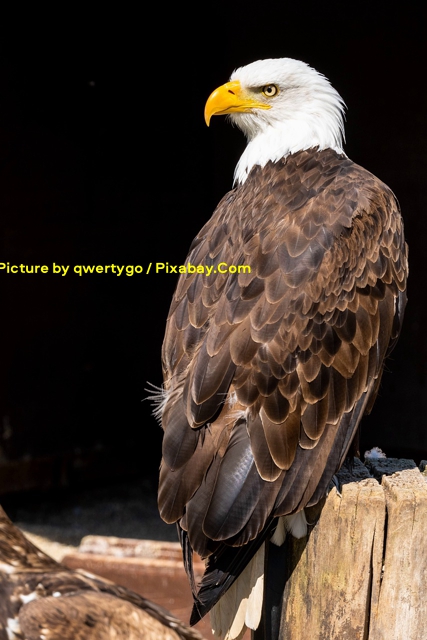
The picture captures a striking close-up portrait of a majestic Bald Eagle perched calmly in what appears to be an outdoor setting, its intense yellow beak and piercing eye sharply focused forward while the iconic white head contrasts beautifully with the rich brown plumage of its body and wings. The Bald Eagle’s feathers are detailed and layered, showing subtle textures from the soft down near the neck to the stronger flight feathers, and it stands atop a rough wooden surface with hints of other birds or logs visible in the dimly lit, dark background that makes the bird’s regal features stand out even more prominently. Picture by qwertygo / Pixabay.Com.
Physical characteristics
Adult Bald Eagles measure 70–102 cm (28–40 inches) in length, with a wingspan ranging from 1.8 to 2.3 meters (5.9 to 7.5 feet). Bald Eagles weigh 3 to 6.3 kilograms (6.6 to 14 pounds), with females typically larger and heavier than males—females can reach the upper end of this range, while males often fall toward the lower end. Their plumage features a chocolate-brown body, snow-white head and tail, a massive yellow hooked beak, and bright yellow legs and talons capable of exerting tremendous gripping force.
Juveniles look quite different, with mottled dark brown plumage and white streaks that gradually give way to the classic adult appearance by their fourth or fifth year.
The Bald Eagle’s call is a series of high-pitched, chirping whistles rather than the dramatic scream often portrayed in media (that sound is usually borrowed from a Red-tailed Hawk).
| Kingdom | Animalia |
| Class | Aves |
| Order | Accipitriformes |
| Family | Accipitridae |
| Genus | Haliaeetus |
| Species | H. leucocephalus |
| Binomial Name | Haliaeetus leucocephalus |
| Length | 70–102 cm (28–40 inches) |
| Wingspan | 1.8 to 2.3 meters (5.9 to 7.5 feet) |
| Weight | 3 to 6.3 kilograms (6.6 to 14 pounds) |
| IUCN Status | Least Concern |
Habitat and distribution
The Bald Eagle thrives near large bodies of open water—lakes, rivers, coastal areas, and marshes—where fish are abundant and tall trees provide nesting sites. Its range spans from northern Mexico through the United States and across most of Canada and Alaska. Northern populations migrate south when waters freeze, while southern birds tend to remain year-round. Preferred nesting trees stand over 20 meters tall with good canopy cover, usually within 200 meters of water.
Diet and hunting behavior
Primarily opportunistic carnivores, Bald Eagles obtain the majority of their diet from fish—typically 70–90% in many regions, though this varies by location, season, and prey availability (e.g., lower in some inland or wintering areas where carrion or birds predominate). Common prey includes salmon, trout, herring, and other species. They also hunt waterfowl, small mammals, and occasionally scavenge carrion or steal prey from other birds (a behavior called kleptoparasitism). With keen eyesight and powerful flight, they can spot fish from high above, then swoop down at speeds up to 160 km/h (100 mph) to snatch their meal with razor-sharp talons.
Reproduction and family life
Bald Eagles mate for life and build some of the largest nests of any bird—structures that can reach 2.5 meters (8 feet) wide, 4 meters (13 feet) deep, and weigh over a ton. Pairs often reuse and expand the same nest for decades. Females typically lay one to three eggs in early spring; both parents incubate them for about 35 days. Chicks fledge after 8–14 weeks but may remain dependent on their parents for several more months. Lifespan in the wild can exceed 30 years, with the oldest recorded individual reaching nearly 38.
Conservation success story
Once pushed to the brink of extinction in the contiguous United States—dropping to just 417 nesting pairs in 1963 and around 412 by the 1950s due to DDT pesticide poisoning (which thinned eggshells and reduced hatching success), habitat destruction, and direct shooting—the Bald Eagle has achieved one of the most celebrated recoveries in wildlife conservation history. Key turning points included the 1972 nationwide ban on DDT, protections under the Endangered Species Act (listing in 1967, with full recovery leading to delisting in 2007), the Bald and Golden Eagle Protection Act, and the Migratory Bird Treaty Act. These measures, combined with habitat protection, captive breeding and reintroduction programs in some regions, vigorous law enforcement, and public education, allowed populations to rebound dramatically.
The U.S. Fish and Wildlife Service’s 2020 update (based on 2018–2019 surveys) estimated 316,700 individual Bald Eagles and 71,400 nesting pairs in the lower 48 states—a quadrupling since 2009 and a massive increase from historic lows. This figure remains the most widely cited national estimate, with ongoing midwinter surveys and state-level monitoring showing continued growth and stability into the mid-2020s. For example, regional reports from states like New Hampshire (over 120 breeding pairs in 2025), Ohio (widespread increases through 2025), and others indicate steady expansion, often with annual growth in active nests and territories. Alaska hosts the largest share, with around 30,000 individuals, while states like Minnesota, Florida, and Wisconsin also support robust populations in the thousands.
Today the species is classified as Least Concern by the IUCN, reflecting its secure status across North America. Ongoing challenges include lead poisoning from ingested ammunition in scavenged carcasses, collisions with vehicles and structures, occasional electrocution on power lines, habitat disturbance from development (as seen in localized cases like nesting site threats), and emerging concerns such as wind energy infrastructure impacts. However, the overall trend remains positive, supported by continued monitoring programs like the National Midwinter Bald Eagle Survey and partnerships among federal agencies, states, nonprofits, and volunteers. This enduring recovery underscores the effectiveness of science-based conservation and protective legislation.
Cultural and historical significance
The Bald Eagle’s role as a symbol of the United States dates back to June 20, 1782, when Congress adopted the Great Seal of the United States featuring the bird with outstretched wings, clutching an olive branch in one talon (symbolizing a preference for peace) and 13 arrows in the other (representing readiness for defense and the original 13 states). The design, finalized by Secretary of Congress Charles Thomson after contributions from committees including input from Thomas Jefferson, John Adams, and Benjamin Franklin, emphasized the eagle’s indigenous North American status to assert independence and distinction from European influences. Eagles had long symbolized power in ancient cultures like Rome, but the Bald Eagle was chosen for its uniqueness to the continent and qualities of strength, courage, and freedom.
Though Benjamin Franklin famously criticized it as a “bird of bad moral character” and preferred the turkey as a more respectable native symbol, the Bald Eagle prevailed and quickly became ubiquitous on official documents, currency (including coins like the quarter and dollar), flags, military insignia, public buildings, postage stamps, and countless government seals and logos. President John F. Kennedy later praised the choice, noting that the bird’s “fierce beauty and proud independence” aptly symbolize America’s strength and freedom. In 2024, Congress and President Biden formally designated the Bald Eagle as the official national bird through legislation, codifying what had long been cultural consensus.
For many Native American tribes, the Bald Eagle has held profound spiritual significance for millennia, long before European arrival. Revered as a sacred messenger between humans and the Creator or divine spirits due to its high flight near the heavens, it embodies courage, wisdom, strength, and connection to the spiritual world. Eagle feathers, talons, and parts are central to religious ceremonies, regalia (such as headdresses, bustles, fans, and war bonnets), powwows, and sacred pipes, symbolizing honor, protection, and the highest virtues. Federal laws, including the Bald and Golden Eagle Protection Act and provisions through the National Eagle Repository, strictly regulate possession to honor tribal religious and cultural uses while protecting the species.
The Bald Eagle thus bridges ancient Indigenous reverence with modern American identity, representing not only national pride and sovereignty but also resilience—mirrored in its own recovery from near-extinction.
The story of the Bald Eagle is one of hope and stewardship. From near-disappearance to widespread resurgence, this magnificent bird reminds us that dedicated conservation efforts can restore even the most iconic species. Whether soaring gracefully over a pristine lake or perched regally atop an ancient pine, the Bald Eagle continues to inspire awe and national pride across the continent.


