
Accipitriformes is an order of birds that includes most of the world’s diurnal (daytime-active) birds of prey, commonly known as raptors. The name comes from Latin accipiter (meaning “hawk”) and formes (“having the form of”). This group encompasses hawks, eagles, kites, harriers, buzzards, Old World vultures, the Osprey, and the Secretarybird. Falcons, however, belong to a separate order (Falconiformes) in modern classifications.
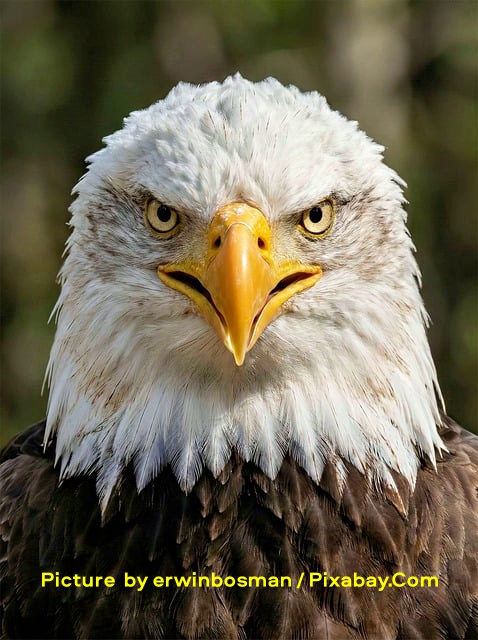
This striking close-up photograph captures the intense and majestic face of a Bald Eagle, showcasing its distinctive bright white head feathers that contrast sharply with the rich, dark brown plumage covering its neck and body. The Bald Eagle’s piercing yellow eyes stare directly forward with a fierce, commanding gaze, while its powerful, sharply hooked yellow beak is slightly parted, revealing the pinkish interior and conveying both strength and alertness. Fine details of the feather textures are visible, from the smooth white crown to the layered brown feathers below, all set against a softly blurred natural background of green foliage that emphasizes the bird’s noble presence. Picture by erwinbosman / Pixabay.Com
Taxonomy and families
The order Accipitriformes currently contains approximately 260–265 species, organized into the following families (per classifications such as those from the International Ornithological Committee):
- Accipitridae — The dominant family, including eagles, hawks, buzzards, harriers, kites, and Old World vultures (roughly 250 species).
- Pandionidae — Monotypic family containing only the Osprey (Pandion haliaetus).
- Sagittariidae — Monotypic family containing only the Secretarybird (Sagittarius serpentarius).
(Note: New World vultures in the family Cathartidae are sometimes included in Accipitriformes or treated as a separate order, depending on the taxonomic system.)
This order is distributed across every continent except Antarctica and is absent only from the most extreme polar and oceanic environments.
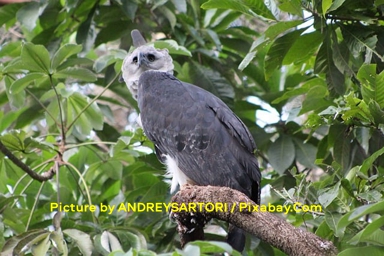
The photograph below captures a majestic Harpy Eagle perched confidently on a sturdy tree branch amidst the dense, vibrant green foliage of a rainforest canopy. This powerful raptor stands out with its distinctive double crest of feathers rising from its head like a regal crown, a striking pale gray face contrasting against its darker slate-gray upper body and wings, while its broad chest displays a prominent white plumage that transitions into the darker tones below. Its intense, piercing eyes gaze forward, and its massive hooked beak and strong talons emphasize its status as one of the world’s most formidable birds of prey, set against the lush backdrop of overlapping green leaves that highlight its natural habitat. Picture by ANDREYSARTORI / Pixabay.Com.
Physical characteristics
Accipitriformes share key adaptations for predation:
- Strong, sharply hooked beaks designed for tearing flesh.
- Powerful legs equipped with long, sharp, opposable talons for capturing and killing prey.
- Exceptionally acute vision—among the best in the animal kingdom—enabling detection of small prey from great distances or heights.
- Wing shapes adapted to their hunting style: broad and long for soaring (eagles, vultures), short and rounded for agile maneuvering in forests (accipiters), or narrow and pointed for speed.
Body size varies widely, from small kites and sparrowhawks to massive eagles with wingspans reaching over 2–3 meters in the largest species.
Diversity and hunting strategies
Species within Accipitriformes employ a wide range of hunting techniques:
- Soaring at high altitudes to scan vast areas for prey (eagles, buzzards, vultures).
- Rapid, low-level pursuit or ambush attacks (accipiters such as goshawks and sparrowhawks).
- Slow, low flight while quartering over open ground to flush small mammals or birds (harriers, some kites).
- Specialized plunging dives into water to catch fish (Osprey).
- Ground-based stalking and foot-stamping to disturb and capture prey (Secretarybird).
Their diet is almost exclusively carnivorous. Most species prey on live vertebrates (mammals, birds, reptiles, amphibians, fish, and large insects), while Old World vultures are primarily scavengers feeding on carrion.
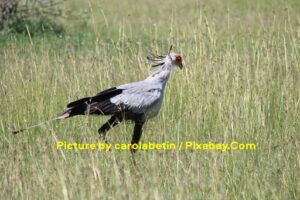
The photograph above captures a majestic Secretarybird standing tall in a dry savanna grassland, its long legs carrying it gracefully through knee-high golden-brown grass under a clear sky. The bird’s distinctive black crest of elongated feathers rises dramatically from its head like a quill pen headdress, contrasting sharply with its pale grey body, while its intense red-orange face and sharp, hooked beak give it a fierce, eagle-like expression. Dark black flight feathers on its wings and tail stand out against the lighter plumage, and its poised, alert stance suggests it is actively scanning the ground for prey in its open, sunlit habitat. Picture by carolabetin / Pixabay.Com
Distribution and habitat
Accipitriformes occur worldwide in nearly every terrestrial habitat: deserts, grasslands, savannas, forests (tropical to boreal), wetlands, mountains, tundra, and even suburban and urban environments.
Notable examples
- Bald Eagle (Haliaeetus leucocephalus) — Iconic North American species and national symbol of the United States. Adults feature a distinctive white head and tail contrasting with a dark brown body, yellow beak, and massive yellow talons. They measure about 70–102 cm (28–40 in) in length, with a wingspan of 1.8–2.3 m (6–7.5 ft) and weigh 3–6.3 kg (6.6–14 lb), with females larger than males. Primarily a fish-eater (opportunistically taking salmon, catfish, and other species), they also prey on waterfowl, small mammals, and carrion. Found near large bodies of water across North America (from Alaska to northern Mexico), they build enormous nests in tall trees or on cliffs. Once nearly extinct due to hunting, habitat loss, and DDT-induced eggshell thinning, the species made a remarkable recovery after protections and the 1972 DDT ban, now classified as Least Concern by the IUCN with stable or increasing populations.
- Golden Eagle (Aquila chrysaetos) — A powerful, widespread predator found across the Northern Hemisphere, including North America, Europe, Asia, and parts of North Africa. Adults are dark brown with golden-brown nape feathers, measuring 66–102 cm (26–40 in) in length, with a wingspan of 1.8–2.3 m (6–7.5 ft) and weight of 3–7 kg (6.6–15 lb), females again larger. They prefer open habitats like mountains, grasslands, tundra, and canyons up to high elevations. Diet focuses on medium-sized mammals such as hares, rabbits, marmots, ground squirrels, and occasionally larger prey like young deer or foxes; they hunt with speed and powerful talons. Classified as Least Concern by the IUCN, populations are generally stable but have declined in some regions due to habitat changes, persecution, and collisions with infrastructure.
- Harpy Eagle (Harpia harpyja) — Among the world’s largest and most powerful eagles, specialized for hunting in Neotropical rainforests from southern Mexico to northern Argentina. Adults are slate-gray above and white below with a prominent double crest, measuring 86–107 cm (34–42 in) in length, with a wingspan of 1.8–2.2 m (6–7 ft) and weight of 4–9 kg (9–20 lb), females significantly larger (up to twice the male’s mass). They inhabit undisturbed lowland tropical forests, building massive nests high in emergent trees. Diet consists mainly of arboreal mammals like sloths, monkeys (howlers, capuchins), opossums, and porcupines, captured with enormous talons (up to 13 cm/5 in long). Classified as Vulnerable by the IUCN due to rapid population declines from extensive deforestation, habitat fragmentation, and hunting; now rare or extirpated in much of Central America.
- Osprey (Pandion haliaetus) — A cosmopolitan fish specialist (the only member of Pandionidae) found on every continent except Antarctica, near rivers, lakes, coasts, and estuaries. Adults are dark brown above, white below with a dark eye stripe, measuring 50–66 cm (20–26 in) in length, with a wingspan of 1.27–1.8 m (4–6 ft) and weight of 0.9–2.1 kg (2–4.6 lb). Unique adaptations include reversible outer toes, spiny foot pads for gripping slippery fish, and closable nostrils for diving. They plunge feet-first from 10–40 m (30–130 ft) to catch fish (99% of diet, 4–30 cm/2–12 in long). Once severely reduced by DDT in the mid-20th century, populations rebounded dramatically after the pesticide ban, now Least Concern globally with increasing trends in many areas.
- Secretarybird (Sagittarius serpentarius) — A tall, distinctive, mostly terrestrial raptor endemic to sub-Saharan Africa, standing 1.2–1.5 m (3.9–4.9 ft) tall on long pink legs with a wingspan over 2 m (6.6 ft) and weight of 2.3–4.3 kg (5–9.5 lb). Gray plumage features long black crest feathers (resembling quill pens of old secretaries, hence the name), black flight feathers, and trailing central tail feathers. Found in open grasslands, savannas, and lightly wooded areas with scattered acacias. It stalks prey on foot (up to 20–30 km/day), stamping to flush and kill with powerful kicks—famous for subduing venomous snakes like cobras and puff adders. Diet includes insects (especially grasshoppers), small mammals, birds, reptiles, amphibians, and eggs. Classified as Endangered by the IUCN due to severe declines from habitat loss (afforestation, agriculture, overgrazing), persecution, and human disturbance.
Accipitriformes have long held cultural significance, appearing in mythology, national emblems, and heraldry across many societies. While many species face threats from habitat destruction, poisoning (especially from agricultural chemicals or lead ammunition), electrocution on power lines, and persecution, conservation successes—particularly for eagles in North America and Europe—demonstrate the effectiveness of legal protection and habitat management.
This order showcases remarkable characteristics among diurnal predators, combining extraordinary sensory capabilities, physical power, and behavioral diversity to thrive in diverse ecosystems worldwide.


