The Ursidae family, commonly known as bears, comprises a small but iconic group of carnivoran mammals within the order Carnivora. These animals are classified as caniforms (dog-like carnivorans) and are closely related to pinnipeds (seals and walruses) among living groups. Although the fossil record shows far greater diversity—with over 100 extinct species across various subfamilies—only eight species survive today, spread across three subfamilies: Ailuropodinae, Tremarctinae, and Ursinae.
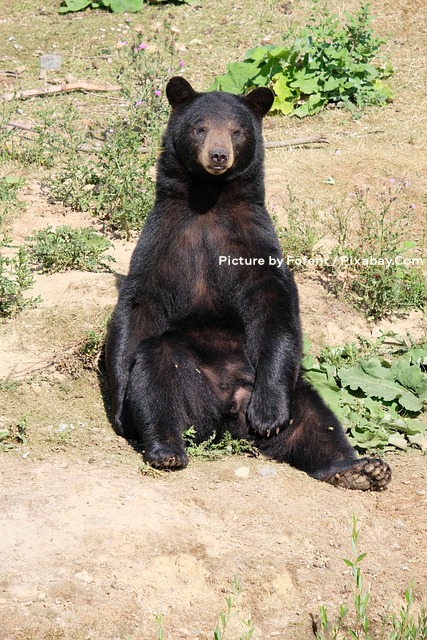
A large American Black Bear (Ursus americanus) sits upright in a relaxed, almost human-like posture on a patch of dry, earthy ground scattered with patches of green vegetation. Its thick, glossy black fur covers its hefty body, with lighter brownish tones visible around the muzzle and inner ears. The bear’s small, rounded ears are perked forward, and its dark eyes gaze directly ahead with a calm, attentive expression while its front paws rest comfortably on its rounded belly and its powerful hind legs are splayed out in front. Tall green plants and leafy foliage rise behind and around the animal, suggesting a naturalistic outdoor setting such as a zoo enclosure or wildlife habitat under soft daylight.
Bears are large, stocky mammals with distinctive physical traits, including plantigrade posture (walking on the soles of their feet), five non-retractile claws per paw, long snouts, small rounded ears, shaggy fur, and short tails. They exhibit sexual dimorphism, with males typically larger than females. Body sizes vary widely: the smallest is the Sun Bear (Helarctos malayanus), weighing 25–65 kg (55–143 lb) and measuring 1–1.4 m (3.3–4.6 ft) in length, while the largest is the Polar Bear (Ursus maritimus), which can exceed 700 kg (1,540 lb) and reach 3 m (9.8 ft) long. Most species have thick fur for insulation, with adaptations like the Polar Bear’s hollow guard hairs and blubber layer for Arctic survival. Their skulls feature powerful jaw muscles, and dentition is adapted for omnivory—large canines, reduced carnassials, and broad molars for crushing vegetation—though diets range from mostly carnivorous to highly specialized herbivorous.
Bears are primarily solitary, except for mothers with cubs or during seasonal food abundances. They are excellent climbers, swimmers, and runners despite their bulky builds. Many hibernate in dens during winter (true hibernation in some, with reduced metabolism, heart rate, and body temperature), though not all species do so consistently. Reproduction involves delayed implantation, with gestation lasting 6–9 months and litters of 1–4 altricial (blind and helpless) cubs born in dens. Males play no role in rearing young and may commit infanticide in some cases. Lifespans in the wild average 15–30 years, depending on the species.
The family is distributed mainly in the Northern Hemisphere, across North America, Europe, and Asia, with one species in South America and some extending into Southeast Asia. Habitats include forests, tundra, mountains, grasslands, and polar ice. Most bears are omnivorous opportunists, consuming plants, insects, fish, mammals, and carrion, though specializations exist (e.g., bamboo for the Giant Panda). They possess an exceptional sense of smell, good color vision, and communicate via vocalizations, body postures, and scent marking.
Conservation challenges affect most species due to habitat loss, human-wildlife conflict, and poaching (e.g., for bile or parts). Six of the eight species are listed as Vulnerable on the IUCN Red List, with only the American Black Bear and Brown Bear generally considered Least Concern (though some populations are threatened).
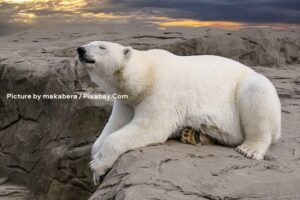
A majestic Polar Bear (Ursus maritimus) rests serenely on a rugged, rocky arctic landscape, its thick white fur glowing softly against the muted tones of the stone and sand beneath it. The massive creature lies stretched out on its side with its powerful front paws tucked comfortably forward, eyes gently closed and head tilted upward as if basking in quiet contentment. Its black nose and small dark eyes stand out sharply against the pale fur, while the dramatic sky behind fills the scene with a warm yet moody sunset glow of orange and deep blue hues streaking across scattered clouds. The bear’s peaceful expression and relaxed posture convey a rare moment of stillness and tranquility in its harsh, icy environment. Picture by makabera / Pixabay.Com.
The eight extant species of Ursidae
- Giant Panda (Ailuropoda melanoleuca): The sole member of subfamily Ailuropodinae, this black-and-white bear is native to central China’s bamboo forests. It is highly specialized for a bamboo diet (over 99% of intake), with a “pseudo-thumb” adaptation for grasping. It is solitary and vulnerable, with populations stabilized through conservation but still low—recent estimates place wild numbers around 1,900 individuals, plus hundreds more in captivity, following its downgrade from Endangered to Vulnerable status due to successful habitat protection efforts.
- Spectacled Bear (Tremarctos ornatus): The only surviving member of Tremarctinae (short-faced bears) and the sole bear in South America, found in the Andes from Venezuela to Bolivia. It has distinctive facial markings resembling spectacles and feeds mainly on bromeliads, palms, fruits, and occasionally meat. It is vulnerable due to habitat fragmentation, with fewer than 18,000 individuals estimated to remain in the wild, and remains reclusive, making population monitoring challenging.
- Sun Bear (Helarctos malayanus): The smallest bear, inhabiting tropical forests of Southeast Asia. It has a distinctive chest patch and long tongue for extracting insects and honey. Primarily nocturnal and arboreal, it is vulnerable from deforestation and poaching, with its small size (often under 65 kg / 143 lb) and agile climbing ability allowing it to thrive in dense vegetation.
- Sloth Bear (Melursus ursinus): Found in the Indian subcontinent, this species has long, shaggy fur, a mobile snout, and lacks upper incisors for suction-feeding on termites and ants (its primary diet, supplemented by fruit). It is vulnerable, often in conflict with humans, and uniquely carries its cubs on its back for protection. Known for its long, curved claws used to dig into insect mounds and its noisy grunts and vacuum-like sucking sounds while feeding.
- American Black Bear (Ursus americanus): Widespread across North America in forests and mountains. Highly adaptable and omnivorous, with color variations (black, brown, cinnamon, white). It is the least concern species, with healthy populations, and can climb trees quickly to escape threats or access food, reaching speeds up to 35 mph in short bursts.
- Asiatic Black Bear (Ursus thibetanus): Also called the Moon Bear due to its chest crescent, it ranges from South and East Asia in forests. Omnivorous but often arboreal; vulnerable from habitat loss and bile farming. It has a distinctive white V-shaped chest mark and is known for its climbing prowess and occasional persistence in fragmented habitats.
- Brown Bear (Ursus arctos): The most widespread, occurring in North America (where subspecies include Grizzly Bear), Europe, and Asia. Omnivorous with regional diets (e.g., salmon in coastal areas). Least concern overall, but some isolated populations are threatened, with sizes varying dramatically by region—coastal individuals can exceed 700 kg (1,540 lb) due to abundant food resources.
- Polar Bear (Ursus maritimus): The Arctic’s apex predator, with a white coat and aquatic adaptations for hunting seals on sea ice. It is vulnerable, with global estimates around 26,000 individuals. As the largest land carnivore, males can reach over 700 kg (1,540 lb), and some populations show resilience in body condition.
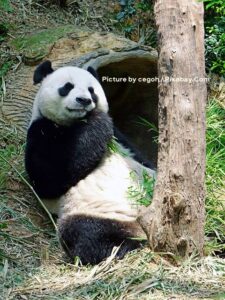
An adorable Giant Panda (Ailuropoda melanoleuca) sits relaxed against a wooden tree trunk in a lush, green outdoor enclosure, its thick black-and-white fur gleaming softly in the natural light. The Panda leans back comfortably with one paw clutching a generous bundle of fresh green bamboo, which it munches contentedly while gazing slightly upward with a peaceful, almost smiling expression. Behind it stands the dark opening of a small cave-like shelter carved into a rocky hillside, surrounded by scattered branches, grass, and patches of earthy ground that give the scene a naturalistic zoo habitat feel. Picture by cegoh / Pixabay.Com.
Bears hold cultural significance worldwide, symbolizing strength and wilderness, yet face ongoing threats requiring continued conservation efforts to ensure their survival.


