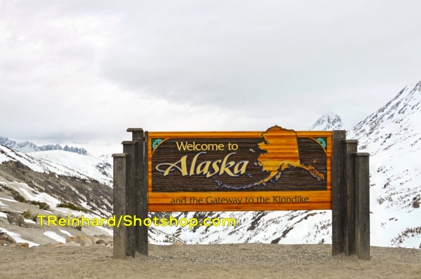
The above image shows a large, colorful wooden welcome sign at the Alaska border along the South Klondike Highway (near Skagway, close to the Canadian border).The main sign reads “Welcome to Alaska” in prominent lettering, with “Gateway to the Klondike” below it. It features an orange background panel with a stylized map outline of Alaska in orange/yellow, accented by a small graphic (possibly a mountain or historical motif) and a bear or Klondike-themed illustration. The sign is mounted on sturdy wooden posts, set against a scenic backdrop of rugged, snow-dusted mountains under a cloudy sky, with barren or rocky ground in the foreground typical of the high alpine area. It’s a classic roadside photo stop for travelers entering Alaska from the Yukon via the Klondike Highway. Photo credit: TReinhard/Shotshop.com.
Alaska, often called “The Last Frontier,” is a land of unparalleled wilderness. Spanning over 1,718,000 square kilometres (663,000 square miles), it remains one of the most untouched regions on Earth, with vast expanses of pristine landscapes that support an extraordinary diversity of wild animals. Much of the state is protected in national parks, preserves, wildlife refuges, and designated wilderness areas, where human presence is minimal, allowing nature to thrive in its raw form.
Alaska’s wilderness is defined by dramatic contrasts: towering mountain ranges, immense glaciers, endless tundra, dense boreal forests, and rugged coastlines. Several iconic protected areas showcase this diversity.
Denali National Park and Preserve centres around North America’s tallest peak, Denali (formerly Mount McKinley), rising over 6,190 metres (20,310 feet). Encompassing more than 24,464 square kilometres (6,045,000 acres or 9,446 square miles)—an area larger than the state of New Hampshire—this vast protected area includes a complete subarctic ecosystem, from low-elevation taiga (boreal) forests that transition to high alpine tundra, vast glaciers, braided rivers, and the dramatic Alaska Range. Established in 1917 as Mount McKinley National Park, it was the first U.S. national park created primarily to protect wildlife rather than scenic grandeur alone. In 1980, under the Alaska National Interest Lands Conservation Act, it was significantly expanded and renamed Denali National Park and Preserve to honour the Koyukon Athabascan name for the mountain, meaning “the high one” or “the tall one.” The park and preserve protect a rich array of wildlife, including the “Big Five”—Grizzly Bears (Ursus arctos horribilis) , Moose (Alces alces), Caribou (Rangifer tarandus), wolves, and Dall Sheep (Ovis dalli dalli)—along with smaller mammals like Canada Lynx (Lynx canadensis), Wolverines (Gulo gulo), foxes, Hoary Marmots (Marmota caligata), and Arctic Ground Squirrels (Urocitellus parryii), plus over 169 species of birds (many migratory). The single access route is the 148-kilometre (92-mile) Denali Park Road, a mostly gravel ribbon that winds through the landscape parallel to the Alaska Range. Only the first 24 kilometres (15 miles) are open to private vehicles year-round (up to the Savage River checkpoint during the main visitor season); beyond that, access is limited to foot travel, bicycles, or park-operated shuttle and tour buses to minimize environmental impact and maximize wildlife viewing opportunities. Narrated bus tours, such as the Tundra Wilderness Tour (reaching up to approximately 69 kilometres / 43 miles in recent seasons due to ongoing road work related to the Pretty Rocks landslide), offer excellent chances to spot animals from elevated seats, with frequent stops for photography and observation. The park features visitor centres (including the Denali Visitor Center with interactive exhibits on natural and human history), ranger-led programs, short day hikes near the entrance, and extensive backcountry opportunities for experienced adventurers. Denali’s dynamic weather—often obscuring the mountain summit—adds to its mystique, while its emphasis on keeping wildlife wild (no feeding, strict viewing distances) preserves the untamed character that draws visitors from around the world.
Wrangell-St. Elias National Park and Preserve, the largest national park in the United States (over 53,320 square kilometres / 13 million acres—larger than Switzerland), features massive glaciers, volcanic fields, and multiple mountain ranges. Its remote valleys and peaks offer some of the continent’s most extreme and unspoiled wilderness.
Gates of the Arctic National Park and Preserve, lying entirely north of the Arctic Circle, contains no roads or maintained trails—pure, untrammeled wilderness. Accessible only by foot or bush plane, it epitomizes isolation and supports large-scale animal movements across its tundra and the Brooks Range.
Other notable protected regions include the Arctic National Wildlife Refuge and Kobuk Valley National Park. Together, these areas preserve vast, connected ecosystems where animals can roam freely with little human interference.
Iconic Wildlife of Alaska’s Wilderness
Alaska supports some of North America’s most iconic and abundant wildlife populations, thriving in large, intact habitats.
Bears — Alaska is home to the majority of the continent’s Gizzly Bears (Ursus arctos horribilis) (also known as Brown Bears), including the massive Kodiak subspecies (Ursus arctos middendorffi) found on Kodiak Island, as well as widespread American Black Bears (Ursus americanus) and, along the northern coast, Polar Bears (Ursus maritimus). Brown Bears are especially abundant in coastal and riverine areas, where they feed heavily on spawning salmon, berries, roots, and vegetation. They are commonly seen in places like Denali and Wrangell-St. Elias.
Moose — The Alaska-Yukon Moose (Alces alces gigas) is the largest subspecies in the world, with mature bulls reaching up to 725 kg (1,600 pounds) (and exceptionally over 815 kg / 1,800 pounds in historical records) and standing nearly 2.3 metres (7.5 feet) at the shoulder. Females are smaller, typically weighing 360–590 kg (800–1,300 pounds) and standing about 1.8 metres (5.9 feet) tall. They inhabit forests, wetlands, and tundra edges, feeding on willow, birch, aspen, and aquatic plants. Moose are widespread across much of the state, particularly in Denali, the Chugach region, and Interior Alaska. These massive herbivores are superbly adapted to their environment: their long legs enable them to wade through deep snow and swim across lakes and rivers (they are excellent swimmers, even capable of diving to feed on underwater vegetation), while their large, pendulous muzzle and specialized nasal passages help warm inhaled air in winter and conserve moisture. They have a distinctive “bell” (dewlap) of skin and hair hanging under the throat, and bulls grow enormous, palmate antlers that can span up to 1.8 metres (6 feet) or more, shed annually after the rut and regrown each spring at an astonishing rate of over 2.5 cm (1 inch) per day during peak growth. Moose are generally solitary except during the fall rut, when bulls become aggressive and compete for mates, sometimes locking antlers in dramatic battles. Calves are born in late May or early June, often as twins in good habitat (twinning rates can reach 75% in high-quality areas), weighing around 11–14 kg (25–30 pounds) at birth but growing rapidly. Predators include Grizzly and Black Bears (which target calves), wolves (which hunt year-round, especially in packs), and occasionally humans through hunting. Populations fluctuate with habitat quality, severe winters, predation pressure, and food availability—post-fire areas with regenerating willow and birch often see booms due to abundant browse—but remain robust in many regions of Alaska, supporting both natural ecosystems and sustainable harvests.
Caribou — Alaska is home to roughly 750,000 Caribou (Rangifer tarandus) spread across dozens of herds (with the Alaskan subspecies often referred to as Rangifer tarandus granti). These nomadic animals undertake some of the longest land migrations on Earth, sometimes travelling 80 km (50 miles) or more in a single day. Both males and females grow antlers, and their seasonal movements across the vast tundra are one of nature’s great spectacles, especially visible in Arctic regions such as Gates of the Arctic and the Arctic National Wildlife Refuge.
Dall Sheep — These striking white sheep, known as Dall sheep (Ovis dalli dalli), inhabit steep, rocky mountain slopes, relying on agility and rugged terrain to escape predators. They are found in alpine areas of Denali, Wrangell-St. Elias, and the Brooks Range, where their bright coats stand out sharply against dark rock faces. Also called thinhorn sheep, Dall sheep are specially adapted to harsh alpine environments, thriving on wind-swept ridges and cliffs where deep snow is limited and strong winds keep forage accessible. Adults stand about 0.9 metres (3 feet) at the shoulder, with rams weighing up to around 136 kg (300 pounds) and ewes about half that size. Their thick winter coats, consisting of a fine wool undercoat and long guard hairs, can exceed 5 cm (2 inches) in length for insulation against extreme cold. Both sexes grow horns that continue throughout life, but rams develop massive, curling horns with growth rings (annuli) that allow age estimation—males can reach 12–16 years, while ewes occasionally live to 19. In summer, they graze on a wide variety of grasses, sedges, forbs, lichens, and mosses; in winter, their diet narrows to exposed dry grasses, sedges, and sometimes lichens. They frequently visit mineral licks in spring to supplement nutrients, sometimes travelling kilometres (miles) to do so, where different bands mingle. Populations are generally healthy but fluctuate with weather—mild conditions allow increases, while severe winters, deep snow, drought, or predation (mainly by wolves, with occasional grizzly bears or lynx) can cause declines, especially among lambs. Their preference for steep, escape terrain makes them masters of vertical landscapes, embodying the untamed alpine wilderness of Alaska.
Other notable residents include gray wolves (Canis lupus) (efficient pack hunters that help regulate prey populations), Wolverines (Gulo gulo), Canada lynx (Lynx canadensis), Red Foxes (Vulpes vulpes) and Arctic Foxes (Vulpes lagopus), and, in the far north, musk oxen (Ovibos moschatus). The skies and coasts are alive with birds—Bald Eagles, migratory waterfowl, seabirds, and raptors—while marine mammals such as whales, seals, sea lions, and sea otters thrive along the extensive coastline.
Alaska’s wilderness areas remain true sanctuaries where these animals follow natural rhythms—migrating across vast distances, hunting, foraging, and raising their young amid immense, largely undisturbed landscapes. This untouched quality makes Alaska a living testament to wild nature and a powerful reminder of the beauty and resilience of ecosystems that remain largely free from heavy human impact. Whether experienced through a guided visit to Denali or a remote backcountry journey, Alaska offers a profound connection to the wild heart of the continent.


