
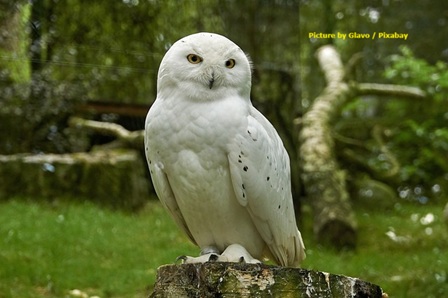
The image shows a beautiful Snowy Owl (Bubo scandiacus) perched on a tree stump in a natural, forested setting. The owl is predominantly white with some scattered dark brown or black speckles and bars, particularly on its wings and back. Its face is pure white with bright yellow eyes and a small, dark beak. The owl has a calm, alert expression as it gazes directly toward the camera. The background is a soft, out-of-focus green woodland scene with tree trunks, branches, and foliage, giving a peaceful, natural atmosphere. The photo credit in the top right reads “Picture by Glavo / Pixabay.” The overall image is bright and clear, highlighting the owl’s striking white plumage against the green surroundings.
In the vast, windswept expanses of the Arctic tundra, a silent white specter glides over the snow. With piercing yellow eyes and an aura of regal stillness, the Snowy Owl (Bubo scandiacus) is one of the largest and most iconic raptors of the far north. Wingspan reaches 125–166 cm (49–65 in), body length 52–71 cm (20–28 in), and weight 1.6–3.0 kg (3.5–6.6 lb), making females noticeably larger than males. The snowy Owl is classified in the avian order Strigiformes and family Strigidae.
A master of camouflage and adaptation
The Snowy Owl’s plumage is perfectly tuned for life above the Arctic Circle. Adult males are often nearly pure white, while females and juveniles display heavy dark barring and spotting that break up their outline on the patchy summer tundra. Even their talons and toes are densely feathered—the most completely feathered feet of any owl—for insulation in temperatures that regularly drop below –40 °C (–40 °F) and occasionally reach –62 °C (–80 °F) in winter.
| Class | Aves |
| Order | Strigiformes |
| Family | Strigidae |
| Genus | Bubo |
| Species | B. scandiacus |
| Binomial Name | Bubo scandiacus |
| Length | 52–71 cm (20–28 in) |
| Wingspan | 125–166 cm (49–65 in) |
| Weight | 1.6–3.0 kg (3.5–6.6 lb) |
| IUCN Status | Vulnerable |
Key adaptations include:
- Silent flight: Comb-like serrations on the leading edges of the primaries reduce noise to below –20 dB at 1 m, quieter than most owls.
- Exceptional senses: Large eyes (tubular, fixed in the skull) provide binocular vision with a field overlap of ~70°. The owls compensate by rotating their heads up to 270°. Asymmetric ear openings allow them to locate prey under 30–60 cm (1–2 ft) of snow with pinpoint accuracy.
King of the arctic larder
Snowy Owls are among the most diurnal of all owls, hunting actively in the 24-hour daylight of the Arctic summer. Their diet is dominated by lemmings, which make up 75–97 % of prey biomass during the breeding season. The two main prey genera are:
- Brown lemmings (Lemmus spp., especially L. trimucronatus / L. sibiricus)
- Collared lemmings (Dicrostonyx spp., 4–11 species depending on taxonomy)
A single adult Snowy Owl eats approximately 3–5 lemmings per day (1,200–1,800 per year). A family raising 5–8 chicks may consume more than 1,600 lemmings in a single 80–90-day breeding season.
Clutch size is tightly linked to lemming abundance:
- Peak years: 7–11 eggs (record 14–16)
- Average years: 5–8 eggs
- Crash years: 0–3 eggs, or the pair may skip breeding entirely
When lemmings are scarce, Snowy Owls switch to Arctic hares (Lepus arcticus), ptarmigan (Lagopus spp.), ducks, and occasionally fish or carrion.
Nomads of the north
Snowy Owls breed circumpolarly from 65° to 82° N, nesting on open tundra in a simple scrape—usually 20–30 cm (8–12 in) wide and 5–10 cm deep—on a low hummock or ridge for drainage and visibility. No nest material is added except occasional bits of lichen or feathers.
Their movements are famously irruptive. In years of high lemming numbers, large broods produce an excess of juveniles. When lemming populations collapse the following winter, thousands of owls—mostly young birds—disperse south as far as 40°–50° N (southern Canada, northern United States, northern Europe, and central Russia). These irruptions are not true migrations; the owls may remain south for weeks or months, returning north only when food becomes available again.
Facing a changing world
The IUCN Red List classifies the Snowy Owl as Vulnerable (since 2017), with a global population estimated at 14,000–28,000 mature individuals and a declining trend. Major threats include:
- Climate change altering lemming cycles and reducing snow-free nesting sites
- Collisions with vehicles, aircraft, wind turbines, and power lines
- Exposure to rodenticides and contaminants
- High mortality from Highly Pathogenic Avian Influenza (HPAI) in recent years
- Disturbance at nesting sites by researchers, photographers, and increasing Arctic tourism
Conservation efforts focus on satellite tracking (e.g., Project SNOWstorm), minimizing human disturbance within 500 m of nests, and protecting key wintering habitats.
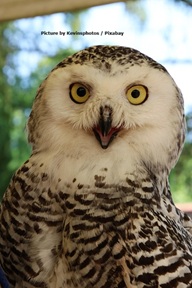
The image shows a close-up portrait of a Snowy Owl (Bubo scandiacus). The owl has striking bright yellow eyes with black pupils, a small black beak that is slightly open, and pure white facial feathers forming a distinctive heart-shaped facial disk. Its head and upper body are covered in dense white plumage with scattered dark brown to black barring and spots. The background is a soft, out-of-focus green, suggesting the photo was taken outdoors in natural light. There is a small credit in the top right corner: “Picture © Kevinsphotos / Pixabay.” The owl is looking directly at the camera with an alert and somewhat intense expression.
A Symbol of wild majesty
From Inuit legends that call the Snowy Owl “ukpik” (the one that never sleeps) to its role as Hedwig in the Harry Potter series, this white ghost of the tundra has long symbolized the untamed Arctic. As an apex predator almost entirely dependent on lemmings, its population fluctuations serve as a barometer for the health of one of Earth’s most fragile ecosystems.
Protecting the Snowy Owl means preserving the last great wilderness—and ensuring that this magnificent sentinel of the north continues to glide silently over the snow for generations to come.


