
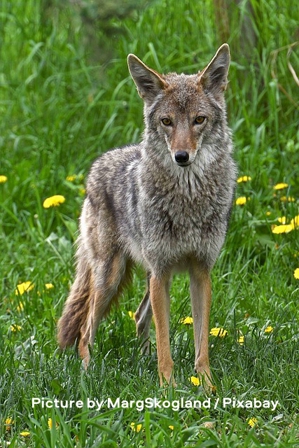
The picture shows a Coyote standing on a grassy field with scattered yellow flowers. The Coyote has a thick, multi-colored fur coat with shades of gray, brown, and tan, and its ears are pointed upright. The background is a lush green, suggesting a natural outdoor setting. (Picture by MargSkoglund / Pixabay)
An iconic howl piercing the twilight, a fleeting shadow at the edge of a field, a symbol of cunning and adaptability—the Coyote (Canis latrans) is one of North America’s most fascinating and misunderstood mammals. More than just a trickster figure of folklore, this intelligent canid is a testament to resilience, thriving in the face of relentless human expansion.
| Class | Mammalia |
| Order | Carnivora |
| Family | Canidae |
| Genus | Canis |
| Species | C. latrans |
| Binomial Name | Canis latrans |
| Length | 75–100 cm (30–39 in) |
| Weight | 8–20 kg (18–44 lbs) |
| IUCN Status | Least Concern |
Originally a creature of the open plains and deserts of the western United States, the Coyote has dramatically expanded its range. Today, its presence is recorded from the icy expanses of Alaska to the tropical coast of Panama, from the forests of Maine to the urban sprawl of Los Angeles, and even in Newfoundland and Labrador, where it arrived in the mid-1980s by crossing ice to the island and has since spread across most of the region. This remarkable expansion is a direct result of its incredible adaptability and the eradication of its main competitor, the wolf, from much of its historical territory.
Master of adaptation
The Coyote is a medium-sized member of the dog family, measuring 75–100 cm (30–39 in) in body length, weighing 8–20 kg (18–44 lbs), with a narrow muzzle, large pointed ears, and a bushy tail. Its fur color varies widely, often a grizzled grayish-brown but ranging from blonde to reddish and even black. This physical flexibility is matched by its behavioral plasticity. Coyotes are opportunistic omnivores with a broad diet. While they are effective predators of small mammals like rabbits and rodents, they are also skilled scavengers, consuming carrion, insects, fruits, vegetables, and even human garbage. This ability to eat almost anything allows them to survive in virtually any habitat.
Their social structure is equally flexible. While often portrayed as solitary, Coyotes can live in a variety of group sizes. The basic unit is a mated pair, which often remains together for several years. In areas with abundant resources, particularly where wolves are present, they may form small packs consisting of a dominant alpha pair and their offspring from previous years, who help raise the new pups.
Life in the urban jungle
The Coyote’s most impressive adaptation has been its colonization of urban and suburban landscapes. Cities provide everything a resourceful Coyote needs: ample food in the form of rodents, rabbits, fallen fruit, and unsecured trash, coupled with a surprising amount of green space for cover and denning. Urban Coyotes have learned to navigate streets, avoid humans, and are most active at dawn, dusk, and night, making their presence often felt but rarely seen.
The Coyote in culture and conflict
In the mythology of many Indigenous peoples of North America, Coyote is a central figure, often portrayed as a clever trickster, a cultural hero, and a complex being full of contradictions. This cultural history stands in stark contrast to its modern reputation among some farmers and ranchers, where the Coyote is viewed as a pest for occasionally preying on livestock.
Managing this conflict humanely is an ongoing challenge. Non-lethal methods, such as secure fencing, guard animals, and hazing (using noise or motion to scare Coyotes away from properties), are increasingly promoted as effective ways to coexist with this native species.
An ecological role
Despite being a source of conflict, the Coyote plays a vital ecological role. As a top predator in many ecosystems, it helps control populations of mesopredators like skunks, raccoons, and foxes, and most importantly, rodents. This regulatory effect can benefit agriculture and even help maintain healthy biodiversity.
The story of the Coyote is one of triumph against the odds. It is a creature that has not only survived but has flourished, carving out a niche for itself in the wild, the countryside, and our very backyards. The Coyote’s enduring presence reminds us of the wildness that persists at the edges of our modern world and the incredible adaptability of nature itself.


