
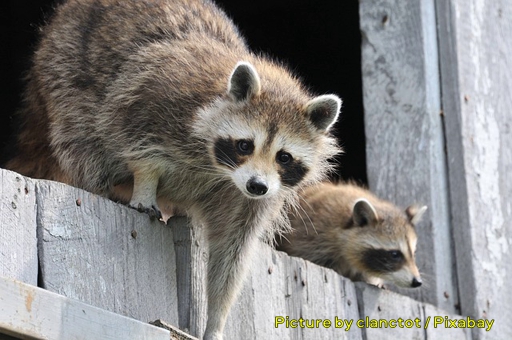
The picture shows two Common Raccoons perched on a wooden surface, possibly a barn or shed ledge. The Common Raccoon in the foreground is facing forward with a curious expression, its fur a mix of gray and brown with a distinctive black mask around its eyes. The second Common Raccoon is slightly behind, peeking out with a similar facial pattern. The background appears to be the interior of a wooden structure, and the image is credited to “clanctot / Pixabay.
Amidst the rustling leaves of a suburban backyard or the quiet hush of a forested stream, a familiar figure often emerges under the cover of dusk. With its distinctive black mask and ringed tail, the Common Raccoon (Procyon lotor), also known as North American Raccoon, Northern Raccoon, or simply Raccoon, is one of North America’s most recognizable and adaptable mammals. This intelligent creature has not only thrived in its native woodland habitats but has also carved out a successful niche in our urban landscapes, making it a fascinating subject of both admiration and frustration.
| Class | Mammalia |
| Order | Carnivora |
| Family | Procyonidae |
| Genus | Procyon |
| Species | P. lotor |
| Binomial Name | Procyon lotor |
| Length | 40-70 cm (16–28 inches) |
| Tail Length | 20–40 cm (8–16 inches) |
| Weight | 4-26 kg (9-57 lbs.) |
| IUCN Status | Least Concern |
A species built for success
The name Procyon lotor offers a perfect description of this animal’s behavior. “Procyon” roughly translates to “before the dog” or “dog-like,” while “lotor” means “washer,” a nod to the Common Raccoon’s famous habit of dunking its food in water. Though they are not related to dogs, and scientists now believe the dousing behavior is a tactile foraging method rather than actual washing, the name has stuck.
Physically, the Common Raccoon is a study in adaptation. Typically, an adult Common Raccoon measures 40–70 cm in body length (16–28 inches), with a bushy tail adding 20–40 cm (8–16 inches). Their weight varies widely depending on habitat and food availability, ranging from 4–12 kg (9–26 pounds) on average, though some well-fed urban Common Raccoons can reach up to 26 kg (57 pounds). Its most remarkable feature is its hyper-sensitive front paws. Underwater, the skin on their paws softens, and their sense of touch becomes incredibly acute, allowing them to identify food items they cannot see. Their characteristic black mask is thought to reduce glare and enhance night vision, a crucial trait for a nocturnal animal. Their dense, greyish fur provides excellent insulation against cold weather.
Habitat and diet: The ultimate opportunist
The Common Raccoon is a primary example of a generalist species. Native to North America, it is found across a vast range, from southern Canada through the United States to Central America, including northern Mexico, Costa Rica, and Panama. In Canada, Common Raccoons are widespread in southern regions, particularly in British Columbia, Ontario, Quebec, and the Atlantic provinces. In Atlantic Canada, they are prevalent in Nova Scotia, New Brunswick, and Prince Edward Island, but absent from Newfoundland and Labrador due to the lack of suitable habitat and historical introductions. In Nova Scotia, they are most common in agricultural areas and near marshes, lakes, and rivers, with notable populations in the Annapolis Valley and around Halifax. In New Brunswick, they thrive in forested regions and urban centers like Fredericton and Moncton, often near waterways. Prince Edward Island hosts Common Raccoons in rural and suburban areas, particularly around Charlottetown and along coastal marshes. Originally inhabitants of deciduous and mixed forests near waterways, populations of Common Raccoons have exploded in urban and suburban areas, from major cities like Toronto, New York, and Chicago to smaller towns.
They are highly intelligent and dexterous, capable of opening latches, turning knobs, and raiding supposedly “secure” garbage cans. Their diet is equally opportunistic. As omnivores, the Common Raccoon will eat just about anything. In the wild, its menu consists of crayfish, insects, frogs, fruits, nuts, and bird eggs. In the city, this expands to include discarded human food, pet food, and anything else they can find. This incredible adaptability is the key to their success.
Intelligence and behavior
The intelligence of the Common Raccoon is comparable to that of primates. Studies have shown they possess excellent long-term memory and can solve complex puzzles to access food, sometimes remembering the solutions for years. They are solitary animals for the most part, with mothers (sows) being exceptionally devoted and teaching their young (kits) essential survival skills for their first year.
Breeding typically occurs in late winter to early spring, from January to March. After a gestation period of about 60–73 days, females give birth to litters of 2–5 kits on average, though litters can range from 1 to 7 depending on environmental conditions and the mother’s health. Newborn kits weigh approximately 60–160 grams (2–5.6 ounces) at birth and are born blind and helpless, relying entirely on their mother for warmth and nourishment. The kits open their eyes after about three weeks and are weaned by 2–4 months, gradually learning to forage under their mother’s guidance.
While often portrayed as solitary, the social structure of the Common Raccoon is more nuanced. Related females will sometimes share a common area, and unrelated males may form loose social groups to maintain their position against rivals during the breeding season.
Coexisting with the Common Raccoon
The relationship between humans and the Common Raccoon is complex. Their cleverness and antics can be entertaining, but their foraging can lead to conflicts. They can damage property, raid crops, and, if they gain access, create dens in attics or chimneys.
The most important strategy for coexistence is to eliminate attractants. This means securing trash cans with locking lids, bringing pet food indoors overnight, and sealing potential entry points into homes and sheds. It is crucial to remember that feeding a Common Raccoon, while seemingly kind, is detrimental. It draws them into closer contact with humans and pets, increases the risk of disease transmission, and disrupts their natural foraging behaviors.
A vital part of the ecosystem
Despite the challenges they can pose, the Common Raccoon plays a significant role in the ecosystem. They help control populations of certain insects and rodents and are themselves a prey species for larger predators like The Coyote (Canis latrans), Bobcat (Lynx rufus), and owls. Their foraging habits also help in seed dispersal.
The future of the Common Raccoon
The story of the Common Raccoon is far from over. As human development continues to expand, the line between wild and urban spaces will only blur further. The incredible adaptability of the Common Raccoon suggests it is well-equipped for this future, likely maintaining and even increasing its presence in our cities.
However, this success brings new questions and challenges. Wildlife managers and scientists continue to study urban populations of the Common Raccoon to understand the long-term ecological impacts of their density and to develop more effective, humane strategies for coexistence.
Ultimately, the Common Raccoon serves as a powerful reminder of the resilience of nature. It is a wild animal that has looked at our human-dominated world and found a way to not just live in it, but to prosper. Their continued presence challenges us to be more thoughtful stewards of our environment, to secure our trash, and to appreciate the clever, resourceful wildness that lives just beyond our backdoors.


