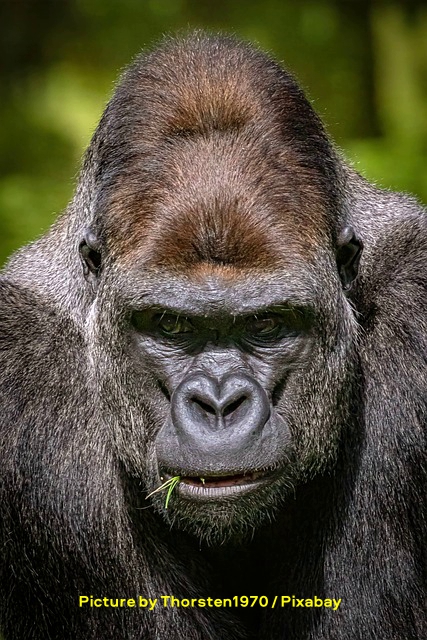
Gorillas are among the most powerful and intelligent primates, known for their immense strength, complex social structures, and striking resemblance to humans. These gentle giants inhabit the dense forests of Central and East Africa and are divided into two species, each with distinct subspecies. Sadly, all gorilla populations are threatened by habitat loss, poaching, and human activities.
The two species of gorillas
1. Eastern Gorilla (Gorilla beringei)
The Eastern Gorilla is the largest living primate and is found in the mountainous and lowland forests of Central and East Africa. Adult males typically weigh 140–205.5 kg (309–453 lb) and stand 1.7 m (5.6 ft) upright, while females weigh 90–100 kg (200–220 lb) and stand 1.5 m (4.9 ft) tall. Their arm spans can reach up to 2.6 m (8 ft 6 in). This species consists of two subspecies:
- Mountain Gorilla (Gorilla beringei beringei) – Living in the volcanic highlands of Rwanda, Uganda, and the Democratic Republic of the Congo, Mountain Gorillas have thicker fur to withstand colder temperatures. They are critically endangered, with only around 1,000 individuals remaining.
- Eastern Lowland Gorilla (Gorilla beringei graueri) – Also known as Grauer’s Gorilla, this subspecies inhabits the lowland tropical forests of the eastern Democratic Republic of the Congo. They are the largest of all gorilla subspecies, with adult males weighing up to 220 kg (484 lb) and females around 80 kg (176 lb). They face severe threats from illegal mining and civil unrest.
2. Western Gorilla (Gorilla gorilla)
The Western Gorilla is slightly smaller than its eastern counterpart and lives in the dense rainforests of Central Africa. Adult males average 167 cm (5 ft 5.7 in) in height and weigh around 168 kg (370 lb), with some reaching up to 176 cm (5 ft 9.3 in), while females weigh 58–72 kg (128–159 lb) and are shorter. Their arm spans can reach up to 2.6 m (8 ft 6 in). This species also has two subspecies:
- Western Lowland Gorilla (Gorilla gorilla gorilla) – The most widespread gorilla subspecies, found in Cameroon, Central African Republic, Gabon, Congo, and Equatorial Guinea. They have a more omnivorous diet, including termites and ants, and are listed as critically endangered due to poaching and habitat loss. Adult males weigh around 180 kg (396 lb).
- Cross River Gorilla (Gorilla gorilla diehli) – The rarest gorilla subspecies, with fewer than 300 individuals remaining in the wild. They live in a small region along the Nigeria-Cameroon border and are highly threatened by habitat fragmentation and hunting.
Behavior and social structure
Gorillas live in stable family groups led by a dominant male, known as a silverback, who protects the group and makes key decisions. They communicate through vocalizations, body language, and facial expressions. Gorillas are primarily herbivorous, feeding on leaves, stems, fruit, and occasionally insects.
Conservation challenges
The main threats to gorillas include:
- Habitat destruction – Logging, agriculture, and human settlement encroach on their forests.
- Poaching – Bushmeat trade and illegal wildlife trafficking remain major dangers.
- Human-wildlife conflict – Proximity to human populations increases risks of habitat encroachment and retaliatory killings.
How to help
Supporting conservation organizations, promoting ecotourism, and advocating for sustainable practices can help protect gorillas. Without urgent action, these magnificent creatures could face extinction in the wild.


