Sweden is a Nordic country located in Northern Europe on the Scandinavian Peninsula. It is the largest country in Northern Europe, the fifth largest in Europe overall, and ranks as the 55th largest country globally by area, covering approximately 450,295 km² (173,860 sq mi). Sweden stretches about 1,572 km (977 miles) from north to south and up to 500 km (310 miles) east to west, giving it a long, narrow shape that spans diverse climates and landscapes.
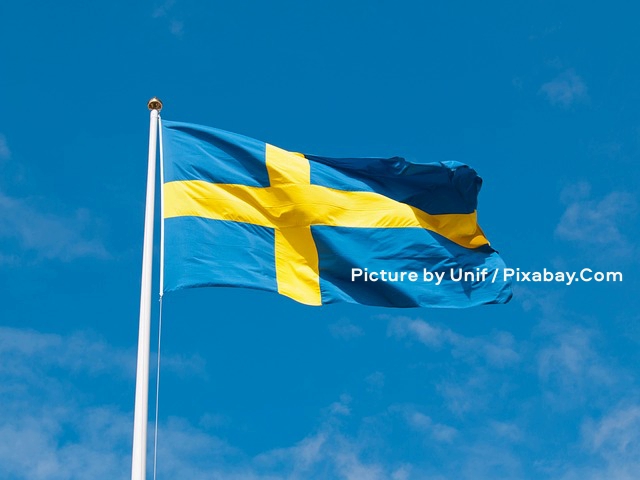
The image above shows the Swedish flag proudly waving against a vibrant, clear blue sky. The flag, with its distinctive Nordic cross design, features a bold yellow Scandinavian cross centered on a deep blue field, and it ripples gently in the breeze, creating soft folds and dynamic curves in the fabric. The bright sunlight illuminates the colors vividly, making the yellow appear warm and golden while the blue blends harmoniously with the expansive sky behind it. The flag is attached to a tall white flagpole topped with a golden finial, and the composition captures a sense of openness and serenity under perfect weather conditions. Picture by Unif / Pixabay.Com
Borders and coastline
Sweden shares its western border with Norway along the Scandinavian Mountains (known as Skanderna or Kölen), a rugged chain that forms a natural divide. To the northeast, it borders Finland, while its eastern and southern coasts lie along the Baltic Sea and the Gulf of Bothnia. A shorter southwestern coastline faces the Skagerrak and Kattegat straits, with Denmark separated by the narrow Öresund (The Sound) strait. The country boasts a highly indented coastline exceeding 3,200 km (about 2,000 miles), dotted with thousands of islands and archipelagos, including the large islands of Gotland and Öland in the Baltic Sea.
Terrain and regions
Sweden’s landscape is shaped by ancient geological forces, including Pleistocene glaciers that left behind vast numbers of lakes (nearly 100,000), rivers, and rolling lowlands. The terrain slopes gently eastward from the high western mountains toward the Baltic. Traditionally, the country divides into three main regions:
- Norrland (the north): Vast, sparsely populated mountainous and forested wilderness, including Swedish Lapland above the Arctic Circle. This northernmost province, also known as Lappland, covers about a quarter of Sweden’s total land area (approximately 109,702 km² or 42,356 sq mi), making it larger than many European countries such as Austria or Portugal. Largely lying above the Arctic Circle, Swedish Lapland features dramatic subarctic and arctic landscapes: rugged mountains (part of the Scandinavian Mountains), dense coniferous forests of pine and spruce, vast marshes, wetlands, wild rivers, frozen lakes, and expansive tundra plateaus. It includes some of Europe’s most pristine wilderness areas, with phenomena like the midnight sun in summer (when the sun doesn’t set for weeks) and polar night in winter (when the sun barely rises). The region is renowned for its extreme seasonal contrasts, clear dark skies ideal for viewing the aurora borealis (northern lights), and abundant wildlife including Moose (Alces alces), Eurasian Lynx (Lynx lynx), Eurasian Wolves (Canis lupus lupus), and birds. Key natural highlights include the UNESCO World Heritage Site of Laponia (a vast protected area with mountains, glaciers, and forests), Abisko National Park (one of Sweden’s oldest, known for its dry microclimate and excellent northern lights viewing), Sarek National Park (with dramatic peaks, glaciers, and deep valleys), and the famous Kungsleden (King’s Trail), a 440+ km hiking route through stunning mountain scenery. Swedish Lapland has a very low population density—around 87,000–91,000 people across the vast territory (with major towns like Kiruna and Gällivare)—leaving much of it as Europe’s “last wilderness.” Activities abound year-round: winter snowmobiling and northern lights hunts; summer hiking, berry picking, and canoeing.
- Svealand (central): The historical core of Sweden and the smallest of the three traditional regions, Svealand lies in south-central Sweden, bounded by Norrland to the north and Götaland to the south. It encompasses six historical provinces: Uppland, Södermanland, Västmanland, Närke, Värmland, and Dalarna. Covering roughly 91,000 km², this region features a diverse mix of landscapes, including fertile plains and rolling lowlands in the east (around Lake Mälaren and the Stockholm area), extensive archipelagos along the Baltic coast with thousands of islands, and more forested, hilly, and mountainous terrain in the west toward the Norwegian border (including parts of Bergslagen, a historic mining district, and areas with snowy mountains and ski resorts in northern Dalarna). It is home to Sweden’s largest lakes, such as Vänern (the country’s largest lake) and Mälaren, which support agriculture and recreation. The region includes the capital Stockholm and its surrounding Mälardalen area, as well as cultural icons like the Dala Horse from Dalarna and Viking-era historical sites. Svealand’s economy is diversified, with urban centers driving manufacturing, services, and technology, alongside forestry, mining, and agriculture in rural areas. It has a higher population density than Norrland, serving as the political and cultural nucleus from which modern Sweden developed, originally home to the Svear (Swedes) people.
- Götaland (the south): The southernmost and most densely populated of the three regions, Götaland comprises ten historical provinces, including Skåne, Blekinge, Halland, Småland, Öland, Gotland, Östergötland, Västergötland, Dalsland, and Bohuslän. Covering about 97,841 km², it stretches from the deep forests marking its northern border with Svealand (such as Tiveden, Tylöskog, and Kolmården) southward to the Öresund strait and the Danish border. The landscape varies widely: fertile, flat plains ideal for intensive agriculture in Skåne (often called Sweden’s breadbasket, with rolling countryside similar to Denmark); deep coniferous and mixed forests in Småland’s highlands; open coastal areas, archipelagos, and rocky shores along the west coast (Bohuslän); and the unique limestone island of Gotland (Sweden’s largest island) with sandy beaches, sea stacks, and medieval heritage. Öland features similar coastal and steppe-like terrains. Götaland includes major cities like Malmö, Gothenburg, and Linköping, supporting industry, trade, and ports. It has a milder climate than the north, with rich farmlands, historic towns, and cultural sites tied to the ancient Geats (Götar). The region is densely populated compared to Norrland, with vibrant agriculture, vineyards in the south, and tourism focused on beaches, islands, and history.
Over two-thirds of Sweden is covered in forests (mostly coniferous in the north, mixed further south), making it one of Europe’s most wooded nations. The landscape supports abundant wildlife, dramatic waterfalls, glacial rivers, and phenomena like the northern lights (aurora borealis) in the far north.
Climate
Despite its northern latitude (from about 55°N to 69°N), Sweden enjoys a relatively mild climate thanks to the warm North Atlantic Current and prevailing southwesterly winds. The south has temperate conditions with four distinct seasons, while the north experiences subarctic influences, long winters, midnight sun in summer, and polar night in winter.
Currency of Sweden
The official currency of Sweden is the Swedish krona (plural: kronor), abbreviated SEK and symbolized as kr. “Krona” translates to “crown” in English, reflecting its historical royal associations. Introduced in 1873, it remains in use today despite Sweden’s membership in the European Union since 1995—Sweden has not adopted the euro, following a 2003 referendum where voters rejected the change. Banknotes come in denominations of 20, 50, 100, 200, 500, and 1,000 kronor, while coins include 1, 2, 5, and 10 kronor. Sweden is largely cashless, with cards and digital payments widely accepted.
Sweden’s geography—from Arctic tundra to fertile southern plains—contributes to its stunning natural beauty, outdoor opportunities, and unique seasonal contrasts, making it a fascinating destination for nature lovers and explorers alike.


