The Black Swan (Cygnus atratus) is a large waterbird native to Australia, famous for its striking black plumage contrasted by a bright red bill and white flight feathers. It is the only entirely Black Swan species in the world and serves as an iconic symbol of Australian wildlife.
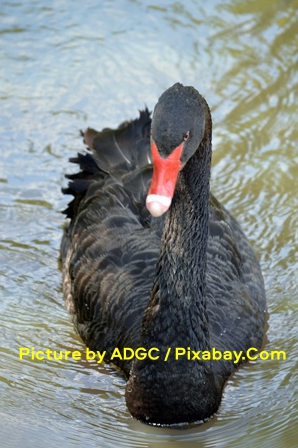
The picture above showcases a majestic Black Swan (Cygnus atratus), an elegant large waterbird with predominantly deep black plumage that covers its body, giving it a strikingly uniform and velvety dark appearance contrasted by bright white flight feathers subtly visible along the edges of its folded wings. The swan glides gracefully on calm water, its famously long, sinuous neck arched in a smooth S-curve, leading to a vivid red bill accented by a pale bar and tip near the end. Its dark eyes peer alertly forward, while the overall form conveys both power and poise typical of this Australian native species, set against a serene natural backdrop that highlights its unique and unexpected coloration among swans. Picture by ADGC / Pixabay.Com.
Physical description
Adults measure 110–142 cm (43–56 in) in length, weigh 3.7–9 kg (8.2–19.8 lb), and have a wingspan of 1.6–2 m (5.2–6.6 ft). Males (cobs) are slightly larger than females (pens), with longer, straighter bills. The plumage is predominantly black, with white primary and secondary flight feathers visible primarily in flight or when wings are raised. The bill is bright red with a pale (white or greyish) bar and tip, and legs/feet are greyish-black. The neck is exceptionally long and curved in an S-shape—the longest relative to body size among swans.
Immature cygnets are greyish-brown with pale-edged feathers. In flight, Black Swans form lines or V-formations, producing whistling wing sounds and bugle-like calls. They also emit musical trumpet-like calls on water or when disturbed. Rare leucistic (white) or mottled variants occur in the wild or captivity.
Distribution and habitat
Black Swans are native to Australia, primarily in the southeast and southwest regions (including Tasmania), with strongholds in the Murray-Darling basin. They prefer wetlands with abundant aquatic vegetation: freshwater, brackish, and saltwater lakes, swamps, rivers, tidal mudflats, and occasionally coastal waters. They are nomadic and highly responsive to rainfall patterns, moving inland during wet periods and concentrating in coastal or permanent wetlands during droughts. They moult all flight feathers simultaneously after breeding, becoming flightless for about a month on large open waters.
Introduced populations exist in New Zealand (now widespread and possibly considered native by some due to historical vagrancy), the UK (feral/ornamental escapees), parts of the US (e.g., Florida, California), Japan, and elsewhere. Global population estimates range from 100,000 to 1,000,000 individuals, with up to 500,000 in Australia.
Behavior and diet
Black Swans are almost exclusively herbivorous, feeding on submerged aquatic plants (e.g., Vallisneria, Potamogeton, algae, reedmace), by dipping, up-ending, or filter-feeding. They form loose flocks of hundreds or thousands outside breeding season but can be territorial during nesting. They are highly vocal and perform aggressive displays (wing-raising, hissing) to defend territory or young.
Breeding and life cycle
Black Swans are largely monogamous (pairing for life, low “divorce” rate of ~6%), though extra-pair paternity occurs in about one-third of broods. Breeding occurs mainly February–September (Southern Hemisphere winter/spring), influenced by rainfall. Nests are large mounds of reeds, grasses, and weeds (up to 1.5 m diameter) in shallow water or on islands; clutches typically 4–8 greenish-white eggs. Both parents incubate for 35–40 days (female mainly at night), with synchronized hatching. Cygnets are precocial, swim and feed soon after hatching, and ride on parents’ backs for protection and transport—less frequently than in some other swans. Parents tend young for up to 9 months until fledging.
Unique behaviors include nest-stealing and the “triumph ceremony” in courtship/displays.
Conservation status
The species is classified as Least Concern on the IUCN Red List (assessed 2018, stable trend). It has a very large range and population with no major threats identified or substantial declines documented. It is fully protected in Australia and occurs in protected areas. Occasional illegal shooting or localized issues exist but do not impact overall status.
Cultural significance and interesting facts
The Black Swan is the state bird and emblem of Western Australia (featured on its flag and historical stamps) and symbolizes “Australianness” in contrast to northern hemisphere white swans. Indigenous names include Kooldjak or maali among Noongar people. It inspired the European literary metaphor of a “rare bird” (from Juvenal) and later Nassim Taleb’s “Black Swan” theory of unpredictable, high-impact events—ironically, because Europeans once believed Black Swans did not exist until discovered in Australia in 1697.
Other facts:
- Longest-lived swans can reach 40+ years.
- Groups are called a “bank” (on ground/water) or “wedge” (in flight).
- During breeding, eyes may appear redder.
- They are popular in zoos and collections worldwide, leading to feral populations.
The Black Swan remains a graceful, adaptable species thriving across varied wetland environments and holding deep cultural resonance.
For the latest sightings or specific regional observations, check resources like eBird or local wildlife authorities.


