
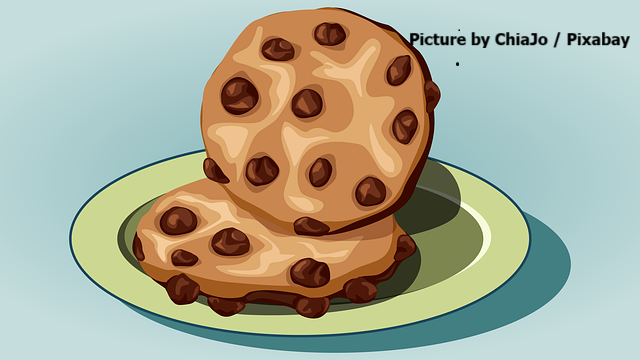
This is a cheerful, cartoon-style illustration of two golden-brown chocolate chip cookies stacked slightly askew on a simple light-green plate. The cookies have crisp edges, soft centers, and are generously studded with big, melty dark-chocolate chips scattered across their surfaces and peeking out from the sides. A subtle shadow falls beneath the plate against a soft pale-blue gradient background, giving the image a clean, inviting look. Small credit text in the top-right corner reads “Picture by ChiaJo / Pixabay.” The overall style is cute and appetizing, with a warm, storybook charm that instantly makes you want to reach for a cookie.
The cookie is not merely a baked good; it is the fundamental unit of edible happiness. It is a philosophy of simplicity rendered in butter and sugar, a miniature monument to immediate, unchallenging joy. In a world that often demands complex multi-course narratives, the cookie offers a perfect, self-contained haiku.
To truly understand the cookie is to engage with its architecture. It is a study in controlled contradiction: the crisp outer halo yielding instantaneously to a warm, molten core. Its scent—that irresistible alchemy of browned butter, caramelized sugar, and vanilla—is not just an aroma, but a temporal trigger. It is the smell of Friday afternoons, of parental approval, of the specific, slightly reckless warmth emanating from a kitchen where the oven light is glowing.
The classic chocolate chip cookie, the archetype from which all others descend, provides the perfect lesson in essentialism. It is a humble, democratic disc. Unlike the fussy formality of a plated dessert or the cold precision of a layered cake, the cookie begs to be consumed immediately, preferably still hot enough to threaten a minor burn. It requires no cutlery, no ceremony, and certainly no intellectual dissection. Its perfection resides in its incompleteness—the slight stickiness left on the fingers, the inevitable scattering of crumbs that marks the territory of true indulgence.
The archive of scent
A cookie is, above all, a vehicle for memory. No other food possesses such potent power as a small, edible time machine. The first bite of a certain gingersnap can yank you back decades, returning you instantly to the specific texture of your grandmother’s apron or the sound of the furnace rattling during a snowstorm.
The cookie is frequently the first culinary success we attempt as children, guided by flour-dusted hands. It is resilient enough to survive clumsy measuring and sporadic stirring, yet sophisticated enough to reward precision. That first tray, imperfectly shaped, with slightly burnt bases and unevenly distributed chips, is a foundational moment of creation. It teaches us that the best things are often born from a little heat, a little mess, and a lot of inherent sweetness.
A universal language
What truly elevates the cookie above other sweets is its universality and its inherent shareability. A cookie is an offering, a gesture of goodwill that requires no translation. You cannot refuse a good cookie; it is a passive invitation to pause, to breathe, and to connect.
In the office, the shared plate of cookies breaks down hierarchies. On a holiday tray, they represent a collective effort of love and time. They are the currency of neighborly exchange and the required fuel for late-night study sessions. They are small enough to be guiltless, yet rich enough to be deeply satisfying. They represent the human capacity for delivering maximal comfort in the most minimal package.
Furthermore, the variations testify to human ingenuity and the desire for personalization. From the delicate, powdery heft of the shortbread to the chewy, complex spice of the oatmeal raisin (a controversial hero, yet essential nonetheless), each cookie tells a different story. They adapt to seasons, cultures, and dietary needs while retaining their core identity: a golden circle of baked promise.
The final crumble
When we reach for a cookie, we are not just satisfying a sugar craving; we are seeking a moment of uncomplicated grace. We are craving texture, warmth, and the brief, beautiful illusion that the world can be momentarily reduced to the perfect balance of ingredients.
The cookie is the perfect answer to complexity. It demands nothing but acceptance. It is a small, warm piece of philosophy we can hold in our hand, a testament to the fact that sometimes, the sweetest and most profound joys are those that crumble around the edges. And when the final bite is taken, leaving only a scattering of crumbs and the faint warmth of indulgence, we are left with the lingering, comforting truth: the cookie always delivers.


