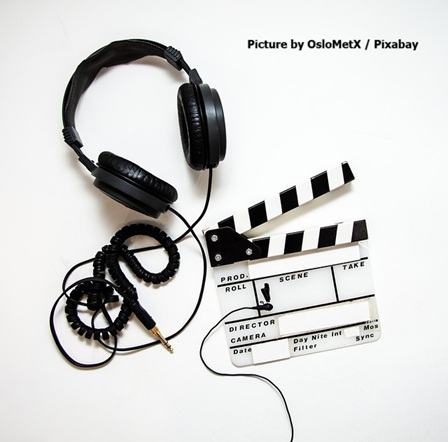
This image is a stock photograph from Pixabay, credited to OsloMetX. It features a pair of black over-ear headphones with a coiled cable ending in a 1/4-inch jack plug, positioned on the left side. To the right is a classic film clapperboard (also known as a slate) with black-and-white diagonal stripes on the hinged clapstick at the top. The clapperboard’s board section includes labeled fields for production details such as “PROD.,” “ROLL,” “SCENE,” “TAKE,” “DIRECTOR,” “CAMERA,” and additional checkboxes or notes for “Day Nite,” “Int Sync,” and “Filter.” Both items are laid flat on a plain white background, suggesting a theme related to film production, audio, or behind-the-scenes movie work. The composition is simple and top-down, with a clean, professional aesthetic.
The Saul Zaentz Company, founded by the legendary film producer and music executive Saul Zaentz, stands as a pivotal entity in the world of independent cinema. Established in 1976, the company quickly became synonymous with high-quality, award-winning films that pushed creative boundaries. Zaentz, born in 1921 in Passaic, New Jersey, transitioned from a successful career in the music industry—where he owned Fantasy Records and worked with artists like Creedence Clearwater Revival—to film production, earning a reputation for meticulous craftsmanship and artistic integrity. Over the decades, the company produced a select slate of films that garnered critical acclaim, including three Academy Award winners for Best Picture.
Early history and rise to prominence
Saul Zaentz’s entry into film was marked by his production of One Flew Over the Cuckoo’s Nest (1975), directed by Miloš Forman and starring Jack Nicholson. Although predating the formal establishment of his company, this film set the tone for Zaentz’s approach: independent financing, international distribution deals, and a focus on literary adaptations. The movie swept the Oscars, winning five major awards, including Best Picture, and solidified Zaentz’s status as a producer willing to take risks on challenging material.
Following this success, Zaentz officially formed The Saul Zaentz Company in 1976. Early projects included Three Warriors (1977), a drama about Native American life, and the animated adaptation of J.R.R. Tolkien’s The Lord of the Rings (1978), directed by Ralph Bakshi. The latter was particularly significant, as Zaentz had acquired the film rights to Tolkien’s works from United Artists in 1976, establishing what would become Middle-earth Enterprises—a subsidiary managing licensing for The Hobbit and The Lord of the Rings. This acquisition proved prescient, later fueling blockbuster adaptations like Peter Jackson’s The Lord of the Rings trilogy (2001–2003), in which Zaentz served as an executive producer.
In 1980, Zaentz expanded his operations by founding the Saul Zaentz Film Center in Berkeley, California. This facility became a hub for independent filmmakers, offering state-of-the-art post-production services, including sound mixing and editing. It attracted a diverse array of projects, from major studio films to indie productions, and played a key role in the Bay Area’s burgeoning film scene.
Notable film productions
The company’s filmography, though not voluminous, is distinguished by its quality. Key productions include:
- Amadeus (1984): Another collaboration with Miloš Forman, this biographical drama about Wolfgang Amadeus Mozart won eight Oscars, including Best Picture. It exemplified Zaentz’s commitment to historical accuracy and lavish production values.
- The Unbearable Lightness of Being (1988): Based on Milan Kundera’s novel, this film explored themes of love and politics during the Prague Spring.
- The English Patient (1996): Directed by Anthony Minghella, this epic romance set during World War II earned nine Oscars, including Best Picture, marking Zaentz’s third win in that category.
- Goya’s Ghosts (2006): Zaentz’s final major production, reuniting him with Forman for a historical drama about painter Francisco Goya.
Beyond these, the company’s involvement in Tolkien adaptations extended to licensing deals for video games, merchandise, and later films. In 2022, Middle-earth Enterprises was sold to the Swedish company Embracer Group, marking a new chapter for the Tolkien rights while preserving Zaentz’s foundational role.
Post-production contributions and the Saul Zaentz Film Center
While best known for its producing credits, The Saul Zaentz Company also made significant contributions through its Film Center, which provided post-production sound services for numerous films. The center’s facilities were renowned for their acoustic excellence, drawing projects from various genres. Notable works include sound mixing for films like The Right Stuff (1983) and The Mosquito Coast (1986).
One such project was the comedy-horror film Ernest Scared Stupid (1991), part of the popular Ernest P. Worrell series starring Jim Varney. Directed by John R. Cherry III and distributed by Touchstone Pictures, the film follows the bumbling Ernest as he accidentally unleashes an ancient troll on his town during Halloween. The Saul Zaentz Film Center handled the post-production sound services, including supervised sound design by Doug Murray. This involved mixing dialogue, effects, and music to enhance the film’s comedic and spooky elements, such as the troll’s growls and Ernest’s slapstick antics. The center’s work on multiple Ernest films, including Ernest Saves Christmas (1988), underscored its versatility in supporting lighter, family-oriented fare alongside prestige dramas.
For Ernest Saves Christmas (1988), also directed by John R. Cherry III, the Film Center provided post-production sound facilities, including comprehensive sound mixing. This holiday comedy sees Ernest helping a down-on-his-luck Santa Claus find a successor while navigating chaotic airport antics and festive mishaps. The sound work at the Zaentz Film Center was handled during a busy period for the facility, with night shifts accommodating the workload. Mixer Dan Olmsted served as the second chair, focusing on sound effects and Foley, while the first chair managed dialogue and music. These contributions helped create the film’s whimsical audio atmosphere, blending cheerful holiday tunes with Ernest’s signature slapstick humor, demonstrating the center’s ability to elevate even modest comedies.
Legacy and impact
Saul Zaentz passed away in 2014 at the age of 92, leaving behind a legacy of artistic excellence. The Saul Zaentz Company, with its Berkeley headquarters, not only produced Oscar-winning films but also fostered a creative ecosystem through its Film Center, which operated until its closure in the 2000s. Zaentz’s rare receipt of the Irving G. Thalberg Memorial Award in 1997 further cemented his influence, recognizing his consistent high-quality output.
Today, the company’s impact endures in the films it produced and the Tolkien universe it helped popularize. From epic adaptations to behind-the-scenes sound work on cult favorites like Ernest Scared Stupid and Ernest Saves Christmas, The Saul Zaentz Company exemplifies the power of independent vision in Hollywood.


